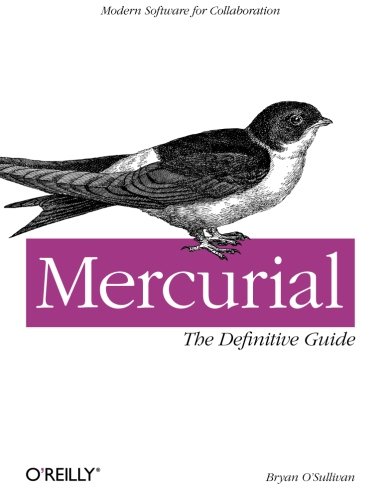
Ebook Info
- Published: 2009
- Number of pages: 284 pages
- Format: PDF
- File Size: 1.51 MB
- Authors: Bryan O’Sullivan
Description
This instructive book takes you step by step through ways to track, merge, and manage both open source and commercial software projects with Mercurial, using Windows, Mac OS X, Linux, Solaris, and other systems. Mercurial is the easiest system to learn when it comes to distributed revision control. And it’s a very flexible tool that’s ideal whether you’re a lone programmer working on a small project, or part of a huge team dealing with thousands of files.Mercurial permits a countless variety of development and collaboration methods, and this book offers several concrete suggestions to get you started. This guide will help you:Learn the basics of working with a repository, changesets, and revisionsMerge changes from separate repositoriesSet up Mercurial to work with files on a daily basis, including which ones to trackGet examples and tools for setting up various workflow modelsManage a project that’s making progress on multiple fronts at onceFind and fix mistakes by isolating problem sourcesUse hooks to perform actions automatically in response to repository eventsCustomize the output of MercurialMercurial: The Definitive Guide maintains a strong focus on simplicity to help you learn Mercurial quickly and thoroughly.
User’s Reviews
Editorial Reviews: About the Author Bryan O’Sullivan is an Irish writer and developer who works with distributed systems, open source software, and programming languages. He wrote the award-winning O’Reilly title Real World Haskell. He has made significant contributions to the popular Mercurial revision control system, and to a number of other open source projects. He lives in San Francisco with his family. Whenever he can, he runs off to climb rocks.
Reviews from Amazon users which were colected at the time this book was published on the website:
⭐If you pay only a little for this book or read the free version, you may get your money’s worth.Pros:Aside from the errata, this book is relatively readable and useful. If you don’t want to read the free version online, then you might find it useful.Cons:One wonders if the author cares. There are several problems with the diagrams and text. I could forgive that if the author bothered to provide an authoritative list of errata that I could use to correct my text. The O’Reilly web site provides a list of “UNCONFIRMED ERRATA” as reported by readers. But the author hasn’t even bothered to review those. Neither has he corrected the free (pdf) version. That’s a bit frustrating.
⭐I mostly work on MS Windows, and I like Linux. I know there is a tradition of command-line interfaces. But they are more difficult to learn. I found TortoiseHG, which is a GUI for Mercurial. And so far it has been a life saver. I have used the book mostly as reference. And I have not come up with very difficult situations. So in that respect the book has not been as useful as the graphical interface. I do recommend using Mercurial.
⭐I was used to using git for a DVCS, but my new job forced me to use Mercurial. What I liked about this book is that in many places, the author points out some of the underlying differentiating features that distinguish other DVCS systems (and SVN) from one another. With this book and TortoiseHg, I am now up and running pretty easily with Mercurial. Personally, I still much prefer git, but that isn’t the book’s fault.
⭐A stand-out in normal technical-manual fare. It goes over not just the boring (though important) low-level design choices in Mercurial, but over the much more interesting day-to-day usage and structure of HG in your workflow.For a project lead or technical manager looking at mercurial for your team, I recommend this book highly. It’s also great for a programmer who’s in-the-weeds in a project, as the book has dedicated a whole chapter to the extensible and workflow malleability HG allows.
⭐MERCURIAL, THE DEFINITIVE GUIDE, is more a reference book than a book to use to learn Mercurial (or any of its bugs or idiosyncratic features). If you’re interested in learning how to use Mercurial for anything but the simplest of tasks, you’d be better served by going to the Internet and searching for answers (google strikes again).Once you know how to use Mercurial backwards and forewards, this book would serve as a useful refresher on some minor features here and there. All in all, don’t waste your money on this book. Spend the time learning off the Net instead – it costs less, and you’ll get better answers.
⭐I’ve used many of the older version control systems, like sccs, cvs, svn, tfs and so forth. But my current job uses Mercurial, and I’ve been struggling with it (it’s definitely a different sort of beast) so I got this book. I can’t say that I’m too impressed by the book. It’s poorly organized and the way it is laid out, makes it difficult to pick it up and find answers to problems and questions. It’s very “wordy” and that is not what I want in a technical book. My preferred technical books tend to favor examples and demonstrations of functionality over wordy discussions, so this book has been mostly useless to me.
⭐One of the strong points about Mercurial is that you don’t need a book like this to get started. But you’ll want it anyway; there are subtleties to using Mercurial that you’re not likely to figure out without some help. The author also makes a compelling argument for distributed source control in general, and Mercurial in particular. If you’re trying to make a decision about choosing a source control system, you make well find his argument persuasive; I did.
⭐This book has all the hallmarks of having been written by a computer nerd. (It was, in fact, written by one of the creators of Mercurial). So in other words, it’s virtually incomprehensible — even to a computer professional with many years of experience.
⭐Mercurial is one of the two most cool Distributed VS now. Differently from Git it’s also very easy to use and user friendly.This book is very clear and easy to read introduction to Mercurial us
⭐Some parts are rather out of date and some sections appear to be missing or unfinished. A good starting point though, and features some interesting introductions into how mercurial works, and how to use some of the more advanced features and extensions.
⭐I’m looking forward to using this book to learn how to use Mercurial.
⭐The book introduces Mercurial to the reader. It explains branches and why it may be better to use local clones instead. The author clearly likes the tool set he writes about, but the book does not end up in blind love to what is just a tool after all. He also mentions its glitches and problems, not just its strengths and in the later chapters tells us how to customize Mercurial for our needs through the power of Python.Though the book is available on the internet free of charge, I prefer the printed form. But I encourage you to have a look there first and buy the book if you like it and don’t want to rely on someone else’s review.
⭐The book starts off with “this book is a work in progress”, which is true. This isn’t the most up-to-date version; in fact, you can’t find the completed version on Amazon. I would recommend this version only for people who need the most basic of information on Mercurial.
Keywords
Free Download Mercurial: The Definitive Guide 1st Edition in PDF format
Mercurial: The Definitive Guide 1st Edition PDF Free Download
Download Mercurial: The Definitive Guide 1st Edition 2009 PDF Free
Mercurial: The Definitive Guide 1st Edition 2009 PDF Free Download
Download Mercurial: The Definitive Guide 1st Edition PDF
Free Download Ebook Mercurial: The Definitive Guide 1st Edition