

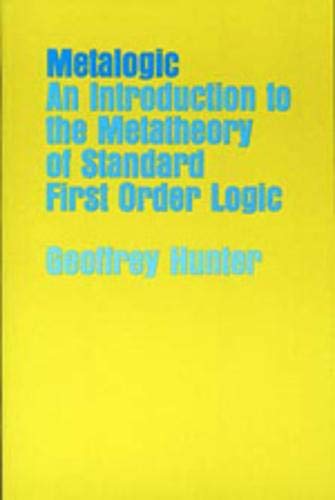
Ebook Info
- Published: 2002
- Number of pages: 302 pages
- Format: PDF
- File Size: 7.17 MB
- Authors: Geoffrey Hunter
Description
This work makes available to readers without specialized training in mathematics complete proofs of the fundamental metatheorems of standard (i.e., basically truth-functional) first order logic. Included is a complete proof, accessible to non-mathematicians, of the undecidability of first order logic, the most important fact about logic to emerge from the work of the last half-century.Hunter explains concepts of mathematics and set theory along the way for the benefit of non-mathematicians. He also provides ample exercises with comprehensive answers.
User’s Reviews
Editorial Reviews: Review “A remarkable book, in a class by itself among logic books. It has the ideal combination of readability, thoroughness, and preciseness. . . . Recommended not only as a first course text, but also as painless, indeed pleasurable reading.”–“Computing Reviews About the Author Geoffrey Hunter, now retired, has taught in the Department of Logic and Metaphysics at the University of St. Andrews, Scotland, and has also taught in Canada, England, the United States, and Wales.
Reviews from Amazon users which were colected at the time this book was published on the website:
⭐I have a dozen books on Foundations, some specifically on Logic, some Logic with Set Theory (e.g., Tourlakis), some pure Set Theory. This one is one of my favorites. I am an accomplished mathematics reader, and more than occasional doer, even though not a mathematician per se (Electrical Engineering is my field). My experience with the subject of this book has not been that of the professional philosopher or logician, but I have endeavored to read and absorb the material in all of my sources. This book is easily the one that opens the door most cordially, assuming little (which I appreciate since I am not getting a professor’s help with subtleties nor that priceless mnemonic support that comes from classroom gestalts induced by a great expositor). The read somehow seems more perspicuous than the others, allowing the reader to feel more confident. The fact that Hunter takes the reader from first principles through decidability without holes or hand-waving is remarkable, and one suffers a minimal amount of that nagging feeling that something wasn’t fully understood. (Of course, that feeling is normal when breaking in new ideas, but it’s nice when you can go pages between bouts.) I recommend the book highly. When I thought I had lost it (I have almost 1000 books) I was ready to buy a replacement. As in all studies, the reader does well to use multiple sources, so he need not make this the “one and only”. But I’d surely start with it.
⭐This was the first book I read on meta-logic. I remember when I first read about the difference between the cardinality of the natural numbers and reals at first I just wouldn’t believe it. I had slogged through calculus and thought I at least knew that you can’t make infinity bigger by adding to it. I’ve since taken more classes and read several books on the topic but of all of them I still think this one is the best. The other good books I’ve read tend to focus more, say on model theory or proof theory or the Godel and Turing/Church proofs but I love the way this one brings everything together. Highly recommend it, a great book on a fascinating topic.
⭐I didn’t have a choice in this logic book as it was prescribed by my logic professor. Difficult to understand sure, but only if you aren’t paying close attention. Errors, there are always errors in textbooks, it only matters if they are fundamental to understanding the content. Without the proper training in this discipline I would suggest you not even try, it is much like another language, in fact it is another language, a metalanguage. About halfway through the class and it is not as bad as other reviewers have stated.I understand this is an introductory book, although my true introduction was symbolic logic and calculus. These two classes will most definitely help in comprehending this book.
⭐Excellent!
⭐I must respectfully disagree with many of the negative things said in the previous reviews about this book. I find it to be by far and away the easiest to understand text on metalogic that I have come across. I am, however, a professional philosopher with a good deal of training in logic. So the material is not new to me, which surely makes the book much easier for me to understand. That said, I think that some of the previous reviewers have unfairly judged this book owing to the complexity of the material it covers. One should remember that Hunter’s aim is not to present rigorous arguments but to INTRODUCE metalogic. I am sure he would be satisfied if his reader is inspired to look into any of the proofs in more detail elsewhere. As far as the claim that the book contains errors, I have yet to read a logic text that didn’t!
⭐This book gives examples and “answers” to the examples. It makes the clear distinction between formality or “syntax” and meaning or “semantics.” This critical distinction is utilized to shed light on consistency proofs and undecidability. Part of Goedel’s proof involved the liar’s paradox. In other words, part of Goedel’s proof required the semantic acknowledgement of a phrase that didn’t go anywhere, namely, “this theorem is not provable” which, as model for the formal sentence or syntax “S”, established proof that the formal sentence couldn’t go anywhere. How tough is that? Goedel’s proof is overrated for its complexity if one takes an inventory of the aforementioned simple fact which is the core of his argument. In other words, to establish Goedel’s proof, in lieu of the tradition bequeathed to us from generations of mathematicians, such as Pappus’ proof (best illustrated in D’Abro’s book on”The Rise of the New Physics”), we need to take a step in the the semantic world and then take a step in the formal/syntax world. All proofs are dependent on the interchange of semantics and syntax. Some things are easier to solve in the syntax world. If not, some things are easier to solve in the semantic world. If a semantic argument is easy, such as the liar paradox, we acknowlege its mirror image in the syntax world, and by solving something in the semantic world we know we’ve accomplished something in the syntax world, and vice versa. That’s all.
⭐I’m sure this book was “readable” and “painless” to people who have degrees in the field, but I found it unnecessarily dry and obscure. Hunter may be a good logician (it’s hard for me to say, since after taking the course and reading the book I still have no grasp of the subject), but he has no facility with getting his point across concisely and understandably. If you’re a professor considering this book as a text, unless you are HIGHLY competent, nay, EXCELLENT teacher, please reconsider. I must admit that some of my negative opinion about Hunter does come from having a lousy professor and thus a generally miserable time with the material, but if the text had been “readable” and “painless” and “an excellent introduction” I would have been able to learn the stuff myself.
⭐This is a wonderful book, taking the subject all the way from a very basic starting point through to Godel. It may appear daunting on a first thumb-through, a veritable forest of symbols, but with a little patience and application even a beginner like me can find their way around. The two main virtues of the book are (a) it takes a magnifying glass to logic, never taking anything for granted, and only moving forward once each step has been rigorously proved and (b) it has a very clear structure, making easy to go back and re-trace your steps if something begins to puzzle you.
⭐Classic superb text on metatheory. Unequalled introduction to logical metatheory aimed at non-mathematicians and expounding many complex results in an accessible manner.
⭐good research material
⭐It’s really a good book to know the logic.
Keywords
Free Download Metalogic: An Introduction to the Metatheory of Standard First Order Logic 1st Edition in PDF format
Metalogic: An Introduction to the Metatheory of Standard First Order Logic 1st Edition PDF Free Download
Download Metalogic: An Introduction to the Metatheory of Standard First Order Logic 1st Edition 2002 PDF Free
Metalogic: An Introduction to the Metatheory of Standard First Order Logic 1st Edition 2002 PDF Free Download
Download Metalogic: An Introduction to the Metatheory of Standard First Order Logic 1st Edition PDF
Free Download Ebook Metalogic: An Introduction to the Metatheory of Standard First Order Logic 1st Edition