

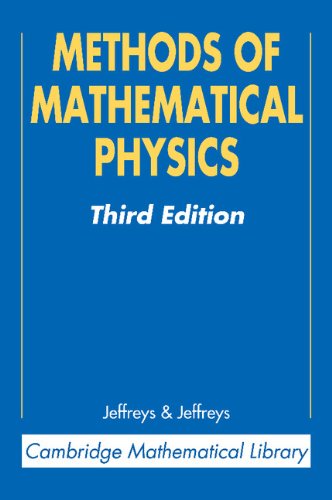
Ebook Info
- Published: 1999
- Number of pages: 730 pages
- Format: PDF
- File Size: 16.24 MB
- Authors: Harold Jeffreys
Description
This well-known text and reference contains an account of those parts of mathematics that are most frequently needed in physics. As a working rule, it includes methods which have applications in at least two branches of physics. The authors have aimed at a high standard of rigour and have not accepted the often-quoted opinion that ‘any argument is good enough if it is intended to be used by scientists’. At the same time, they have not attempted to achieve greater generality than is required for the physical applications: this often leads to considerable simplification of the mathematics. Particular attention is also paid to the conditions under which theorems hold. Examples of the practical use of the methods developed are given in the text: these are taken from a wide range of physics, including dynamics, hydrodynamics, elasticity, electromagnetism, heat conduction, wave motion and quantum theory. Exercises accompany each chapter.
User’s Reviews
Reviews from Amazon users which were colected at the time this book was published on the website:
⭐I was turned on to this book decades ago by one of my professors. The book bursts with useful material, but the organization is poor, the explanations almost nil, and the problems remote. (Indeed, most of the “drill” problems that the book provides are from British university honors’ examinations in mathematics on which applicants are expected to score 15%.) If you are looking for a strong, harmonious collection of advanced techniques in advanced analysis, harmonic functions, and many aspects of operational calculus, you would do better to read “Applied Analysis” by the immortal Cornelius Lanczos.
⭐The preface to the first edition of this book starts by saying it will provide an account of those parts of pure mathematics that find an application in at least two branches of physics. This sets the tone for a volume that sets the tools of mathematical physics on a solid, rigorous foundation, from tensors to multiple integrals, from functions of a complex variable to Fourier analysis, with a thorough coverage in the last ten chapters of differential equations including the wave and diffusion equations, and the Bessel, Hypergeometric, Legendre and Elliptic functions. The style is crisp and precise throughout, without any of the hand-waving that is all too common in some mathematical methods courses.If you apply a method from this book to a problem, you will know exactly what conditions are required for it to be valid, and there is little in this book that is not still useful, despite the 60 years since its first edition.
⭐It’s difficult to obtain an unambiguous understanding in review of a book that was almost ‘mandatory’ reading for those in the application of mathematics to physics and the physical elucidation of mathematics as part of the undergraduate course; but now there is now a quaint charm to 1980 reprint that has an emphasis on the hand calculation and hence a need for systems of calculi to decide on solutions to mathematical models and the later need for an easy method into computer aided mathematical modelling that would be numerically and grid-like based. The obvious answer is to use the methods as templates for computer programs but that ain’t easy. The procedure is unstated in general – but chose a model – even if only an approximate model – that can be solved analytically. For those functions then draw up ‘tables of 2 or 3 figures’ and interpolate or extrapolate and answer numerically. The more bold with the approximation the more speedy with the analysis. This approach can provide an insight into the machinations of Mathematica and might even serve as a check by being an alternative method. There is substance there but a modern usage is not as clear.
⭐This is a classic text. It is written in the classical british style of maths texts; not easily understandable (with very little leeway for the novice) but exceptionally comprehensive and written for purists and advanced practitioners of math. Written some time ago, it does however not address some of the more current and arcane aspects of group theory and vector calculus – methods applied to present mathematical physics. Personally it is an excellent reference textbook; for an everyday book, i would go elsewhere.
Keywords
Free Download Methods of Mathematical Physics (Cambridge Mathematical Library) 3rd Edition in PDF format
Methods of Mathematical Physics (Cambridge Mathematical Library) 3rd Edition PDF Free Download
Download Methods of Mathematical Physics (Cambridge Mathematical Library) 3rd Edition 1999 PDF Free
Methods of Mathematical Physics (Cambridge Mathematical Library) 3rd Edition 1999 PDF Free Download
Download Methods of Mathematical Physics (Cambridge Mathematical Library) 3rd Edition PDF
Free Download Ebook Methods of Mathematical Physics (Cambridge Mathematical Library) 3rd Edition