

Ebook Info
- Published: 2001
- Number of pages: 606 pages
- Format: PDF
- File Size: 26.06 MB
- Authors: Mikhail Gromov
Description
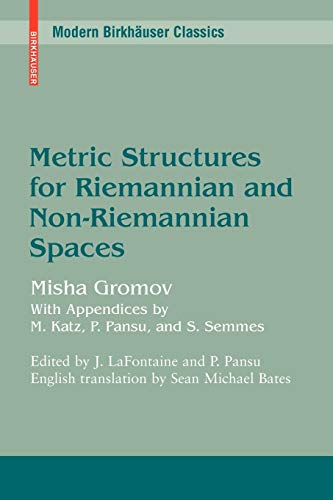
This book is an English translation of the famous “Green Book” by Lafontaine and Pansu (1979). It has been enriched and expanded with new material to reflect recent progress. Additionally, four appendices, by Gromov on Levy’s inequality, by Pansu on “quasiconvex” domains, by Katz on systoles of Riemannian manifolds, and by Semmes overviewing analysis on metric spaces with measures, as well as an extensive bibliography and index round out this unique and beautiful book.
User’s Reviews
Editorial Reviews: Review From the reviews:”The book gives genius insight into the connections between topology and Riemannian geometry, geometry and probability, geometry and analysis, respectively. The huge variety of progressive key ideas could provide numerous research problems in the next decades.” ―Publicationes Mathematicae”This book will become one of the standard references in the research literature on the subject. Many fascinating open problems are pointed out. Since this domain has dramatically exploded since 1979 and also is one which has many contact points with diverse areas of mathematics, it is no small task to present a treatment which is at once broad and coherent. It is a major accomplishment of Misha Gromov to have written this exposition. It is hard work to go through the book, but it is worth the effort.” ―Zentralblatt Math”The first edition of this book…is considered one of the most influential books in geometry in the last twenty years… Among the most substantial additions [of the 2/e]…is a chapter on convergence of metric spaces with measures, and an appendix on analysis on metric spaces… In addition, numerous remarks, examples, proofs, and open problems are inserted throughout the book. The original text is preserved with new items conveniently indicated… This book is certain to be a source of inspiration for many researchers as well as required reading for students entering the subject.” ―Mathematical Reviews“This is a reprint of the 2001 edition of Gromov’s by now classical book on metric structures. … this work will continue to set the standard in the field for the foreseeable future.” (M. Kunzinger, Monatshefte für Mathematik, Vol. 156 (4), April, 2009) From the Back Cover Metric theory has undergone a dramatic phase transition in the last decades when its focus moved from the foundations of real analysis to Riemannian geometry and algebraic topology, to the theory of infinite groups and probability theory.The new wave began with seminal papers by Svarc and Milnor on the growth of groups and the spectacular proof of the rigidity of lattices by Mostow. This progress was followed by the creation of the asymptotic metric theory of infinite groups by Gromov.The structural metric approach to the Riemannian category, tracing back to Cheeger’s thesis, pivots around the notion of the Gromov–Hausdorff distance between Riemannian manifolds. This distance organizes Riemannian manifolds of all possible topological types into a single connected moduli space, where convergence allows the collapse of dimension with unexpectedly rich geometry, as revealed in the work of Cheeger, Fukaya, Gromov and Perelman. Also, Gromov found metric structure within homotopy theory and thus introduced new invariants controlling combinatorial complexity of maps and spaces, such as the simplicial volume, which is responsible for degrees of maps between manifolds. During the same period, Banach spaces and probability theory underwent a geometric metamorphosis, stimulated by the Levy–Milman concentration phenomenon, encompassing the law of large numbers for metric spaces with measures and dimensions going to infinity.The first stages of the new developments were presented in Gromov’s course in Paris, which turned into the famous “Green Book” by Lafontaine and Pansu (1979). The present English translation of that work has been enriched and expanded with new material to reflect recent progress. Additionally, four appendices―by Gromov on Levy’s inequality, by Pansu on “quasiconvex” domains, by Katz on systoles of Riemannian manifolds, and by Semmes overviewing analysis on metric spaces with measures―as well as an extensive bibliography and index round out this unique and beautiful book.
Reviews from Amazon users which were colected at the time this book was published on the website:
⭐The french version (written by Pierre Pansu, based on Gromov’s lectures) is a jewel which gives a perfect introduction to the subject (not too much detail, a lot of insight, etc). The new parts (chapter 3.5, Semmes’ supplement) really unbalance the book, though if you think of them as Volume 2, the changes might be palatable…
⭐The cover was a little bit wrinkled.
⭐Formally speaking, this is the second edition of a set of Paris lecture notes published by Gromov two decades ago in the French language. However, such a wealth of entirely new material has been added that in essence we are talking of a new book.Among the additions, the bulky new chapter 3 1/2+ stands out, dealing with the phenomenon of concentration of measure on high-dimensional structures. This is a relatively recent discovery of modern analysis and geometry, tracing its origin to the work of Paul Levy and especially Vitali Milman. The essence of the phenomenon is that on many multidimensional structures, every `nice’ function is constant with high probability. The manifestations of the phenomenon are many – from geometric functional analysis (Dvoretzky theorem) through information theory (blowing-up lemma) and probability (law of large numbers) to graph theory (superconcentrators) and topological dynamics. As Gromov stresses in his book, even deeper aspects of the concentration phenomenon have been long since discovered and are constantly explored in statistical physics in the context of phase transitions of various kind, and some of the first known examples where phase transitions appear in the context of geometry have been discovered by Gromov himself, e.g. for hyperbolic groups. Finding and exploring more instances of phase transitions in mathematics might well become a unifying heuristic principle across a large number of disciplines.The mathematical setting for dealing with concentration and related issues is the concept of a metric space equipped with finite measure, what Gromov calls an mm-space. Apart from concrete objects (such as for instance spheres and cubes), there are `higher-level’ examples of mm-spaces, for instance those whose elements are isomorphism classes of mathematical objects themselves (e.g. Riemanning manifolds or finitely generated groups). This leads to a probabilistic treatment of such objects. Of course Gromov’s strength is that his treatment is always concrete and he never theorizes without having particular objects and applications in mind.It is quite safe to claim that the full range and power of applications of the interaction between metric and measure are yet to be discovered, which is what makes this book so important. It is rich in open questions and suggested new research directions, but more than that, it helps the reader to develop a good intuitive feeling of where things are going these days, what things ought to be done, and what constitutes proper mathematics.Even though I unexpectedly found myself among the privileged ones who received a copy of the book as a gift from the author, I would have certainly purchased it otherwise, as I firmly believe that every mathematical library in the world, be it that of a top-class University or just a modest, lovingly selected office collection of a humble mathematician, will be wanting without a copy of the monograph under review, which might well become one of the most important books in mathematical sciences for the early XXIst century.
⭐This book (originally published in French and improved here) is a fundamentally important book opening up an entire field of mathematics. For a textbook based on this material and related topics try Burago-Burago-Ivanov’s textbook on the subject which can be taught to first year graduate students. For mathematicians and advanced graduate students, Gromov’s book is a masterpiece.
Keywords
Free Download Metric Structures for Riemannian and Non-Riemannian Spaces (Modern Birkhäuser Classics) in PDF format
Metric Structures for Riemannian and Non-Riemannian Spaces (Modern Birkhäuser Classics) PDF Free Download
Download Metric Structures for Riemannian and Non-Riemannian Spaces (Modern Birkhäuser Classics) 2001 PDF Free
Metric Structures for Riemannian and Non-Riemannian Spaces (Modern Birkhäuser Classics) 2001 PDF Free Download
Download Metric Structures for Riemannian and Non-Riemannian Spaces (Modern Birkhäuser Classics) PDF
Free Download Ebook Metric Structures for Riemannian and Non-Riemannian Spaces (Modern Birkhäuser Classics)