

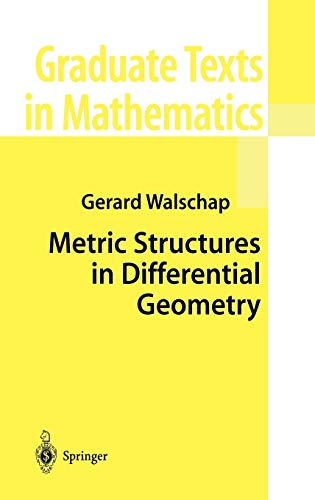
Ebook Info
- Published: 2004
- Number of pages: 237 pages
- Format: PDF
- File Size: 6.81 MB
- Authors: Gerard Walschap
Description
This book offers an introduction to the theory of differentiable manifolds and fiber bundles. It examines bundles from the point of view of metric differential geometry: Euclidean bundles, Riemannian connections, curvature, and Chern-Weil theory are discussed, including the Pontrjagin, Euler, and Chern characteristic classes of a vector bundle. These concepts are illustrated in detail for bundles over spheres.
User’s Reviews
Editorial Reviews: Review From the reviews:”The book gives an introduction to the basic theory of differentiable manifolds and fiber bundles … The book is well written. The presentation is clear, detailed and essentially self-contained. This book is suitable for senior undergraduate and graduate students. It can be used for a course on manifolds and bundles, or a course in differential geometry.” (M. Burkhardt, Zeitschrift für Analysis und ihre Anwendungen, 1, 2005)”This text is an introduction to the theory of differentiable manifolds and fiber bundles … provides a comprehensive overview of differentiable manifolds … concepts are illustrated in detail for bundles over spheres … This book can be used for a one-semester course on manifolds or bundles, or a two-semester course in differential geometry.” (L’enseignement mathématique, 50:1-2, 2004)”This book is based on the author’s graduate-level lecture notes. … One of the strengths of this book is the fact that the author manages in a 220-page volume to cover important themes in Riemannian geometry and fiber bundles. … The book contains some nice examples … . The topics are well-closed and the content is well-organized. … This clearly written book is an excellent source for teaching a course in differential geometry … . It is a worthwhile addition to any mathematical library.” (Stere Ianus, Zentralblatt MATH, Vol. 1083, 2006)”This text should be an elementary introduction to differential geometry. … The style is rather concise and many facts are shifted to 165 nontrivial exercises. The book is very well written and can be recommended to those who want to learn the topic quickly and actively.” (EMS Newsletter, June, 2005)”This book is a carefully written text for an introductory graduate course on differentiable manifolds, fiber bundles and Riemannian geometry. … This book is a thorough and insightful introduction to modern differential geometry with many interesting examples and exercises that illustrate key concepts effectively; it is highly recommended by the reviewer.” (Thomas E. Cecil, Mathematical Reviews, Issue 2006 e)”In every mathematical library a number of introductory books to differential geometry can be found. They are all different in some aspect, but – at the same time – none presents all the concepts equally successfully to all the readers. So there is allways a need for new introductory books, and Walschap’s book is a good one of these. … The series of definitions, concepts and theories are punctuated by examples, remarks. Each section ends with exercises.” (Árpád Kurusa, Acta Scientiarum Mathematicarum, Vol. 73, 2007) From the Back Cover This text is an introduction to the theory of differentiable manifolds and fiber bundles. The only requisites are a solid background in calculus and linear algebra, together with some basic point-set topology. The first chapter provides a comprehensive overview of differentiable manifolds. The following two chapters are devoted to fiber bundles and homotopy theory of fibrations. Vector bundles have been emphasized, although principal bundles are also discussed in detail. The last three chapters study bundles from the point of view of metric differential geometry: Euclidean bundles, Riemannian connections, curvature, and Chern-Weil theory are discussed, including the Pontrjagin, Euler, and Chern characteristic classes of a vector bundle. These concepts are illustrated in detail for bundles over spheres. Chapter 5, with its focus on the tangent bundle, also serves as a basic introduction to Riemannian geometry in the large. This book can be used for a one-semester course on manifolds or bundles, or a two-semester course in differential geometry.Gerard Walschap is Professor of Mathematics at the University of Oklahoma where he developed this book for a series of graduate courses he has taught over the past few years.
Reviews from Amazon users which were colected at the time this book was published on the website:
⭐The printing is very bad: the pages look like a Xerox copy, some characters lack serifs, there are tiny gray dots all over the pages. The (hardcover) binding is also of poor quality, but passable since the book is not thick. Looks like Springer is pirating their own books now. (My review doesn’t concern the mathematical content itself, which is good.)
⭐Walshap’s book came as a bit of a surprise to many of us. There are so many books on graduate differential geometry,but most of the best ones are just too lengthy to be practical for use in a real graduate differential geometry course. M.Spivak’s 5 volume epic,John M.Lee’s wonderful trilogy, Jeffery Lee’s more recent text and Lawrence Conlon’s excellent tome are all terrific choices for graduate courses. The big problem with them is that unless one spends 90 percent of a day reading and working through them, there’s no way one is going to be able to cover a significant chunk of them in a single semester course on differential manifolds or a full year course on differential geometry. The average graduate student barely has time to sleep and eat, let alone work his or her way though them. Boothby is very user friendly and has a nice choice of topics, but it doesn’t really cover enough for a good graduate course. Also, despite many of them having good problems to chew on-Lee and Conlon have particularly strong exercises-it’s usually not enough to prepare for graduate exams, let alone the geometry qualifying exam.Then there are books that have the opposite problem-they’re ludicrously terse and are flat out painful to work through. Most infamous for decades in this class is Frank Warner’s readable and clear but painfully intense text. In this niche we can also place Thierry Aubin’s much easier but equally concise book, Milnor’s classic on Morse theory, do Carmo’s Riemannian geometry text,Taubes’ lecture notes, the most recent incarnation of the late S.S.Chern’s notes and, hardest of all,the incredibly compressed text of Jurgen Jost. These books-particularly Warner and Jost-need to be left to the very strongest of students at the best universities. (Indeed,I believe Jost is best used as a second year course text.) Also, the lecture notes by Chern and Taubes, while beautifully written,have no exercises and therefore will be of limited use as course texts by themselves.What was needed was a relatively short, very readable option with broad coverage and minimal prerequisites. Such a book by necessity would shift most of the results to the exercises and therefore would create a text the graduate student would need to learn actively with. Not only would this allow the student to learn the subject quickly, it would help acclimate them to taking the training wheels off in graduate school without being too discouragingly dense. It would need to have clear definitions, sections broken into bite-size pieces and a couple of well-placed diagrams wouldn’t hurt.We finally have that book in Walshap. In a mere 226 pages, Walshap races the student through all the major broad strokes of the subject without making their eyes glaze over-quite a feat. He covers differentiable manifolds,multilinear algebra and forms,vector and fiber bundles,homotopy groups over spheres (a tough topic without algebraic topology, but Walshap does a good job covering just the bare bones), connection structures on bundles such as Reimannian structures and the book finishes with an elementary introduction to complex differential geometry and characteristic classes.The book has a definite topological bent by emphasizing fiber bundles rather then vector bundles. Walshap tries very hard to keep the prerequisites to a minimum: a good grasp of real analysis,point set topology and algebra. The author introduces algebraic topology only when it’s needed. For example the fundamental group is introduced as a special case of homotopy groups.Another example is that cohomology isn’t used in characteristic classes, they are constructed directly using the Weil homomorphism. This is more involved algebraically, but conceptually simpler. The language of the book is completely modern, commutative diagrams are used throughout. The real joy of the book is the hundreds of integrated exercises-they’re all substantial and none are too hard. A great deal of the material is developed in these exercises,so the student really needs to work through them. But working through them is half the fun-and the fact Walshap makes working exercises fun is a measure of his skill as a teacher.While all those books above have their place, Walshap has written a practical text that will allow graduate students to actively and rapidly learn all they need to know about differential geometry unless they plan to specialize in it. Best of all,he’s done it in a way that’s not torturous. Kudos to him and for any student finding the standard texts too formidable to master in their incredibly limited time, I strongly advise they give this wonderful and unorthodox text a look.They’ll be glad they did. I know I was.
⭐
Keywords
Free Download Metric Structures in Differential Geometry (Graduate Texts in Mathematics, 224) 2004th Edition in PDF format
Metric Structures in Differential Geometry (Graduate Texts in Mathematics, 224) 2004th Edition PDF Free Download
Download Metric Structures in Differential Geometry (Graduate Texts in Mathematics, 224) 2004th Edition 2004 PDF Free
Metric Structures in Differential Geometry (Graduate Texts in Mathematics, 224) 2004th Edition 2004 PDF Free Download
Download Metric Structures in Differential Geometry (Graduate Texts in Mathematics, 224) 2004th Edition PDF
Free Download Ebook Metric Structures in Differential Geometry (Graduate Texts in Mathematics, 224) 2004th Edition