

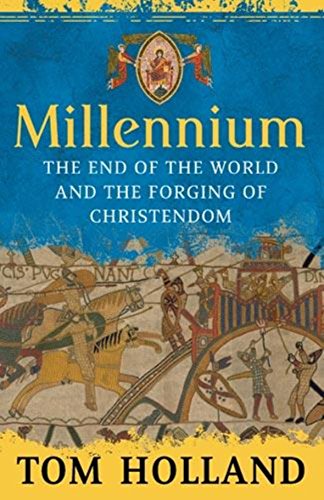
Ebook Info
- Published: 2010
- Number of pages: 476 pages
- Format: PDF
- File Size: 2.14 MB
- Authors: T. A. Holland
Description
Of all the civilisations existing in the year 1000, that of Western Europe seemed the unlikeliest candidate for future greatness. Compared to the glittering empires of Byzantium or Islam, the splintered kingdoms on the edge of the Atlantic appeared impoverished, fearful and backward. But the anarchy of these years proved to be, not the portents of the end of the world, as many Christians had dreaded, but rather the birthpangs of a radically new order. MILLENNIUM is a stunning panoramic account of the two centuries on either side of the apocalyptic year 1000. This was the age of Canute, William the Conqueror and Pope Gregory VII, of Vikings, monks and serfs, of the earliest castles and the invention of knighthood, and of the primal conflict between church and state. The story of how the distinctive culture of Europe – restless, creative and dynamic – was forged from out of the convulsions of these extraordinary times is as fascinating and as momentous as any in history.
User’s Reviews
Reviews from Amazon users which were colected at the time this book was published on the website:
⭐Tom Holland’s writing style is superb as usual. He gives a good overview of the political world (which was closely tied to the Catholic religion in Western Europe) around 1000 A.D. Though I was familiar with the various dynasties and rulers of the era, I was less clear on their relationship and history with the Christian Church in Rome and the rise of papal power. I read this alongside Valerie Hansen’s new book, The Year 1000: When Explorers Connected the World―and Globalization Began, which dealt with expanding trade the world over. Reading both of them gives a great overview of the political, religious, and economic landscape during this period in history. Highly recommend both books.
⭐I think I may have developed an addiction to Tom Holland. His writing is so clear, his historical research so accurate and detailed, his insights so vivid, I don’t think I can honestly live without his books.I don’t know if there are rehab programs for Holland addiction. Until I find one I will continue to read.
⭐Nothing in history can be definitive but this is a very convincing tapestry that lead to the political formation of modern Western Europe. Reading it many things come to place, and you understand the layers on top of layers, people’s, cultures and languages of Europe and its relationship, myopic and missoginistic of the world outside its borders. If you want to understand why strict separation of church from state is a must, read the book. Incredible the level of bottom reached by what’s today is Europe after the implosion of the Roman Empire.
⭐This was the third book I’ve read by Tom Holland. He gives a remarkable insight into the events that shaped Europe at the time and still have an impact today. I learnt so much about The Holy Roman Empire and the politics, and corruption, of Christendom and the known world in the 10th and 11th Centuries.His almost novelistic style makes for very easy reading – not at all stuffy as many historians can be.I would recommend this book to anyone interested in the history of the Roman Catholic Church but would suggest that his book “In the Shadow of the Sword” should be read first.I have recently bought his “Rubicon” and cannot wait to get started on it.VJ SweetJohannesburg, South Africa
⭐Tom Holland has a knack for writing about interesting topics in an interesting way, something very few people have seemed to find a way to do. I read “Rubicon” by Mr. Holland a few years ago, and while I’ve always been interested in ancient Rome, I had a hard time finding a book that really captured the subject in a way someone who was not previously schooled in the topic could easily read. The same is true for “Millenium.” As someone who has always focused on early US history, it can be hard to transition into a totally different era and region. Tom Holland’s writing style, a very fluid narrative, is perfect for someone who knows almost literally nothing about the time period. While I can’t speak for someone looking for an in-depth analysis of certain people or events in turn-of-the-millenium Europe, for someone who is not familiar with the time or territory, this book was an excellent and very informing read. Definitely recommended.
⭐The book is so far a good read, but the service from Brit Books Ltd. was even better! Thank you.
⭐My recommendation would be that everyone willing to start “Tom Holland experience” should start with Rubicon or Persian Fire.This book being pretty good on it’s own, it is definitely not as good as Rubicon and contains some kind of political analysis that definitely takes getting used to.Either way it got me hungry for more. 1 more month from now on (20th may 2016) until i get myself “Dynasty” in paperback.
⭐Excellent book throughout. Captivating and memorable, history presented with wit and superbly written details. Holland is the best writer of history I have ever experienced.
⭐This is an engaging populist romp through the early Middle Ages that within the framework of the Millennium (and millenarist fears and hopes) seeks to draw together the development of the Holy Roman Empire and the emergence of papal monarchy, the two contending forces claiming to be be the temporal and spiritual heirs of Rome, in order to explain the distinct culture of the medieval Christendom that evolved in the eleventh to fourteenth centuries and was the foundation of modern western European society.This is an overwhelmingly political narrative, focusing upon emperors and popes and kings and lords, and so has little to say about the economic and social changes that underlay the creation of the more stable, confident, and resurgent Christendom that emerged after 1000, and, while touching upon knighthood and castellateion, quickly brushes over the formation of a recognisably feudal land tenure (except in a brief social contract discursion), and says nothing about demesne farming beyond the great ecclesiastical estates of Cluny, or the environmental and climatic changes, which together helped to produce the population explosion and economic growth that profoundly affected demography, society, agriculture, and material culture in 1000 to 1300. So, this is a history of origins – the origins of medieval Christendom – but only as seen through a political lens. Tom Holland’s medieval Christendom is therefore predominantly a political construct, one driven by the symbiotic rivalry of empire and Church, and conceived in terms of ideas about the Book of Revelation and the End of Days associated with the millennium from Christ’s birth and death. It is a story told through the deeds of great men and, sometimes, great women, and framed by elite political culture and elite thought and action. It is a popular history from which the mass of the people is mostly excluded.Holland brings his usual dramatic and enthusiastic prose to his tale, with amusing asides and selections that support his viewpoint, beginning in a prologue with that most symbolic of confrontations between church and state, the submission of the emperor Henry IV to Pope Gregory VII at Canossa in 1077, at the end of his period. He then explains how these two powerful individuals and the European societies at which they stood at the head got there, starting with the knitting together of the post-antique conception of the Roman Christian empire in the West with Germanic kingship, through the foundation of the Carolingian and Ottonian empires, with diversions to the creation of the French, English, Scandinavian, and Kievan monarchies and brief trips to the other, older, eastern Roman empire of Constantinople, and on to the Gregorian and Cluniac reform movements of the eleventh century that rejuvenated the papacy and reordered the Church, bringing both a check to and a legitimisation of the power of secular rulers and division within Christendom itself, a division of Roman West from Orthodox East, and a division between the aims and actions of those who exercised spiritual power and those temporal power.At the end of his book, Holland returns to Canossa, its context now having been established, and charts the recovery of Henry IV from his subjugation and the apparent failure of Gregory VII. However, he does not leave the story there, but goes on to the papacy of Urban II and the council of Clermont with the Pope’s call for a crusade to take back Jerusalem and the Holy Sepulchre into Christian hands, which by allying the religious power of papal monarchy with the military prowess of knighthood provided both a solution to the Gelasian knot of the two swords, spiritual and temporal, and a human manifestation of millenial hopes for the defeat of Antichrist and the Second Coming. All roads, it seems, do not lead to Canossa, but to Clermont, and the Crusades are not an aberration or the product of insensible prejudice, but both the consequence of the foundation of medieval Christendom and an inherent manifestation of the civilisation thereby created. The Crusades are the defining characteristic of the western medieval society that emerged after 1000, and whose creation Holland seeks to describe within the distinct history of western European, Christian, and Roman, identity.This book is a lively read and an entertaining introduction to a period often erroneously regarded as the Dark Ages, and will stimulate discussion for those already familiar with the period and medieval European history.
⭐The central thesis of the book is that folk were in awe of the date 1000 as it was believed to be the date of the second coming. There is not much evidence produced to support this and it frankly doesn’t impact the story much. The real story is that during the 10th and 11th centuries Christianity spread across Europe and became the universal religion. Still, the kings, emperors and knights continued to hack each other to bits from the Baltic to the Pyrenees. Through all this carnage the Popes tried to maintain supremacy over the warlords; sometimes successfully, sometimes not.So far, so interesting and well written. However, the book really loses momentum in the middle. Many paragraphs say the same thing several different ways and in the plethora of kings and queens and all their kin, it becomes hard to keep track of the wicked uncles and saintly wives. A book with lots of good bits which could have been great if it had a chunk of padding edited out, to the benefit of the narrative.
⭐The years between the fall of the Roman Empire and the turn of the first millennium are generally known as the ‘Dark Ages’, an era of brutality, poverty, illiteracy, paganism and savagery, when all the advances of the Greek and Roman civilisations seemed to vanish as though they had never been, and the shape of the countries we know as England, France, Germany, Italy, Norway, Denmark, were barely coming into focus. Such was the case in Western Europe, at least. There was no such Dark Age in the Islamic or Byzantine Empires. In these years, it would have been all but impossible to imagine a time, not so far in the future, when both these mighty empires would be toppled and Western Europe would stand triumphant, stable and orderly, crowned by the splendour and spiritual muscle of the Pope in Rome.Tom Holland chronicles the course of the centuries either side of 1000 AD, a time of much convulsion and upheaval: the ‘birth pangs’, as he calls it, of Western Europe. These were the years in which France was emerging from West Francia, a breakaway portion of the empire of the Franks, the empire of Charlemagne, who had been crowned emperor of the West in Rome itself and acknowledged as the western counterpart of the eastern emperor in Constantinople; in which the Scandinavia countries of Norway, Denmark, Iceland were turning away from Odin and the old gods and embracing Christianity; in which Vikings were settling, by force, in France and forming the land that would become Normandy; other Norsemen were settling further in the continent and becoming known as the Rus, eventually giving their name to Russia; yet more Normans were invading and conquering England, Sicily and southern Italy; the Muslim caliphate was splitting in two, with the Umayyad clan basing their dynasty in Cordoba in Muslim Spain, al-Andalus, and the Abbasid caliphate waging persistent war against the Byzantines.And above all of this, the Church was establishing its grip, the power and influence of the Pope reaching into every kingdom – the secular and the spiritual no longer as separate as they had once been. Popes were claiming new powers and rights over kings, culminating in many kings coming under the papal sway as vassals, crowned and acknowledged by the Pope alone – in effect, the Pope was claiming that the whole of Christendom was subject to him and the Church. And in an act that would have lasting consequences, popes were coming to embracing the concept of a church-blessed ‘holy war, a concept already well embedded in the Islamic jihad. In the space of two scant centuries, all this came to pass – and how much can be ascribed to ‘millennial fever’, to the fervid belief that the End of Days was nigh and the Antichrist due, with the thousand year anniversary of Christ’ birth on the horizon, is the major theme of this book. The years before the turn of the millennium were dark and feverish, with many believing that the world was sinful and needed perfecting before the End of Days, giving rise to much of the impetus that propelled these changes.Tom Holland is a marvellous writer – he has a tone that somehow manages to be wry and melodramatic at the same time, quite a skill. This isn’t academic history, it is very much history for the uninformed, but there can be few authors better at painting such a sweep of history so enjoyably. I found the central theory of the millennial fever a little lacking, and it only really forms a central theme in the first half of the book. But I didn’t enjoy this book any less for that. This is an era of history I’ve never been especially interested in – it’s either Greek, Persian and Roman, or skipping over these middle years to get to 1066, but I could hardly put this book down.
⭐I’ve read a few of Holland’s books and found this one perhaps the hardest to get through. Mostly, because the time period covered (around 800-1100) is not an area of history I know much about, and it’s not where my interest predominantly lies. That said, this book is extremely interesting.Holland’s book is essentially the story of the making of mainland Europe and the shift from tribes and small kingdoms to a global presence. The latter was greatly helped by the spread of Christianity, which created a community spread across vast areas.Much of the book focuses on the conversation of the ‘barbarian’ tribes to the faith and how they went on to convert others and so on. I never realised just how much of Europe was settled by the Vikings! It also focuses on the tension between the rising power of Kings vs the power of the Church. Pope vs King, and also Pope vs the representatives of Eastern Christianity. The area most discussed is what is now France and Germany, we learn about the origin of Knights, of the creation of Castles and their use, and of the constant jostling for position.What’s noticeable throughout the work is the sense of the end of days (people thought the millennium was the coming of the antichrist, and Christ’s return) the desperation to make the earth ‘better’ while also killing/pillaging and committing acts that modern observers would condemn as unbelievably barbaric. Holland tells us that even men at the time were torn between acts they committed (or were going to) and their Christian faith. The book ends as Europe is starting to unite under the banner of Christianity and as the first crusade is called.
⭐The author details events in Britain and Europe leading up to 1033, being the time when Christians believed the Anti-Christ would come. It then details the power struggles between the Francs, Reich, Saracens and Byzantine empires for ascendancy in Europe and the establishment of religious centres in Rome, Constantinople, Cluny, Kiev, Cordoba and Santiago. It was a period of turmoil, intrigue and almost constant fighting and changes in leadership.
Keywords
Free Download Millennium: The End of the World and the Forging of Christendom in PDF format
Millennium: The End of the World and the Forging of Christendom PDF Free Download
Download Millennium: The End of the World and the Forging of Christendom 2010 PDF Free
Millennium: The End of the World and the Forging of Christendom 2010 PDF Free Download
Download Millennium: The End of the World and the Forging of Christendom PDF
Free Download Ebook Millennium: The End of the World and the Forging of Christendom