

Ebook Info
- Published: 2000
- Number of pages: 236 pages
- Format: PDF
- File Size: 3.02 MB
- Authors: Deirdre Haskell
Description
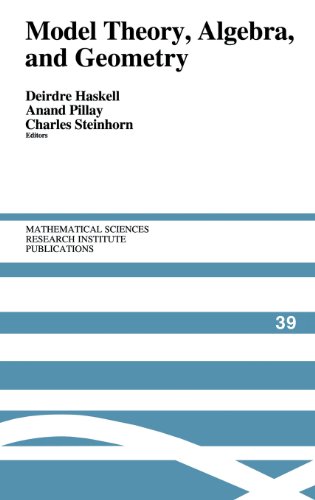
Model theory is a branch of mathematical logic that has found applications in several areas of algebra and geometry. It provides a unifying framework for the understanding of old results and more recently has led to significant new results, such as a proof of the Mordell-Lang conjecture for function fields in positive characteristic. Perhaps surprisingly, it is sometimes the most abstract aspects of model theory that are relevant to those applications. This book gives the necessary background for understanding both the model theory and the mathematics behind the applications. Aimed at graduate students and researchers, it contains introductory surveys by leading experts covering the whole spectrum of contemporary model theory (stability, simplicity, o-minimality and variations), and introducing and discussing the diverse areas of geometry (algebraic, diophantine, real analytic, p-adic, and rigid) to which the model theory is applied. The book begins with an introduction to model theory by David Marker. It then broadens into three components: pure model theory (Bradd Hart, Dugald Macpherson), geometry(Barry Mazur, Ed Bierstone and Pierre Milman, Jan Denef), and the model theory of fields (Marker, Lou van den Dries, Zoe Chatzidakis).
User’s Reviews
Editorial Reviews: Book Description Leading experts survey the connections between model theory and semialgebraic, subanalytic, p-adic, rigid and diophantine geometry.
Reviews from Amazon users which were colected at the time this book was published on the website:
⭐If you know a few of the ideas of model theory and want to know what the subject does today this fast-paced survey is the book for you. If you want just the most exciting current results look at van den Dries TAME TOPOLOGY AND O-MINIMAL STRUCTURES. Either way you will have to know some algebra and analysis.In principle this book introduces model theory. I don’t know how well it would work as an absolutely first look at the subject. Years ago I read a few hundred pages of Chang and Keisler MODEL THEORY. I.e. half of it. That classic, great, and now dated book is still indispensable to mastery of the subject. And it gives a fuller account of the very first steps than this one so beginners should probably look at both. The books written in between by Hodges, Poizat, and Marker seem to have virtues largely in between these two — so you might as well read these two first: the classic Chang and Keisler, and the brisk up to date Haskell et al.This one surveys the latest most exciting work in model theory, and it is exciting indeed. At the hands of Macintyre, van den Dries, Hrushovski and others model theory has focussed less on models of powerful foundational theories (notably arithmetic, and set theory) where Goedel incompleteness puts strong limits on how simple and thorough the results can ever be. It now focusses more on exploring the extremely nice and useful properties of structures *definable* in elegant weaker models (paradigmatically: algebraically closed fields like the complex numbers, and real closed fields like the real numbers; but also p-adic fields with deep applications in number theory).The basic ideas go back to Tarski’s use of “quantifier elimination” but the direction has shifted radically. Tarski’s main purpose for this technique was to give a decision routine for elementary algebra. He found an algorithm for taking any formula in the first-order theory of the real field and eliminating the quantifiers one-by-one to get an equivalent but quantifier-free formula without adding any free variables. If the first formula was a sentence then the resulting sentence is trivially either provable or refutable, so this gives a decision routine (albeit far from efficient).But put it another way: Tarski showed that any subset of the real numbers which is definable at all in the first order theory, is definable by finitely many equations and inequalities. It does not need quantifiers. Every such set is a finite number of intervals (counting an isolated point as an interval, and including unbounded intervals like all real numbers greater than 0).Of course set theory can define much “wilder” subsets of the real line, including ones with all kinds of difficult properties that an earlier generation called “pathologies”–e.g. non-measurable subsets. Tarski’s result shows that all the subsets *definable in* elementary algebra are “tame.” Van den Dries noticed that this implies very strong constraints on all the subsets of n-dimensional real space R^n that can be defined in the first order theory, and indeed very nice constraints, and that it all lifts to much more general contexts. In great generality, *definable* sets are “tame.”Van den Dries’s ideas grew from model theory but Lawvere and others emphasized the relation to the “tame topology” proposed in Grothendieck’s “Esquisse d’un Programme” (Sketch of a Program). You can read the esquisse (in English) in Leila Schneps and Pierre Lochak eds. GEOMETRIC GALOIS ACTIONS.This became a powerful idea. Very often the specific structures we want to know about in algebra and geometry can be defined within models of suitable first order theories, where “suitable” means that all such definable structures are “tame.” Many set-theoretic complications are ruled out by just looking at the first-order definable cases and this has penetrating useful consequences.So Macintyre sees a time when model theory will be re-named definability theory. In this book van den Dries quotes Hrushovski’s proposal that “model theory = the geography of tame mathematics” (p. 38).This book introduces that perspective including “stability” and “o-minimality” and applications in number theory. You may even want to refer to the more specialized chapters only as needed, while focussing on the general accounts of model theory, classical results on fields, o-minimality, and stability.This is a more conceptual, unified subject than model theory a la Chang and Keisler. One line on the back of the book harks back to the older view: “Perhaps surprisingly, it is sometimes the most abstract aspects of model theory” that have important applications. From the current viewpoint it could, and should, say instead “Happily, it is often the most conceptual and least technical aspects of model theory…” Again, the massive Chang and Keisler remains indispensable for full mastery of the field, but there has been real progress.The subject has become clearer and so more suited to a brilliant concise survey like this.
⭐
Keywords
Free Download Model Theory, Algebra, and Geometry (Mathematical Sciences Research Institute Publications, Series Number 39) 1st Edition in PDF format
Model Theory, Algebra, and Geometry (Mathematical Sciences Research Institute Publications, Series Number 39) 1st Edition PDF Free Download
Download Model Theory, Algebra, and Geometry (Mathematical Sciences Research Institute Publications, Series Number 39) 1st Edition 2000 PDF Free
Model Theory, Algebra, and Geometry (Mathematical Sciences Research Institute Publications, Series Number 39) 1st Edition 2000 PDF Free Download
Download Model Theory, Algebra, and Geometry (Mathematical Sciences Research Institute Publications, Series Number 39) 1st Edition PDF
Free Download Ebook Model Theory, Algebra, and Geometry (Mathematical Sciences Research Institute Publications, Series Number 39) 1st Edition