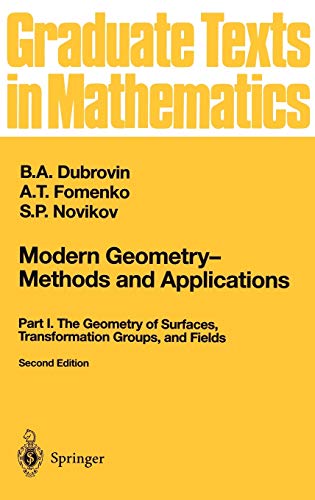
Ebook Info
- Published: 1991
- Number of pages: 486 pages
- Format: PDF
- File Size: 32.11 MB
- Authors: B.A. Dubrovin
Description
This is the first volume of a three-volume introduction to modern geometry which emphasizes applications to other areas of mathematics and theoretical physics. Topics covered include tensors and their differential calculus, the calculus of variations in one and several dimensions, and geometric field theory. This new edition offers substantial revisions, and the material is written in concrete language with terminology acceptable to physicists.
User’s Reviews
Reviews from Amazon users which were colected at the time this book was published on the website:
⭐There’s some great material that professor Novikov presents in this three volume set, indispensible to the mathematician and physicist. What seperates it (and elevates it) from it’s numerous competitors in the differential geometry textbook line is the following:1. He presents pretty much every idea in multiple ways and from multiple viewpoints, illustrating the ubiquity and flexibility of the ideas.2. He gives concrete examples of the concepts so you can see them in action. The examples are selected from a very wide range of physical problems.3. He presents the ideas in a formal setting first but then gives them in a form useful for actual computation or working problems one would actually encounter.4. He segregates the material cleanly into what I would call “algebraic” and “differential” sections. Thus, if you are interested in only a specific viewpoint or topic, you can fairly well read that section independent of the others. The book’s chapters are for the most part independent.5. There is virtually no prerequisite knowledge for this text, and yet it provides enough to not bore even the “sophisticated reader”, for even they will no doubt learn something from the elegeant presentation.I only own the first volume, but I have looked at the others in libraries and I would say for the most part the above holds for them too, making this three-volume set truly a masterpiece, a pearl in the sea of mathematical literature.Anyone iterested in a readable, relevant, viable introduction to the huge world of differential gometry will not be disappointed.
⭐Students begin their study of mathematics using coordinate notation exclusively. By the time they get the chance to study differential geometry, it is useful and wise to establish coordinate free notations as much as possible. In doing that, most texts impose an unnecessary roadblock for students. The notation shifts in a way that is abstract and can be confusing. This text is very good because it makes the link from the most elementary to modern thinking, and it does so carefully. It is written in a style that is a little less fashionable now, but it is certainly not out of date or useless. I would not want my library to be without this book, and I use it to get better clarity on a lot of points. I much prefer the more modern language of tensors as multi-linear mappings, compared to the coordinate transformation language used here, but that is not a substantial problem. This book is very good. I have to comment that Semi-Riemannian Geometry, by O’Neill, while a little different in character, is also very important for learning modern geometry properly.
⭐Very thorough, but very dense, at least from the undergraduate perspective. From the grad perspective, at least according to the authors, it is a quick and pseudorigorous treatment.
⭐This book is a classic in the subject and I think is obligated to have in your library. I recomended of people interested in the differential geometry read and read this book, is a nice piece of mathematics
⭐While this is an excellent text on Geometry, the title is misleading : this is not a modern text on differential geometry, but a classical text where vectors and tensors for example, are defined as “objects that transform according to rule x”.
⭐Good!!
⭐If you want to understand the much of Arnol’d’s book on classical mechanics. Written for physicists in language that physicists can follow, the book starts with advanced calculus (geometry of surfaces and curves in 2D and 3D) and provides a readable and informative introduction to Riemannian geometry, including connections defined by structure coefficients of a Lie algebra, all the way through gauge theories. However, the books by Schutz and by Nakahara cover interesting topics not included here, so see them as well.I’ve worked through the sections on curves and surfaces in detail, Frenet-Serret equations, principal and Gauss curvatures. The book is readable if you persist. An irritation is that no notation distinguishes vectors from scalars so you have to fill that in for yourself. <..> denotes scalar product while [..] denotes a cross product. I found it useful to use the sphere, helicoid, and torus as examples to work through. The shape operator is not discussed so it took some time to find it and use it for the derivation of the principle direction curves. I do not know of a better book for a physicist to use to learn differential geometry.
⭐Written by prominent mathematicians it is the one of the best books on the topic .The language of the book is very simple so it is suitable for physics …
⭐Goooooood!!
Keywords
Free Download Modern Geometry ― Methods and Applications: Part I: The Geometry of Surfaces, Transformation Groups, and Fields (Graduate Texts in Mathematics, 93) 2nd Edition in PDF format
Modern Geometry ― Methods and Applications: Part I: The Geometry of Surfaces, Transformation Groups, and Fields (Graduate Texts in Mathematics, 93) 2nd Edition PDF Free Download
Download Modern Geometry ― Methods and Applications: Part I: The Geometry of Surfaces, Transformation Groups, and Fields (Graduate Texts in Mathematics, 93) 2nd Edition 1991 PDF Free
Modern Geometry ― Methods and Applications: Part I: The Geometry of Surfaces, Transformation Groups, and Fields (Graduate Texts in Mathematics, 93) 2nd Edition 1991 PDF Free Download
Download Modern Geometry ― Methods and Applications: Part I: The Geometry of Surfaces, Transformation Groups, and Fields (Graduate Texts in Mathematics, 93) 2nd Edition PDF
Free Download Ebook Modern Geometry ― Methods and Applications: Part I: The Geometry of Surfaces, Transformation Groups, and Fields (Graduate Texts in Mathematics, 93) 2nd Edition