

Ebook Info
- Published: 2001
- Number of pages: 280 pages
- Format: PDF
- File Size: 3.71 MB
- Authors: Stuart J. Kaufman
Description
Ethnic conflict has been the driving force of wars all over the world, yet it remains an enigma. What is it about ethnicity that breaks countries apart and drives people to acts of savage violence against their lifelong neighbors?Stuart Kaufman rejects the notion of permanent “ancient hatreds” as the answer. Dissatisfied as well with a purely rationalist explanation, he finds the roots of ethnic violence in myths and symbols, the stories ethnic groups tell about who they are. Ethnic wars, Kaufman argues, result from the politics of these myths and symbols―appeals to flags and faded glories that aim to stir emotions rather than to address interests. Popular hostility based on these myths impels groups to follow extremist leaders invoking such emotion-laden ethnic symbols. If ethnic domination becomes their goal, ethnic war is the likely result.Kaufman examines contemporary ethnic wars in the Caucasus and southeastern Europe. Drawing on information from a variety of sources, including visits to the regions and dozens of personal interviews, he demonstrates that diplomacy and economic incentives are not enough to prevent or end ethnic wars. The key to real conflict resolution is peacebuilding―the often-overlooked effort by nongovernmental organizations to change hostile attitudes at both the elite and the grassroots levels.
User’s Reviews
Editorial Reviews: Review “Modern Hatreds is an excellent and timely contribution to scholarship on ethnic war…. Kaufman manages to combine a thoroughly researched and detailed analysis of the case studies and the construction of a hypothesis that may explain, to some extent, the emergence of ethnic war.” ― Journal of International Studies”Convincing in arguing that ethnic violence is not the result of ‘ancient hatreds,’ and that contemporary politics and the struggle for power among individuals and elite groups largely determine who will engage in violence and who, ultimately, will get killed.” ― New York Review of Books”This detailed work on the history of hatred provides a thoughtful perspective of events and motivations that should fascinate any serious reader.” ― Political Science Quarterly”While providing excellent background of ethnic wars, Modern Hatreds is not simply a historical text. It offers a modern interpretation of the many recent individual conflicts, and helps knit together the broader themes that are relevant to them all.” ― National Journal Review “In Modern Hatreds, Stuart Kaufman provides a solid, cohesive argument in favor of paying more attention to the myths and symbols underlying ethnic conflict. The systematic treatment of ethnic conflict across comparable case studies distinguishes this study from most other recently published works on this topic. This is not only a sound piece of scholarship, but also an accessibly written book that should be read in and beyond academe.” — Robert J. Kaiser, University of Wisconsin About the Author Stuart Kaufman is Professor of Political Science and International Relations at the University of Delaware. Read more
Reviews from Amazon users which were colected at the time this book was published on the website:
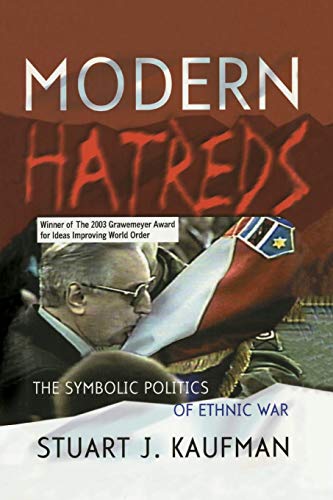
⭐Stuart J. Kaufman presents a political theory that can explain why ethnic violence and war begin and how it can be prevented in his book Modern Hatreds: The Symbolic Politics of Ethnic War. Kaufman believes that ethnic violence has its roots in the prevalent myths and symbols of the ethnic groups involved in the conflict, and dismisses other prominent theories as being too narrow to explain multiple conflicts and wars.The idea of a “myth-symbol complex” is what Kaufman credits as being the root of ethnic conflict. This complex is the combination of various myths, symbols, histories, and cultural values that define who a person is and of which group that person is a part. These myths and symbols evoke strong emotions from the masses. If wielded properly by a leader, symbols can lead the masses’ energy towards a chosen conflict simply because of the emotional baggage that is accompanied by many controversial symbols. To support his theory, Kaufman presents empirical examples. The case studies that are examined are each a former Soviet, eastern European state. He chose these cases because they are all former soviet bloc states and have survived a similar past of occupation and dominance. By choosing cases that have similar histories, Kaufman is able to eliminate unnecessary differences and therefore concentrate on relevant asymmetries and circumstances, thus he is able to better examine the roles of myths and symbols in each case. An example that he puts forth is the conflicts involving Azerbaijanis after the collapse of the Soviet Union. While Azerbaijanis in Armenia and Azerbaijan were enveloped in conflict with Armenians, Azerbaijanis in Georgia had no conflict with the chauvinistic Georgians. The reason, he asserts, is because the myths and symbols in Georgia are not gauged against Azerbaijanis; rather, they are directed against other larger Georgian minorities. Likewise, Azerbaijani myths are not directed against Georgians. In addition to the presenting his theory, rejecting other prominent theories, and examining case studies, Kaufman also presents ideas on avoiding ethnic violence through peace keeping and peace building efforts. He is optimistic about the great potential of peace keeping if people are promoting said peace by monitoring and controlling the prevalence and intensity of controversial ethnic myths and symbols. Kaufman mentions the event which is illustrated on the cover of the book as being a symbolic action which contributed to aggravation of ethnic conflict between Serbs and Croats. Had Tudjman refrained from kissing the flag that represented both Croatian and Ustasha fascist, the Serbs would have been less fearful of Croats and therefore less willing to engage in violence. Kaufman’s theory is sound; however he too quickly dismisses other theories in the outset of the work before turning to incorporate them into his own at the end of the book. He rightly asserts that the other theories, if combined, account for why ethnic conflicts exist. But by the end of his argument, he incorporates emotion into his theory as being a driving force behind the outbreak of ethnic violence. Compared to other various types of theories that have been used to explain ethnic conflict, such as rational choice, economic, or emotional theories, Kaufman’s is a well rounded and adaptable theory. He recognizes the immense roles that emotion and opportunity play in the escalation of conflict, but maintains that cultural myths and symbols are at the roots of ethnic animosity. According to Kaufman, the histories and memories of a culture shape their myths, which in turn produce symbols that evoke strong emotion from the masses. Should the opportunity present itself, emotions lead those masses to violence gauged against mythical adversaries. While myth-symbol complex theory is a good basis for explaining ethnic conflict in post Soviet areas, it is unclear whether it would fit as nicely to other conflicts in a different region. Kaufman’s attempt to demonstrate the universal applicability of the theory is less concise and less effective than his arguments supporting the theory as an explanation for former Soviet bloc conflicts. He provides an example in the United States, which although emotionally loaded and relevant to symbolic politics, is not an issue that would lead to massive violent conflict, thus weakening his argument. Overall, however, the book was well written, easy to read, and very useful for providing information on infamous ethnic conflicts. Where other authors tend to assume a reader’s knowledge of the conflicts before presenting theory content, Kaufman explains the histories and progression of events and interjects why different situations can be explained by his theory.
⭐Great book demonstrating the theories of ethnic violence and the hysteria involved with creating tension and breeding violence among different ethnic groups. The author gives good theoretical explanation to the use of symbols, myths, and politics that can be misused to spark interethnic violence among people living together. The book goes over Moldova, Georgia, Armenia, Azerbaijan, and the former Yugoslavia. Great book for research or for general education on ethnic violence.
⭐I haven’t read this book, so I obviously can’t review it. I gave it five stars based on the following note that appeared in today’s (Dec. 4, 2002)on-line notes from the Chronicle of Higher Education, the “industry” newspaper for colleges and universities. I quickly add that I do not know Professor Kaufman, nor do I work in academia (unless paying college tuition for kids counts), but the fact that he was receiving this award suggests that his peers and other professionals consider this an important and noteworthy work. The Chronicle noted thatTHE GRAWEMEYER FOUNDATION at the University of Louisville today will give the 2003 Grawemeyer Award for Ideas Improving World Order to Stuart J. Kaufman, an associate professor of political science at the University of Kentucky. Mr. Kaufman was chosen for his book on the causes of ethnic conflict.Given world tensions, this sounds like a timely contribution to finding ways to understand differences and to resolve conflicts without the last resort of violence and war.
⭐This book is a good book to buy if you are studying political violence. It provides a good synthesis of the primordialist and intrumentalist points of view to effectively explain how ethnicity can be manipulated.
Keywords
Free Download Modern Hatreds: The Symbolic Politics of Ethnic War (Cornell Studies in Security Affairs) in PDF format
Modern Hatreds: The Symbolic Politics of Ethnic War (Cornell Studies in Security Affairs) PDF Free Download
Download Modern Hatreds: The Symbolic Politics of Ethnic War (Cornell Studies in Security Affairs) 2001 PDF Free
Modern Hatreds: The Symbolic Politics of Ethnic War (Cornell Studies in Security Affairs) 2001 PDF Free Download
Download Modern Hatreds: The Symbolic Politics of Ethnic War (Cornell Studies in Security Affairs) PDF
Free Download Ebook Modern Hatreds: The Symbolic Politics of Ethnic War (Cornell Studies in Security Affairs)