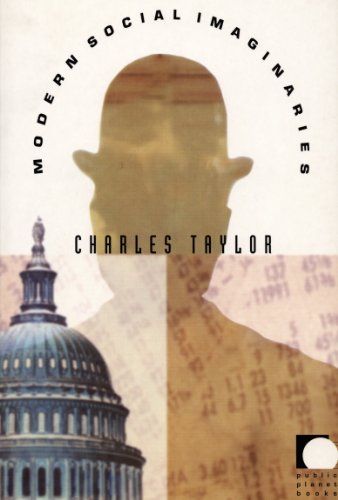
Ebook Info
- Published: 2003
- Number of pages: 231 pages
- Format: PDF
- File Size: 4.60 MB
- Authors: Charles Taylor
Description
One of the most influential philosophers in the English-speaking world, Charles Taylor is internationally renowned for his contributions to political and moral theory, particularly to debates about identity formation, multiculturalism, secularism, and modernity. In Modern Social Imaginaries, Taylor continues his recent reflections on the theme of multiple modernities. To account for the differences among modernities, Taylor sets out his idea of the social imaginary, a broad understanding of the way a given people imagine their collective social life.Retelling the history of Western modernity, Taylor traces the development of a distinct social imaginary. Animated by the idea of a moral order based on the mutual benefit of equal participants, the Western social imaginary is characterized by three key cultural forms—the economy, the public sphere, and self-governance. Taylor’s account of these cultural formations provides a fresh perspective on how to read the specifics of Western modernity: how we came to imagine society primarily as an economy for exchanging goods and services to promote mutual prosperity, how we began to imagine the public sphere as a metaphorical place for deliberation and discussion among strangers on issues of mutual concern, and how we invented the idea of a self-governing people capable of secular “founding” acts without recourse to transcendent principles. Accessible in length and style, Modern Social Imaginaries offers a clear and concise framework for understanding the structure of modern life in the West and the different forms modernity has taken around the world.
User’s Reviews
Reviews from Amazon users which were colected at the time this book was published on the website:
⭐I regret to say that I was disappointed in this book. I was an avid reader of the author’s SOURCES OF THE SELF, but I found this book to be turgid and not terribly interesting. The purpose of the book was to reinforce CT’s notion of ‘multiple modernities’ by focusing on the concept of the ‘social imaginary’ and how it speaks to the prior issue. The ‘social imaginary’ is a society’s conception of itself. It is the society’s sense of the moral order, built on history, structures, myths, legends, and so on. Here, he argues, there are three key elements to the modern social imaginary—the notion that we are part of a large interlaced economy, the notion that we are part of a public sphere (a notion developed by Habermas) and that we are self-governing. Religion plays a different role in the contemporary social imaginary than it once did; it has not disappeared but it is no longer the central element in our secularized world.There is nothing wrong with these ‘elements’ but the devil remains in the details. For example, CT traces the notion of national and global economic embeddedness to Adam Smith and the Physiocrats. In fact, both Defoe and Addison discussed this issue three generations earlier. It was a key element, for example, in the debate on ‘luxury’. Some thought that sending men in fragile ships all over the world to secure coffee, tea and spices for the wealthy in London put them at unnecessary risk. Others thought that the location of spices in exotic locales was part of a providential plan to bring the world together in shared commerce. Defoe, e.g., argues for spheres of commercial enterprise and against colonialism. In our own time, e.g., I once heard Fred Barnes, a conservative, say that there’s no need any longer ‘for us to make refrigerators’. That may be true, but the notion of seeing our factories locate abroad, in countries that may not wish us well, is a central part of our heavily-divided contemporary political discourse. There is no authentic social imaginary without a significant level of agreement and our social imaginary today (CT is writing in 2007 and should have anticipated this) is characterized by opposition and division. Some believe that our planet is doomed and that the final stroke is on the horizon; others believe that climate change is a hoax. But what side is the science on? Does the science make any difference? As the FB posts put it, how can you believe that bacteria on Mars would constitute life but a human embryo would not? This social imaginary is also heavily shaped. Polls suggest that racial and sexual demographics are greatly overestimated/underestimated by young people who see a world on television sitcoms, reality shows and in commercial advertising that may (or may not) bear any relation to actual realities. This is designed to attract market share but also to shape opinion and direct political activity. Bottom line: our social imaginary is characterized by radical division. Every moment we hear of geographic, urban, and media bubbles.The second problem (besides the problem of the superb notion of a ‘social imaginary’ being oversimplified) is that the elements which CT focuses on to construct a notion of modernity are so limited. For many years I taught classes that entailed the onset of modernity. The elements included the scientific revolution and its impact, the shift in philosophy to epistemology and its subjectivism and so-called perspectivalism, the radical alteration in literature (the development of the essay, the rise of the novel, she tragedies and domestic tragedies), the course of political history from Tudor England to the regicide, the civil wars, the Glorious Revolution, the diminution of royal authority, and so on. I also utilized material on such things as domestic architecture (lifted from Lawrence Stone). CT mentions some of these things in passing, but his subject involves the grand sweep of modern history, a subject that simply cannot be covered within his page constraints. When he does touch on some of these issues he is an unreliable guide. He considers the pivotal figure of literary modernity to be his beloved Rousseau’s Julie; Leslie Fiedler would have argued for Richardson’s Clarissa (and with solid, global evidence); Marx and Rousseau himself would have argued for Robinson Crusoe. CT also has a tendency to move from social imaginary to social imaginary, considering there to be such a thing as, e.g., an Enlightenment social imaginary. The problem is that there were multiple enlightenments, Johnson and Burke, e.g., taking a very different view of things than Rousseau. Indeed, Boswell believed in slavery (a central element in the contemporary social imaginary); Johnson opposed it and named his black manservant the residuary legatee of his estate, to the shock and surprise of some of his friends. In other words, these ‘social imaginaries’ are crucially-important concepts, but very, very complex.The one thing that is complex in this book is the prose. CT may be on the side of the angels and not that of the French Nietzscheans (though he bows to Foucault often enough), but his prose can be as tortured as theirs. One example:“In a science concerned with these conditions, there is room neither for action unenframed by a normatively constituted reality, nor for a study of a normatively neutral, inert social field. Neither component of the modern bifocal take can find a niche” (p. 79).My bottom line: take the wonderful notion of a ‘social imaginary’ and construct it for yourself using far broader materials and greater social and cultural detail.
⭐Taylor begins the work of Modern Social Imaginaries by introducing the concept of “`multiple modernities,’ the plural reflecting the fact that other non-Western cultures have modernized in their own way and cannot properly be understood if we try to grasp them in a general theory that was designed originally with the Western case in mind[.]” To be fair, Taylor rather politely asks a question, rather than demanding an answer.Taylor sees teleological progress in what he calls “the long march[.]” This progress has involved a gradual interplay between theory and practice, and he argues forcefully against any “false dichotomy . . . between ideas and material factors as rival causal agencies.” From this interplay between elite ideas and ordinary social practice, arises a “modern understanding of moral order[,]” which consists of four main points: 1) an order of “mutual benefit” between individuals; 2) these benefits “include life and the means to life,” but are secured through virtue; and 3) the centrality of rights and “freedom” as an expression of this order; and 4) “these rights . . . freedom [and] mutual benefit” are owed “to all participants equally.” If the reader is confused by the ambiguity of these four main points comprising this “modern . . . moral order” specific to the Western imaginary, the situation is hardly helped by Taylor’s description of the “social imaginary” in general:”By social imaginary, I mean something much broader and deeper than the intellectual schemes people may entertain when they think about social reality in a disengaged mode. I am thinking, rather of the ways people imagine their social existence, how they fit together with others, how things go on between them and their fellows, the expectations that are normally met, and the deeper normative notions and images that underlie these expectations.”Taylor claims to be discussing what he calls “broader and deeper” notions of human consciousness. Taylor admits that “[o]ur social imaginary at any given time is complex.” To muddy the waters even further, he distinguishes “imaginary” from “theory” by further confessing that “[t]his wider grasp . . . can never be adequately expressed in the form of explicit doctrines because of its unlimited and indefinite nature.” Ultimately, practice and understanding merge in Taylor’s imaginary: “If the understanding makes the practice possible, it is also true that it is the practice that largely carries the understanding.”Taylor admits that our modern understanding does not come without a price; “the number one problem of modern social science has been modernity itself”–our progress in terms of “science, technology, industrial production . . . individualism, secularization, [and] instrumental rationality” are paid for with “alienation, meaninglessness, [and] a sense of impending social dissolution[.]” Yet Taylor’s concept of modern order, which begins with the “Natural Law” theories of the seventeenth century, ultimately manages to overcome the “devastating critique” of Nietzsche. Furthermore, Taylor seems convinced that there is some insurance policy against a return of totalitarianism: “Attempts to build a polity around a rival notion of order in the very heart of modern civilization, most notably the various forms of fascism and related authoritarianism, have failed.”Taylor does not seem to group communism or other forms of the “Rousseau redaction” together with the fascist “critique” of the modern moral order, Pol Pot’s taste in philosophy notwithstanding. A cheap shot perhaps, but at times Taylor’s optimism comes across as overwhelmingly naive; while content to paste Nietzsche on the same page as `fascism and related authoritarianism,’ and though admitting “the Jacobin Terror[,] . . . Soviet communism and its offshoots” as part of the “totalitarian temptation,” Taylor is reluctant to slander his precious Rousseau–“Does this mean that we are blaming the `excesses’ of 1792-94, in particular the Terror, on the ideology espoused by revolutionaries? That would be rather too simple.”Ultimately, whether one can blame ideology for excesses or not, the “Grotian-Lockean theory of moral order” takes the fall for the “three important forms of social self-understanding which are crucial to modernity . . . the economy, the public sphere, and the practices and outlooks of democratic self-rule[.]” Here, perhaps, Taylor has identified something concrete and accessible to a popular audience. Most Western moderns can find comfort in Taylor’s trinity here, which speaks to the accuracy of its place within Taylor’s modern social imaginary. On the other hand, the critics of modernity–and not just Nietzsche–might have something else to say. Despite giving modernity’s critics superficial recognition in their most extreme–and thus most easily dismissed–forms, Taylor for the most part downplays as insignificant the shadow side of his analysis; from the earlier sacred or premodern perspective, or from the perspective of modernity’s critics (not all of them Nazis), Taylor’s `secular trinity’ (“the economy, the public sphere, and the practices and outlooks of democratic self-rule”) might be thought of (at least metaphorically) as `sex, pornography, and masturbation.’ I am reminded of a seminar recently attended, at which Professor John McGinnis remarked that “[i]f politics ever does rise to the level of entertainment, it’s better called `show business for ugly people.'” The next step towards an analogy between politics and pornography is not so far, and hardly unheard of as a “critique” of modernity; witness the film Taxi Driver, wherein a casualty of the modern age, a figure as familiar as he is perverse–the mundanely psychotic, anti-heroic and tragicomic Travis Bickle–conflates `politician’ with `pimp,’ and vice versa. This relates perhaps to what Taylor calls “the Great Disembedding” of modernity, wherein concepts of individual identity triumph over social belonging, the primacy of ordinary life is asserted over a previous hierarchy of sacred norms, and a new sense of “ordinary” or “secular” time is elevated to a status formerly reserved for the “premodern . . . `time of origins[.]'” Variations on Taylor’s secular trinity are reflected in all of these developments, and they are obviously not without their negative counterparts. Taylor paints a vivid picture of modernity’s rise in the social consciousness, but what is most intriguing is that Taylor finds himself addressing the primacy of humans rights as central to the Western modern social imaginary.Though Taylor speaks in terms of “mutual understanding” as a global imaginary, in discussing the Western social imaginary, the direction of his aim is obvious, and indirectly alludes to the Nuremberg trials as evidence of the Western apotheosis in terms of ‘human rights’: “This whole development reaches its culmination in our time, in the period after the Second World War, in which the notion of rights as prior to and untouchable by political structures becomes widespread–although they are now called “human” rather than ‘natural’ rights . . . . These declarations of rights are in a sense the clearest expression of our modern idea of a moral order underlying the political, which the political has to respect.”Furthermore, this Western social imaginary has been crucial in defining “a supranational order [that] has itself been gradually transformed over the centuries, until one of its principal defining characteristics has come to be democratic rule and respect for human rights.” Interestingly, Taylor seems compelled to lump together “democratic rule” with “respect for human rights.” Could it be that secretly he finds “mutual understanding” to be intimately connected with “democratic rule” or “human rights?” Despite the fact that Taylor asks us to conceive of the West as merely one “province” among many in the Modern world, on a theoretical level it seems only a small distance between the Western concept of human rights and “the real positive work . . . of building mutual understanding[.]” On a practical level, however, the distance between human rights and mutual understanding may be fatal, especially on a global scale.On this global scale, Taylor relegates the West to the status of a province, to the end of promoting “mutual understanding,” yet he does not explain how this “provincializing” of Europe will further the cause of human rights. Perhaps Taylor does not, in fact, equate “mutual understanding” with “human rights.” Or perhaps mutual understanding may lead to the realization that the two concepts, at least so far as Westerners imagine them, are incompatible. How would one, after all, have come to a “mutual understanding” with the Nazis? How does a feminist come to “mutual understanding” with patriarchal systems? And how can Taylor pretend that “mutual understanding” is possible while the very definition of “human rights” is contested? Taylor admits at least the difficulty of his program when he says that “we lack even the adequate language to describe these differences . . . .”
⭐Je rejoins le commentateur précédent. Il y a des analyses et des propositions séduisantes quoique j’aurais aimé que Taylor les approfondisse plus.J’ai des fois l’impression qu’il y va de son interprétation des choses sans trop les étayer.Suite à la lecture, j’ai acheté Habermas ( en français la sphère publique il me semble).Tout ceci reste archi-intéressant pour qui veut se renseigner sur la genèse de l’esprit moderne et sur notre conception de l’état.L’Etat soviétique ne me semble pas si éloigné que cela après tout….Must have book
⭐邦訳の細部にやや理解に苦しむ部分があったので、原著を取り寄せた。明晰で判りやすい表現であり、英語が読めるのならば、英文が最善。 原著の問題構制で重要なキーは、思想ideasとそれに対応した社会的制度化(social institutional forms)に還元して考察する手法が明快に見える。邦訳を読むよりスピードがでるのでお奨め。 惜しむらくは懇切な注はあるが、索引がない。
⭐
Keywords
Free Download Modern Social Imaginaries (Public planet books) in PDF format
Modern Social Imaginaries (Public planet books) PDF Free Download
Download Modern Social Imaginaries (Public planet books) 2003 PDF Free
Modern Social Imaginaries (Public planet books) 2003 PDF Free Download
Download Modern Social Imaginaries (Public planet books) PDF
Free Download Ebook Modern Social Imaginaries (Public planet books)