

Ebook Info
- Published: 2005
- Number of pages: 292 pages
- Format: PDF
- File Size: 7.85 MB
- Authors: Reuven Amitai-Preiss
Description
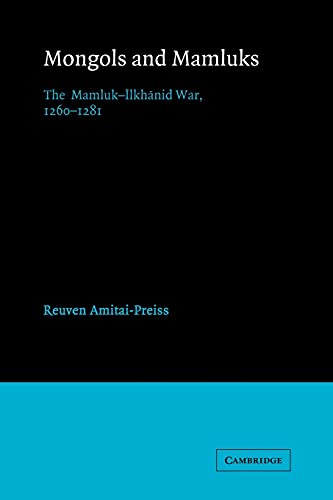
For sixty years, from 1260 to 1323, the Mamluk state in Egypt and Syria was at war with the Ilkhanid Mongols based in Persia. This is the first comprehensive study of the political and military aspects of the early years of the war, from the battle of ‘Ayn Jalut in 1260 to the battle of Homs in 1281. In between these campaigns, the Mamluk-Ilkhanid struggle was continued in the manner of a ‘cold war’ with both sides involved in border skirmishes, diplomatic manoeuvres, and espionage. Here, as in the major battles, the Mamluks usually maintained the upper hand, establishing themselves as the foremost Muslim power at the time. By drawing on previously untapped Persian and Arabic sources, the author sheds new light on the confrontation, examining the war within the context of Mongol/Mamluk relations with the Byzantine Empire, the Latin West and the Crusading states.
User’s Reviews
Editorial Reviews: Review ‘… a book that is as important as it is learned, and that offers us a thorough and illuminating study of a turning-point in the history of the Middle East and the Mediterranean world’. David J. Wasserstein, Mediterranean History Review’Mongols and Mamluks is a welcome addition to the body of knowledge on the transition between the ‘Abbasid and post-‘Abbasid periods of Islamic History.’ Dr Muhammad A. Jabbar Beg, Impact International Book Description From the battle of ‘Ayn Jalut in 1260 to the battle of Homs in 1281.
Reviews from Amazon users which were colected at the time this book was published on the website:
⭐Interesting book but if you are not in academia you might be overwhelmed by it. I found it interesting to learn about this short history of Egypt and its transition to the Mamluk rule, which lasted about 300 years until it became part of the Ottoman empire. The author has used what appears to be the true Islamic spelling for names and places, which is good but very challenging for our American tongues. The book is less than 200 pages which felt about right.
⭐Well researched. This covers a topic which is only barely visible to history but had epoch changing ramifications. It would surely make an epic , middle ages, warrior movie based on fact.
⭐This is an exceptional piece of academic research. It is not for the casual reader, it is not a super difficult read and it is not an easy read either.
⭐What a history–brilliantly researched
⭐Recommended for people who are interested in the subject but also for those in Golden Horde history. Very detailed and first sourses oriented. Good job.
⭐This book is really a dissertation at a doctoral level and this is reflected in the dry manner in which it is written. The narrative style is weak – necessarily so, perhaps, given the nature of the work – and is hampered repeatedly by copious references. It is therefore not a work that will appeal to the ‘educated layman’ such as myself. However, the book deals with a most fascinating subject: how an imperial power – the Mongols, in this case, specifically the Il-Khanids – who, up till they came up agains the Mamluks, had not been defeated by any non-mongol force – how such an overwhelming power was in effect routed by another more recent power that seemed to emerge from nowhere – the Mamluks of Egypt and Syria. The story in itself is so gripping that it colours this dry academic work, infuses it with spirit and makes it compelling. And I could not desist from making comparisons between this historical situation – where an imperial power is eventually forced to admit that it is no longer invincible and can never be universal – and the current situation involving another arrogant imperial power, the United States, which was routed twice, first by the Iraqis and now by the Afghans (the writer, of course, makes no such comparisons). The writer attempts, in the last fascinating chapter of the book, to explain why it was that the Mongols were ‘defeated’ by the Mamluks and in this there is much food for thought, particularly in relation to the difference between the morale of the Mamluks as opposed to that of the Mongols. A difficult read but compulsory in my view as there few other sources – at least in the form of accessible books – that deal with these momentous events.
⭐Importante livro para entender uma página relevante do capítulo da história do islã.
⭐
Keywords
Free Download Mongols and Mamluks: The Mamluk-Ilkhanid War, 1260–1281 (Cambridge Studies in Islamic Civilization) in PDF format
Mongols and Mamluks: The Mamluk-Ilkhanid War, 1260–1281 (Cambridge Studies in Islamic Civilization) PDF Free Download
Download Mongols and Mamluks: The Mamluk-Ilkhanid War, 1260–1281 (Cambridge Studies in Islamic Civilization) 2005 PDF Free
Mongols and Mamluks: The Mamluk-Ilkhanid War, 1260–1281 (Cambridge Studies in Islamic Civilization) 2005 PDF Free Download
Download Mongols and Mamluks: The Mamluk-Ilkhanid War, 1260–1281 (Cambridge Studies in Islamic Civilization) PDF
Free Download Ebook Mongols and Mamluks: The Mamluk-Ilkhanid War, 1260–1281 (Cambridge Studies in Islamic Civilization)