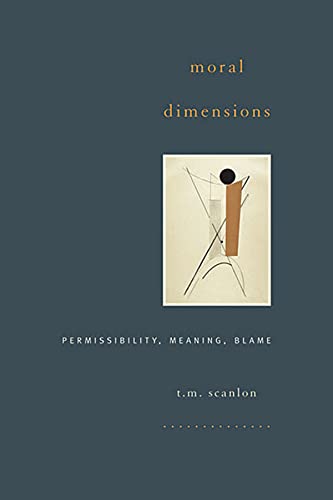
Ebook Info
- Published: 2010
- Number of pages: 264 pages
- Format: PDF
- File Size: 0.62 MB
- Authors: T. M. Scanlon
Description
In a clear and elegant style, T. M. Scanlon reframes current philosophical debates as he explores the moral permissibility of an action. Permissibility may seem to depend on the agent’s reasons for performing an action. For example, there seems to be an important moral difference between tactical bombing and a campaign by terrorists―even if the same number of non-combatants are killed―and this difference may seem to lie in the agents’ respective aims. However, Scanlon argues that the apparent dependence of permissibility on the agent’s reasons in such cases is merely a failure to distinguish between two kinds of moral assessment: assessment of the permissibility of an action and assessment of the way an agent decided what to do. Distinguishing between these two forms of assessment leads Scanlon to an important distinction between the permissibility of an action and its meaning: the significance for others of the agent’s willingness to act in this way. An action’s meaning depends on the agent’s reasons for performing it in a way that its permissibility does not. Blame, he argues, is a response to the meaning of an action rather than its permissibility. This analysis leads to a novel account of the conditions of moral responsibility and to important conclusions about the ethics of blame.
User’s Reviews
Editorial Reviews: Review “Scanlon offers a detailed account of a new analysis of key distinctions in theoretical ethics. These distinctions have very real consequences in a wide variety of practical issues, including debates regarding justified acts of war, the effort to justify terror or campaigns against terror, and seemingly intractable debates in biomedical ethics. Scanlon examines the permissibility of actions and the evaluations of actors, with a new account of both the initial–and as he sees it, illusory–attraction of the “doctrine of double effect.” He argues that the illusion stems from confusion between two types of moral judgment, which apply principles in what Scanlon terms either “critical” or “deliberative” uses. Scanlon uses this difference to make an important new distinction between the permissibility of actions and their meaning, and to develop accounts of blame (linked to the meaning of an action) and moral responsibility that bear close attention.”―J. H. Barker, Choice“The first half of the book, on permissibility and meaning, amounts to masterful and insightful philosophical housekeeping. The second half is revolutionary in the ways it tells us to think about blame.”―Allan Gibbard, London Review of Books“Moral Dimensions is a penetrating study that forces–and enables–us to see the moral landscape in a fresh and nuanced way…Moral Dimensions culminates in a masterly exploration of blame, understood as a distinctive response to meaning.”―Gary Watson, Times Literary Supplement About the Author T. M. Scanlon is Alford Professor of Natural Religion, Moral Philosophy, and Civil Polity, Emeritus, at Harvard University.
Reviews from Amazon users which were colected at the time this book was published on the website:
⭐Understandable logic and discourse on challenging philosophical topics. The chapters on “means and ends” and “blame” are well written.
⭐I’d like to start this review by considering some comments which others have made in regard to this book. Some either find (1) the first two or three chapters to be unclear, but find the chapter on blame to be extremely illuminating and redeeming, or (2) find the chapter on blame somewhat superficial and the treatment of the Doctrine of the Double Effect in the first section to be well examined.I think there is a clear reason for both of these attitudes, which will be brought out throughout this review. First, I’ll examine (1). The criticism here seems to be mainly about the writing and exposition of the topics. I agree, when I first started to read Moral Dimensions I found myself frequently lost and rereading bits. Part of this can be a result of Scanlon’s writing, but I’m not sure that this is really where the difficulty lies. The real issue is just how difficult it is to talk about the Doctrine of the Double Effect (DDE). Scanlon’s criticism is clear and concise, the issue is when he rejects DDE, he still accepts the intuitions of the cases which DDE is supposed to explain. As a result, his solution is much more muddled and less parsimonious.Scanlon does not see how an agents intentions can have any influence on the permissibility of an action. DDE claims that intentions do influence permissibility. I agree with Scanlon on this point, it is extremely puzzling for an agent’s reasons for acting can have any effect on whether the action is impermissible. But to make sense of the permissibility of problem cases without appealing to an agent’s reasons for acting is difficult. Scanlon achieves this end by making a distinction between two means of employing principles; critical and deliberative. The critical employment of a principle is what reasons an agent is moved by. The deliberative employment of a principle is when the agent deliberates on what the permissibility of an action itself is in relation to some relevant principle.Take for example Terror Bombing (bombing a target during war in order to kill 100 innocent civilians to lower the moral of the enemy and end the war) vs. Tactical Bombing (bombing a military target in a war which will effectively end the war with the foreseen consequence of the death of 100 innocent civilians):In war, terror bombing fails this deliberative element where tactical bombing does not. Though terror bombing is impermissible and the impermissible act is intentional towards the killing in a way that tactical bombing is not, it is not impermissible as a result of its being intentional. It is impermissible because the act is wrong under deliberative employment of the principle in question. The predictive element of intention comes out in any real world scenario, and this is partly what motivates the belief in DDE.Real world cases generally have different effects, and those involving the intentional harm of individuals would typically involve more harm than in other cases. So with Terror Bombing vs. Tactical Bombing, there will be a difference in the amount of casualties from a pilot bombing in order to take down a building while trying to kill as few civilians as possible and a pilot with the same mission relishing in the deaths of those he killed. The latter will likely lead to more deaths than the former.But the impermissibility still comes from the violation of some principle under deliberative employment. Though the intention does have an influence on the effect, it is still not this intention which makes the act wrong.To sum: an act is permissible or not, independent of the agents intention.Now, the critical employment of a principle by an agent does have some significance as well. This is another motivation for DDE. The Critical employment of principles has implications for the meaning of an action and its meaning to the relationship that agent shares with those affected. So if Scanlon is correct in assuming that an agent has no choice as to their ultimate reasons for an action, then cases where one does the right thing for the wrong reasons are permissible, but the individual is still open to moral criticism on the grounds of the agents critical employment and the meaning of that action and what it says about the relationship that persons holds with those affected.From here, Scanlon examines the ideas of Means and Ends and draws a similarity between his understanding of the meaning of an action and Kant’s conception of moral worth.This is a rough outline of the first half of the book, and it is easy to see why it may be so confusing to those reading it. This account fails to generalize all cases of moral permissibility and instead supports the idea that there are particular principles in particular circumstances which allow for exceptions in the permissibility of certain actions. The discussion is, at times, labyrinthine. But, it is well worth working through. When one does properly analyze this part of the discussion, the chapter on blame follows so perfectly from its premises, that one can easily discover Scanlon’s conception as soon as one understands his thoughts on meaning.This is what explains those complaints in (2). Once you have properly understood Scanlon’s notion of meaning, you understand his views on blame. To the careful reader, what results may seem superficial. But I must emphasize that this in no way means that it is. This can be seen by those who express how profound they found this chapter. It should be no surprise that those who found this exposition on blame so enlightening were also those who found themselves trudging through the conceptual chaos of the first three chapters.Here is the basic account of blame presented within the work:Someone is blameworthy iff some action shows something about the agents attitudes towards others which impairs the relationships others can have with that person.Someone is blamed iff they are judged blameworthy and you take your relationship with that person to be modified in a way that this judgment of impaired relation holds to be appropriate.His notion is partly evaluative (though stronger), while also not being a kind of sanction.Scanlon then sets up what he sees as the Moral Relationship. He also uses this notion to wonderfully explain some puzzling intuitions which are central to the problems of moral luck. He analyzes the Ethics of blame, that is, when one has a standing to blame, when one does not, and why. He goes on to assess his notion of blame and the type of freedom that it requires. He states two notions of freedom and how they relate to his notion, those of the requirement of psychological accuracy, and the requirement of adequate opportunity to avoid. He shows that the only one which has any significance is the former, while the latter does not. The requirement of psychological accuracy is just that one’s actions are a result of responding to reasons by one’s dispositions and character without external coercion or significantly mistaken beliefs. The requirement of adequate opportunity to avoid is the requirement that one not only act out of their dispositions, but that they had an adequate opportunity to choose the type of person they would be. This is the type of freedom which, if met, could justify punishment or reward. Scanlon does not believe we necessarily have this, and thus there is no true justification for serious punishment. But as long as the requirement of psychological accuracy is met, one can find someone blameworthy and blame them by modifying their relationship with that person.This idea can help explain why it is right to blame someone in cases like this:Someone is in a serious and committed relationship, but falls in love with someone else. This person has no control over this emotion and could not avoid feeling it. They know that they should not feel this way, and try to convince themselves that they do not. This person is still blameworthy despite their lack of control and their recognition of the wrongness of the emotion. They may never act on it, and do whatever they can to avoid the person they have fallen in love with, but they can still be blamed by the person that they are with. The fact that they love another person impairs the foundation of the relationship they have with the one they are with.And turning to an example of a case which involves the impairment of the Moral Relationship:There is some heartless killer who was also abused as a child. Though he may be blamed and blameworthy, his also being a victim makes it appropriate to have certain attitudes (perhaps sympathy or willingness to help) toward him. It also would be inappropriate to berate him for his faults which he cannot help. It would be wrong to deny this person the basic moral rights all rational beings have in the moral relationship as well, since he would have lacked an adequate opportunity to avoid being the type of person he is. Despite this, it is still necessary to find him blameworthy and to blame him for impairing the Moral Relationship he has with all rational beings. One could not enter into certain relationships with such a person, and there may be a need to prevent him from being able to enter into certain relations with others for their safety.I found this work to be an enormous step forward in the ethics of blame, it also solves a lot of difficulties in the problems of Moral Luck as well as the free will/moral responsibility debate. Overall, I find myself agreeing with most of Scanlon’s conclusions, but there is certainly much more work to do on the topic (such as the notion of self-blame, which may be a serious problem, though it helps to explain why so many people who blame themselves for some terrible act commit suicide). My advise is to not be deterred by those reviewers in either camp (1) or (2). The work is best taken as a whole, the first half to adequately dissolve DDE and set up the discussion for the second half, and the second half which flows seamlessly from the premises of the first half.
⭐this kindle book comes without page numbers which makes it pointless for academic purposes as it cannot be referenced. My advice stay away.
⭐Perfect
Keywords
Free Download Moral Dimensions: Permissibility, Meaning, Blame in PDF format
Moral Dimensions: Permissibility, Meaning, Blame PDF Free Download
Download Moral Dimensions: Permissibility, Meaning, Blame 2010 PDF Free
Moral Dimensions: Permissibility, Meaning, Blame 2010 PDF Free Download
Download Moral Dimensions: Permissibility, Meaning, Blame PDF
Free Download Ebook Moral Dimensions: Permissibility, Meaning, Blame