Ebook Info
- Published: 2009
- Number of pages: 193 pages
- Format: PDF
- File Size: 0.00 MB
- Authors: Walter Sinnott-Armstrong
Description
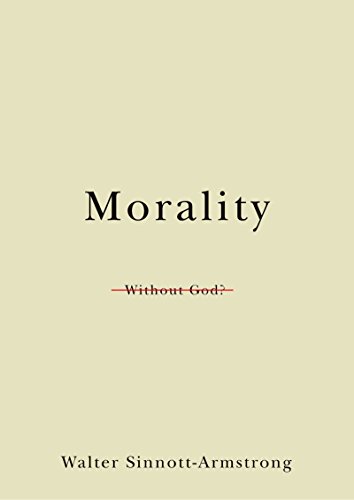
Some argue that atheism must be false, since without God, no values are possible, and thus “everything is permitted.” Walter Sinnott-Armstrong argues that God is not only not essential to morality, but that our moral behavior should be utterly independent of religion. He attacks several core ideas: that atheists are inherently immoral people; that any society will sink into chaos if it is becomes too secular; that without religion, we have no reason to be moral; that absolute moral standards require the existence of God; and that without religion, we simply couldn’t know what is wrong and what is right.Sinnott-Armstrong brings to bear convincing examples and data, as well as a lucid, elegant, and easy to understand writing style. This book should fit well with the debates raging over issues like evolution and intelligent design, atheism, and religion and public life as an example of a pithy, tightly-constructed argument on an issue of great social importance.”In his call for sincere dialogue with theists, Sinnott-Armstrong provides a welcome relief from the apoplectic excesses of Richard Dawkins and Christopher Hitchens, while also addressing objections to homosexuality and evolution frequently raised by evangelical Christians.” –Publishers Weekly “[I]t is accessible and lively, my hope is that it will be widely read, especially by theists.”–Peter Lamal, The Humanist “… the clarity of this text successfully defuses many erroneous claims about religion and morality, both popular and academic; this volume certainly deserves a wide audience in this increasingly secular and skeptical world.” -Choice”Morality Without God? is an engaging, pithy book arguing against the necessity of God and religion for a robust morality. Walter Sinnott-Armstrong has distinguished himself as a leading philosopher in his work on metaethics and moral psychology, as well as books on moral and epistemological skepticism, and in Morality Without God? he commendably succeeds in writing a philosophically respectable introduction to the problems facing religious morality suitable for virtually any audience.” –Philosophia Christi
User’s Reviews
Reviews from Amazon users which were colected at the time this book was published on the website:
⭐Walter Sinnot-Armstrong argues in this book that the basis of morality can be found without god, as the subtitle states. In addition to this he argues for why morality based on god, in particular the Christian god, can not form a basis for morality. His basis for morality without god involves the concept of harm. Those who harm another, or fails to prevent a harm when possible, commits a moral wrong.After he sets the stage, he presents that there is no factual evidence that atheists or secular societies are any less moral than Christians or Christian societies. From there he goes on to give a version of objective morality based on the concept of harm as stated above. After making his case for a workable morality without god, he confronts god based morality, and shows the problems with it and how it is not a workable solution. He ends up discussing what more needs to be investigated in coming to a better secular morality.Here are some comments I made at particular points in reading the book. Numbers in brackets [] are pagination in the Kindle edition.[21] After Sinnot-Armstrong mentions the story of the fall in the Garden of Eden, I thought there is a form of human evolution here. Human beings evolved the capability to obtain moral knowledge. When humans evolved from some form of ape to humans moral knowledge became possible in the reality of real life, not the made up biblical kind.[52] “Theists use this popular slogan [‘If God is dead, everything is permitted’] to assert that nothing can be objectively morally wrong if God does not exist. The question, in short, is whether atheism entails nihilism, which is the denial of all real moral values, duties, and obligations.” Even supposing moral subjectivity, atheism does not necessarily entail nihilism.[56-7] “Everyone I know—whether theist or atheist or agnostic—agrees that rape is morally wrong.” The theist is questionable on this if he or she really accepts the Bible as the word of god. The Old Testament does not condemn rape, at least not in all cases, and the New Testament is silent on it. So, the Christian can believe that rape is not morally wrong, at least in some cases. And, marital rape occurs in some Christian marriages. The fact that most theists believe rape is morally wrong is because they feel it is, not that they are command not to.[59-60] “Almost everyone agrees that death, pain, and disability are bad.” But, the reason for this does not have to be an objective standard. People when they think that these things are bad, usually have feelings associated with this thinking. Matter of fact this kind of thinking without feeling may not lead to moral behavior, and it maybe that the feelings actually lead to the thought. A reason for people to believe these things are bad is that they, in most cases, would not want them occurring to themselves or are in psychological pain when they observe these situations. So, it is possible that morality does not depend, or at least initially, on an objective standard. I think that it is moral feelings that lead to objectivity in morality.[62] “Certainly each item [in a list of harms] needs to be specified more precisely.” This and other statements he makes leads me to an admire his sense of grayness.[85] “Call that harm-based core of morality ‘shared morality,’ because it is shared with theists, who agree that rape, murder, theft, child abuse and neglect, and so on are morally wrong.” However, some Christian parents abuse their children when administering punishment because they believe the Bible sanctions severe punishment. So, if moral feelings are the basis of morality, how is it that some people do not see some acts that most people consider to be harmful to be immoral? It is because feelings can be overridden by thoughts, especially thoughts that are repeatedly reinforced by others and supposedly sacred texts.[131] Speaking of group discussion as an aid to making moral decisions, he writes: “An example should help to bring these abstractions down to earth. This case illustrates a real problem that hospital ethic committees have faced many times and that has been controversial in the past.” Never mind the specifics of his example, the point I wish to make is that few of us have the benefit of a committee discussion when faced with a moral decision, and certainly not when the decision is urgent. So, while hospital ethics committees are useful in their domain, as a general approach to finding out the differing amount of harm among moral choices is not much use.[150] Coming to a firm conclusion to his exploration of morality he states: “But at least they [those who are willing to give up divine command morality and fear of atheism] would base their positions on the real foundation of morality, which is avoiding harm and preventing harm.” (My italics) I would agree that this is a better standard than a god based morality.Sinnot-Armstrong’s whole concept of moral harm seems like a negative form of classic utilitarianism—the greatest happiness principle. And, while his concept of moral harm as an objective form of morality is on sound footing, it does not negate that it is moral feelings that lead one to see that harming or not preventing harm to others is not the way of moral action.I think Sinnot-Armstrong firmly and effectively argues against the divine command theory of morality, despite not focusing on this in my comments. I really like the way he approaches the subject. He is respectful of others and refrains from obnoxious attacks like some atheists and theists are prone to do. And, while his conclusions are firm he does not present his exploration as leading to an absolute claim of correctness of his moral theory. I also felt he wrote very well and avoided technical jargon, so that it would be attractive to non-specialists.I rated this book highly and would recommend it to anyone who is serious about how we can come to moral conclusions that would be acceptable to most people willing to reflect honestly. If you are a Christian he does not attack your beliefs per se, but divine command morality that is often associated with Christianity. Plus he spells out, at least as a beginning, an acceptable moral theory without god.
⭐I think it is a great introduction on the basics of secular morality, for anyone that thinks morality and ethics is something that can only come from religion. I think it is a very accessible book. I dont think you need a college education, much less a philosophy degree, to understand it.
⭐First, let me say that I am a practicing Catholic, very committed to my faith. However, this book is very well written, fair, balanced, and honest. Never does Professor Sinnott-Armstrong use ad hominum attacks, make wild assertions, or neglect to show care and concern for theists. I felt nothing but love for his fellow theists while reading this book. This does not, however, mean that Professor Sinnott-Armstrong compromises his position.Of course, there are still arguments that the author makes which I disagree with, but I think Professor Sinnott-Armstrong is a much needed addition (or voice, I suppose) to the growing body of intelligent, kind, and rational atheists (including John Lofton and David Ramsey Steele among others) not driven by malice, unlike the new atheists (yes, I have an axe to grind with the new atheism).The goal of this book is basically to show that atheists can be and are moral. In fact, the last sentence of the preface states “[My main goal] is only to show that atheists need not be arbitrary, unreasonable, ignorant, inconsistent, irresponsible, disreputable, uncaring, or, especially, immoral.” I completely agree with Professor Sinnott-Armstrong’s thesis as he states it here. In fact, at the end of the first chapter, Professor Sinnott-Armstrong lists 5 main claims that he discusses in detail throughout the book. I agree with his beliefs about the truths of all 5 claims except the third one. I think the most accurate way to state my main disagreement with Professor Sinnott-Armstrong is to say that I believe that objective morality has no firm foundation without God. He does tries to show that the atheist does indeed have a firm foundation for morality apart from God in one of the chapters, which I will discuss a little bit below.I appreciate much of what Professor Sinnott-Armstrong has to say in Chapter 2. This Chapter deals with the question of whether or not atheists are bad people. Unfortunately, many Christians do paint the picture that Professor Sinnott-Armstrong discusses in this chapter of atheists; that is, that they are immoral, indecent, and most oddly claimed to be that they suppress what they really know to be true. So the fact that Professor Sinnott-Armstrong addresses this topic is not unreasonable. I would say that a more historical and correct understanding of the question is that we are all sinners in need of God’s grace and that any good that a theist or atheist does is a grace from God. I am not able to do good anymore than Professor Sinnott-Armstrong is able to do good; it all comes from the source of goodness, which is God. But that is really something more to argue with my fellow Christian brethren.Professor Sinnott-Armstrong is also reasonable enough to point out the venomous attacks of the “new atheists” (of which Professor Sinnott-Armstrong is NOT a member of) and how they do more harm than good. I very much appreciated that, and it showed me that he has nothing to hide and believes his position to be correct based on reason rather than intimidation.I also can not convey how much I appreciate the fact that Professor Sinnott-Armstrong is fair and balanced when it comes to the horrible sex abuse scandal in the Catholic Church. He mentions that the problem is not as widespread as many new atheists make it out to be and even mentions that it is not limited just to the Catholic Church. While smaller numbers and other people doing it certainly does not excuse it, it is a breath of fresh air to read someone who does not use it to clobber us over the head and make the lovely non sequiter that therefore religion is pure evil. He is also very careful not to confuse correlation with causation (this mathematician thanks you!).On the same page, Professor Sinnott-Armstrong discusses the possible biblical support that is given for wives being submissive to their husbands (Ephesians 5:25 ish). He then asks to what extent this means that they be submissive and asks whether things like abuse and marital rape qualify. However, I would consult Pope Pius XI’s 1930 encyclical Casti Connubii for a more proper understanding of what is actually a very beautiful teaching in the entire context of Ephesians 5. Again though, this is not something that even my non-Catholic Christian brethren are aware of and hence, I think that this “to what extent” question does need to be addressed because so many non-Catholic Christians don’t understand it properly.The chapter that I was most interested in reading (because I came into this book disagreeing with the premise) was how an atheist can ground objective moral values. The argument was built around a theory of harm; that is, what does harm to someone can be considered immoral. The author is careful to define harm and give many examples and predict possible objections. It was one of the longer chapters in the book, but the author made it clear that it was intended to be a brief overview of a possible theory of morality that an atheist could hold to and ground objectively. I don’t think I quite buy the argument, but I will have to look at it more carefully and think about it a bit more. It was definitely an interesting theory, but it seems to me to be too reminiscent in some cases of situation ethics, where depending on the wants of a person, certain acts that may otherwise be immoral become not immoral. Sometimes it fell on the utilitarian side of things. Again, I need to think about it a lot more, but it’s a good, well-thought out theory.There was one thing in the chapter outlining the harm theory of ethics that shocked me. Now, Professor Sinnott-Armstrong said this somewhat in passing, so to be fair, I may have misunderstood. But what shocked me was not that Professor Sinnott-Armstrong admitted to supporting experimentation on human embryos, but that he claimed that there was NO non-religious argument for doing so! That claim blew me away. I don’t know if Professor Sinnott-Armstrong is farmiliar with Embryo: A Defense of Human Life by Robert P. George and Christopher Tollefsen ( http://www.amazon.com/Embryo-Defense-Robert-P-George/dp/0385522827/ref=sr_1_1?ie=UTF8&s=books&qid=1246974956&sr=1-1 ), but this book goes out if its way in the preface to let the reader know that no religious arguments will be given to defend their premise that the embryo is a human person with dignity and moral worth (and thus can not be used in scientific experimentation). While Professor Sinnott-Armstrong may disagree with the arguments of the book, he would actually have to argue that the book DOES rely solely on religious arguments. There are many others who argue against h-ESCR without punting to religion including Wesley J. Smith, Leon Kauss, and William May. Again, perhaps I misunderstood, but this seemed to be a very unusual thing to say.Professor Sinnott-Armstrong gives critiques of the so-called divine command theory espoused by many Evangelicals. One thing I noticed when he was critiquing the position is that he interchange of the phrases “moral duties” and “moral values.” Several times these phrases were substituted for each other. The author discusses how what makes something morally good in the Christian worldview (according to divine command theory) is that God commands it i.e. it is a moral duty, and because of the non-differentiation I mentioned above, it is also a moral value. Now, I am not well read on many evangelical divine command theories so I am sure that Professor Sinnott-Armstrong is representing well those Evangelicals whom he has read, but the version of divine command I have in mind very much distinguishes between moral values and duties in the following sense; we define, or we say what is objectively good by that which is in accordance with God’s unchanging nature. Goodness springs from God’s nature. At this point, that says nothing about what our duties are, only the ontological question of where objective moral values are grounded. Then God’s commands to us reflect that moral nature which he has. Since God can not act (and hence command) things contrary to his nature, what he commands is good. So I think this is a different take on the divine command theory (and I think a better one) than the one the author discusses. He does give a view similar to this about a paragraph in the chapter when discussing Euthyphro’s dilemma, but I think there is more to it than that. However, there are many thought provoking and insightful comments the author makes in this chapter. This Chapter, too, has definitely got me thinking harder and deeper about why I believe what I believe and how I might answer some of the objections.The chapter on why anyone be good gave good and convincing reasons to be moral. This was in contrast to some of the Fundamentalist doctrines about you should be good because you go to heaven, and badness is punished by hell. Ultimately, the author shows that this view of being good is really lacking in any sort of substance. I would argue that there are deeper theological understandings to answer that question from a Christian perspective, but this sort of pop shallow theology that we sometimes hear does need to be addressed. One thing I would have liked to have seen the author address in this chapter is whether or not he believes we actually have a moral duty or obligation to be good and if so, where that comes from. He gave reasons that one would WANT to be good, but is there a moral duty? I would especially be interested in hearing what he would have to say in response to Sartre’s “existence precedes essence” argument which implies that we have no human nature and hence, no moral duties. Again, I think it’s important to differentiate between moral duties and moral values.All in all, this book is very easy to read and argued well. The train of thought is clear and easy to follow. The book is an attempt to dialogue with Christians, which is something I’ve never seen so well done and in such a gracious manner by an atheist. The author goes out of his way to point out the good in religions, how atheists and agnostics should embrace many aspects of religion that are good, and even get some good out of the bible. This is definitely a man who is serious about dialogue and serious about painting the other side with the correct brush.One final thing I would like to point out is the common misconception about blasphemy against the Holy Spirit. This was mentioned a couple times in the book. St. Augustine understood (I would argue correctly) blasphemy against the Holy Spirit as the sin of final impenitence. In other words, the only unforgivable sin is the one that you refuse to ask forgiveness for. Because Professor Sinnott-Armstrong was once a believing Evangelical, he believes that even if Christianity was true and if he were to repent, he (as well as many others in a similar situation) would be damned. This is based on the blasphemy against the Holy Spirit passage as well as a passage in Hebrews which the author points out. I would just like to say that whatever these passages do mean, they do NOT mean that anyone is guaranteed hell without any chance of repentance on this earth. No matter WHAT you do, if you repent while alive, you can still be saved. This is the constant and historical teaching of the Catholic Church. So if there is anything that I may be so bold as to correct the good Professor about in the book, it is that he is NOT damned to hell no matter what he does for the rest of his life. God ALWAYS forgives. As long as one is still breathing, they are not necessarily damned. There is ALWAYS ALWAYS ALWAYS the possibility of repentance in this life, and ultimately salvation in the next.
⭐Prof. Walter Sinnott-Armstrong makes many outstanding arguments for a non-religious type of morality. This is one of the basic arguments that theist pose to Atheist, Agnostics, and non-believers;”Without god what will give humanity there moral foundation?” Sinnott-Armstrong addresses this major question in a book that is easy to read and covers a lot of ground about this question. Not has dense has Richard Dawkins, or Christopher Hitchens books;Sinnot-Armstrong takes a less hostile approach towards those with beliefs. He is critical of people on both sides of the god vs. no-god debate, he poses that both sides consider eachother ignorant thus there can never be any true debate. Although, I strongly agree with the position Richard Dawkins take about people being in free and contemporary societies not giving religion a “special” pass from being challenged or analyzed critical. Prof. Sinnot-Armstrong makes it a point to be critical of religion without going to the low blows and sensationalism of Hitchens, or Dawkins when countering religions beliefs. Any person whether they are a devout Christian, passive observer, or stance Atheist will be enlighten by the ideas of a rational based theory of morality. Anybody who has pondered the question of where do our morals come from,or has been challenged by theists about humans their having morals dictated to them from an omnipotent being will benefit from this book.
⭐I should confess at the outset that I am writing from a UK perspective, though I hope that this does not invalidate my argument. The distinction is important though, in that evangelical Christianity is a potent force in America, whereas here in the UK, we live in a largely secular country, despite the establishment of the Church of England. No secular office is likely to be barred from a professed atheist. In America it would be difficult for a declared atheist to become president, or indeed aspire to many high offices.What Professor Sinnott-Armstrong seems to want is a peaceful co-existence between atheism and religion. At the same time he sees a clear distinction between the two. The hope is that atheists will see the virtues in religion as Christians will recognise that atheists do not in general hold to a belief where all is permitted once there is denial of the existence of a personal God. (Please note that I use capital letters for “Christian etc out of deference to tradition – I know that this is inconsistent with my point of view.Most of the author’s points are familiar to all of us. The big question is – what is morality? In general terms we know what we are talking about when issues of morality arise. We also understand the difference between morality and the law. If all moral principles were enshrined in legal dictates we would live in an oppressive state, as Professor Sinnott-Armstrong makes clear. At the centre of his argument is the issue of harm. Morality is essentially about avoiding needless harm to others. The problem, which WSA half acknowledges is that what constitutes harm to others is often the source of disagreement. Issues such as abortion, pornography, vivisection, euthanasia, pacifism and a host of others make it clear that we do not live according to the same moral compass, whether or not we are religious. WSA knows all this well enough, and no doubt he is right in suggesting that at a personal, individual level there is more common assent concerning how we treat our neighbour.In the UK, and to a lesser extent in America, but still a considerable one, harm merges into offence. It is often said that we are almost all encouraged to see ourselves as victims, and increasingly the state has intruded with laws and restrictions which dictate what may be said, who may be permitted to speak etc. This raises vital issues about freedom and morality.Apart from the fact that I find WSA’s small book long-winded, my main complaint is that he shoves aside the crucial issue of truth. Is there a god, or are there gods – and does it matter? It matters enormously. The harm done by, and in the name of, religion is difficult to overestimate. That, of course, does not mean that there are very many, decent, Christian people, who adhere to a common practice of kindness to others – as close as we are likely to come to what is the good. There is a huge difference between this and discovering “many good aspects of religion” in WSA’s words. For a philosopher, there seems to me to be a serious absence of critical analysis and logic. He mocks Dawkins and Hitchens, for example but they have argued at a much deeper level of enquiry, and to brush aside what they say, which is what happens here, albeit politely, is wholly unacceptable. The author tells us at the beginning not to expect too much. In truth all we have is re-heated points rather than any fresh insights. Sadly disappointing.
⭐Just one word: very good!!!
⭐Armstrong endeavours to prove why morality has nothing essential to do with religion. He claims that the statement “god is dead” has nothing to say about what is permitted or not. I must say i find that his tone though out the book fair and balanced. He is very clearly defending a non-religious centric morality but he does so with such respect and civility. He does not engage in bad mouthing religious believers.His argument is that morality is a real thing and its importance is undeniable. But we have reasons to be moral that are thoroughly secular. Armstrong goes about his task by answering a series of questions which in the end reveal why religion is not necessary for morality. the questions are: are all atheists morally bad? Do secular societies filled with Atheist become corrupt? Does objective morality make any sense without God? Do atheists have any reason to be moral? Can atheists know what is morally right or wrong without the guidance of God..I think it is a very fine and eyeopening argument he puts forward. Many of us can learn how to discuss tendentious questions by studying this masterful exposition.
Keywords
Free Download Morality Without God? (Philosophy in Action) 1st Edition in PDF format
Morality Without God? (Philosophy in Action) 1st Edition PDF Free Download
Download Morality Without God? (Philosophy in Action) 1st Edition 2009 PDF Free
Morality Without God? (Philosophy in Action) 1st Edition 2009 PDF Free Download
Download Morality Without God? (Philosophy in Action) 1st Edition PDF
Free Download Ebook Morality Without God? (Philosophy in Action) 1st Edition