

Ebook Info
- Published: 2006
- Number of pages: 645 pages
- Format: PDF
- File Size: 9.81 MB
- Authors: Dave Benson
Description
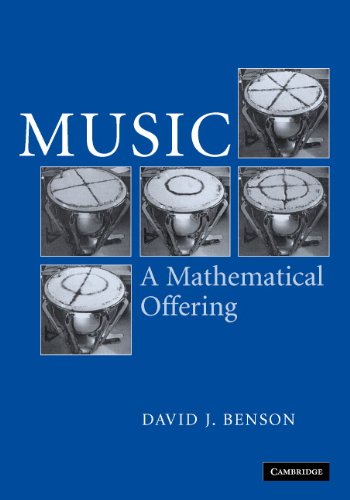
Since the time of the Ancient Greeks, much has been written about the relation between mathematics and music: from harmony and number theory, to musical patterns and group theory. Benson provides a wealth of information here to enable the teacher, the student, or the interested amateur to understand, at varying levels of technicality, the real interplay between these two ancient disciplines. The story is long as well as broad and involves physics, biology, psycho acoustics, the history of science, and digital technology as well as, of course, mathematics and music. Starting with the structure of the human ear and its relationship with Fourier analysis, the story proceeds via the mathematics of musical instruments to the ideas of consonance and dissonance, and then to scales and temperaments. This is a must-have book if you want to know about the music of the spheres or digital music and many things in between.
User’s Reviews
Reviews from Amazon users which were colected at the time this book was published on the website:
⭐This is perhaps the most definitive book on the mathematics of music I have ever read. Benson writes the book from the perspective of both a musician and music theorist and knowledgeable mathematician. Benson also sprinkles throughout the book a wonderful literature review of research done in the field of music, music perception, and applied mathematics. My hat is off to the brilliant scholarship of Dave Benson. He takes difficult topic and makes it quite accessible. It is not for the number phobic, you do need some mathematical understanding, but beyond that this is a brilliant book from an obvious brilliant scholar. I highly recommend it honestly for fun reading and as source for research projects it can’t be topped.
⭐:D
⭐This book is the result of material that the author compiled while teaching an undergraduate course on the subject of sound and music and their relationship with mathematics. The mathematical level of different parts of the book varies tremendously from algebra to partial differential equations. Chapter 1 begins with the fundamental question “What is special about sine waves that we consider them to be the pure sound of a given frequency?” Chapter 2 deals with the mathematical subject that answers the question “To what extent can sound be broken into sine waves?”. The answer is, of course, Fourier analysis. The mathematics of Bessel functions is also developed in Chapter 2. Chapter 3 goes on to describe the mathematics associated with musical instruments, which are divided into five categories depending upon the mathematical description of the sound they produce . This is done in terms of the Fourier theory developed in chapter 2, but it is really only necessary to have a vague understanding of Fourier theory for this purpose.Chapter 4 is where the theory of consonance and dissonance is discussed along with the simple integer ratios of frequencies. Consonance and dissonance are musical terms describing whether combinations of notes sound good together or not. This is a preparation for the discussion of scales and temperaments in Chapters 5 and 6. The emphasis in these two chapters is on the relationship between rational numbers and musical intervals. The fundamental question here is “Why does the modern western scale consist of 12 equally spaced notes to an octave?” Has it always been this way? Are there other possibilities? After the discussion of scales, the book breaks off of its main thread to consider a couple of other subjects where mathematics is involved in music, the first being computers and digital music. Chapter 7 discusses how to represent sound and music as a sequence of zeroes and ones, and again Fourier theory is used to understand the result. Also described is the closely related Z-transform for representing digital sounds, and this is then used to discuss signal processing, both as a method of manipulating sounds and producing them. This leads to a discussion of digital synthesizers in Chapter 8, where we are again confronted with the questionof what it is that makes musical instruments sound the way that they do. The discussion is based around FM synthesis. Although this is an old-fashioned method of sound synthesis, it is simple enough to understand many of the salient features before taking on more complex synthesis methods.Chapter 9 changes the subject completely and examines the role of symmetry in music. The area of mathematics concerned with symmetry is group theory, and the reader is introduced to some of the elementary ideas from group theory that can be applied to music. The book contains numerous exercises, and the answers to almost all of them are included in the book. It should be noted that the author assumes the reader can read music, as this subject is not approached with the exception of a few entries in the appendices. Thus this book is more of mathematics for musicians rather than vice versa. There is an online version of the book available if you want to browse it before deciding to buy. To me, this is one of the clearest books on the relationship of mathematics to music I have read. The text is accessible and clear, there is a good use of graphics, and the exercises emphasize the understanding of the mathematics presented. I highly recommend it.
⭐I bought this book because i was interested in working through it myself. After reading the first few pages, I find that it is available for free online.[…]I bought the kindle version so feel slightly ripped off! (minus 1/2 star) The kindle version also does not have the answers to the questions at the end of the chapters, so I had to download the free version anyway. (minus another 1/2 star)The content is good and well written, so hopefully some of the $40 I spent on the kindle version will find it’s way back to the author.
⭐This is an important book. Although very technical, and intended for musicians with a strong mathematical background, others can learn a great deal by neglecting the more technical parts. It is probably the most complete treatment of its various topics so far. It is interestingly and well written by a strong mathematician who has researched the musical aspects well.Despite all this, I do propose that there needs to be a more elementary treatment of much of this material for those who have not taken major coursework in college-level mathematics. Thus, Benson has left a niche for others, less gifted, to fill.
⭐Although this book is not comprehensive (it would have to be 5 times as thick), it does contain a really terrific overview of many of the places that math and music intersect. The writing is engaging and clear. There are ample references if you want to go into more depth in a particular area. There is also a valuable list of sound recordings in Appendix G that make a lot of the material come alive. All in all this is a must have book if you are interested in math or music or both.
⭐excellent book,especially on tuning and temperaments with ratios/cents.
⭐Very good book
⭐This book is really more suited for the person who is more interested in the maths than in the music, e.g., a sound engineer, not the concert pianist. It is very broad in scope, covers a lot of ground including historical aspects (though mainly restricted to western music). Familiarity with some advanced maths is assumed, broad in scope, sometimes brief on details, but good with references – which is one of its strong points.It’s not suitable for the musician who wants to know just enough simple maths behind the even-tempered scale and its peculiarities, or why perfect tuning of the piano is never possible, without going into Fourier series, Bessel functions, or algorithms for digital music.
Keywords
Free Download Music: A Mathematical Offering 1st Edition in PDF format
Music: A Mathematical Offering 1st Edition PDF Free Download
Download Music: A Mathematical Offering 1st Edition 2006 PDF Free
Music: A Mathematical Offering 1st Edition 2006 PDF Free Download
Download Music: A Mathematical Offering 1st Edition PDF
Free Download Ebook Music: A Mathematical Offering 1st Edition