

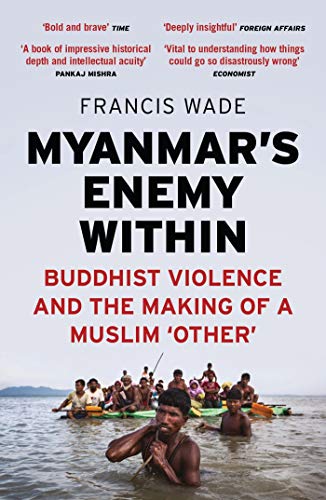
Ebook Info
- Published: 2017
- Number of pages: 304 pages
- Format: PDF
- File Size: 16.07 MB
- Authors: Francis Wade
Description
For decades Myanmar has been portrayed as a case of good citizen versus bad regime – men in jackboots maintaining a suffocating rule over a majority Buddhist population beholden to the ideals of non-violence and tolerance. But in recent years this narrative has been upended.In June 2012, violence between Buddhists and Muslims erupted in western Myanmar, pointing to a growing divide between religious communities that before had received little attention from the outside world. Attacks on Muslims soon spread across the country, leaving hundreds dead, entire neighbourhoods turned to rubble, and tens of thousands of Muslims confined to internment camps. This violence, breaking out amid the passage to democracy, was spurred on by monks, pro-democracy activists and even politicians.In this gripping and deeply reported account, Francis Wade explores how the manipulation of identities by an anxious ruling elite has laid the foundations for mass violence, and how, in Myanmar’s case, some of the most respected and articulate voices for democracy have turned on the Muslim population at a time when the majority of citizens are beginning to experience freedoms unseen for half a century.
User’s Reviews
Editorial Reviews: Review “A sober account of ethnic mistrust and communal violence in Myanmar.’” ―Australian Foreign Affairs“The strength of Myanmar’s enemy within lies in Wade’s attempt to understand and explain the complex ways in which discrimination has been perpetuated and entrenched, by looking at the human experience-on all sides-of this ongoing situation … excellent starting-points for those wanting to understand more about the situation of the Rohingya in Myanmar.’” ―International Affairs“A lucid and admirable attempt to come to terms with a deeply complicated country.” ―TLS“Lucid … exceptionally timely … vital to understanding how things could go so disastrously wrong. Wade predicted the miserable fate of Myanmar’s hated Muslim minority.” ―Economist“This is a deeply insightful work on the dynamics of ethnic violence.” ―Foreign Affairs“As Francis Wade’s excellent new book shows, this disaster was easily predictable and, with a bit of forethought, could have easily been prevented.” ―Literary Review“Dotted with anecdotal recollections, the book brilliantly captures how individual lives are shaped, reshaped and irrevocably damaged due to a real or acquired membership within a certain group … an important work informing debates in these troubled times.” ―Tea Circle“Bold and brave … Wade’s book tells the personal stories of Muslim and Buddhist characters who have animated the tragic scenes of Myanmar’s deadly morality play.” ―TIME Magazine“Francis Wade has invested immense energy in pursuit of the truth about the tragedy of Myanmar and its Muslim population. There is no other writer on this topic with the same moral courage and intellectual insight. His work demands serious attention.” ―Fergal Keane, BBC Correspondent and author of Road of Bones: The Epic Siege of Kohima“Essential for all who wish to understand the ethnic cleansing that today threatens Myanmar’s Rohingya population and, with it, Myanmar’s tenuous path to democracy. Historically deep, balanced, large-spirited, and adorned with vivid and enlightening vignettes.” ―James C. Scott, Yale University, author of The Art of Not Being Governed: An Anarchist History of Upland Southeast Asia.“Elegantly written, empirically rich, and analytically nuanced, the book combines in-depth, on-the-ground reportage with a solid command of the scholarship. An excellent book.” ―John T. Sidel, LSE, and author of Riots, Pogroms, Jihad: Religious Violence in Indonesia“[Wade’s] razor-sharp attention to narrative … succeeds, with remarkable nuance and precision, at bringing the country’s intricate history into the present.” ―Los Angeles Review of Books“A fine, engrossing work, at the centre of which is that all too common enmity and conflict between people of different religious and ethnic adherences.” ―Paul Brass, author of The Production of Hindu-Muslim Violence in Contemporary India“This gripping investigation into the plight of Myanmar’s Muslim community reads like a forensic case history, uncovering the full extent of a nation’s festering wound. Lucid, compassionate, admirably researched and reasoned, here is scholarly reportage at its best.” ―Wendy Law-Yone, author of Golden Parasol: A Daughter’s Memoir Of Burma“A book of impressive historical depth and intellectual acuity. Francis Wade shatters many clichés about religious violence as he explores its tangled roots in Buddhist Myanmar.” ―Pankaj Mishra, author of Age of Anger: A History of the Present About the Author Francis Wade is a freelance journalist and analyst specialising in Burma and Southeast Asia. His work has been published in The Guardian, Al Jazeera English, Asia Times Online, Foreign Policy, and the Los Angeles Review of Books. He previously worked as an editor and reporter for the Democratic Voice of Burma, an exiled Burmese news organization based in Thailand.Paul French has been based in Shanghai for many years as Chief China Representative of research and analysis consultancy Access Asia. He is a regular commentator of China and North East Asia on the international media. He is the author of a number of previous books including the well received North Korea The Paranoid Pensinsula for Zed Books.Sam Chambers has lived in China for a decade and his career as a travel and transport writer has taken him to the four corners of the country. He has co-authored a number of books including a travel guide to Yunnan and Hunan provinces as well as a transportation guide to the Yangtze. Writing for a variety of titles including the Sunday Times and the Royal Geographic Society Chambers follows very closely the day-to-day needs and demands of this rapidly evolving nation. After living in Hong Kong for many years he is now based in the northeastern city of Dalian.
Reviews from Amazon users which were colected at the time this book was published on the website:
⭐It gives an informative look inside Myanmar. Well written
⭐The message very connection with my live and life.
⭐What are those in Myanmar creating for themselves? What can we all learn from their thoughts, actions, and experiences? This is an enormously insightful book on the people in this country and the stories are instructive for people in every country in the world. Pay attention to Burma. Pay attention.
⭐The author’s profile doesn’t match with the real author. Amazon needs to correct it.
⭐Beautifully written and very comprehensive discussion of a tragic people.
⭐interesting
⭐Eye-opening and fascinating read of an issue that’s much more complex than its portrayal in the news. Anyone interested in the transition to democracy or Southeast Asia should read this
⭐Packaging was good, book in perfect conditions. Content amazing and super recommendable!! If you want to read something to understand Myanmar, this is THE book
⭐This book is a must read for those who want to understand the power dynamics at play in Myanmar and the plight of the Rohingya Muslims .
⭐The tragedy currently facing the Myanmar Rohingya Muslim community as they flee into neighbouring Bangladesh amid fears of mass ethnic cleansing come as no surprise after reading Francis Wade’s terrifyingly prescient first book.Released just prior to the 2017 refugee crisis, it chronicles the way regional Muslims, specifically the Rohingya in Rakhine state, have been periodically persecuted, often being used as pawns for sinister political agendas on all sides, from the powerful Bamar and Rahinke elite to the ruling Junta, in a blood-soaked quest to ‘unify’ the country under the religious identity of Buddhism.Based on Wade’s many years of reporting from the country for press outlets like, The Guardian and Newsweek, it is an impeccably well researched and impressive piece of work that looks back at almost a thousand years of history, charting the region’s rich mix of people and ideas from 11th century, King Anawrahta through to, Aung San Suu Kyi’s independence party and its seminal election win. In between it examines how the British East India companies occupation of the area and its strategy to ‘divide, categorise, and conquer’, entrenched racial divides and set the scene for the atrocities that followed.Wade peppers the book with his own experiences of travelling a country he so clearly loves along with interviews from local witnesses and compelling stories from fellow journalists. You often feel like you’re getting to peek behind the curtain into a secretive country that few will ever fully understand. The stories act as excellent framing devices and essential colour, giving the book a fast-paced and personal tone that lacks in many similar nonfiction reads.It’s a brave piece of work that isn’t afraid to move away from the traditional good Vs evil narrative that Aung San Suu Kyi’s party was so keen to popularise against the military Junta. The book makes clear the many shades of grey present in the current ruling party, as it turns a blind eye to the rise of ultra-nationalism, the persecution of the Rohingya and the radicalisation of youth through conservative Buddhist organisations like the Ma-Ba Tha.At times, the book feels like your reading a report from 1945, detailing the grim discoveries of the German labour camps – it’s quite upsetting, but nevertheless, an essential read, it covers the implementation of ghettos, the removal of basic rights from the Rohingya and the previous mass exodus to Bangladesh in the 1990’s. The theme of history constantly repeating is sadly littered throughout.The wider implications afford an uncomfortably familiar parallel at how Muslims are being treated globally. It shows the power of what an unchecked press looks like when wielded by governmental forces and religious zealots and the book’s allusions to fake news and a country terrified by events like 9/11 and the destruction of the Buddhist statues in 2001 by the Taliban, make the persecution of the Rohingyas as much a symptom of global problems as well as regional.This book will be required reading for anyone looking to better understand the tensions in the region, but more than that, it’s an uncomfortable truth about how democracy is not a cure-all to a society’s ills, but often simply a mirror.
⭐To anyone who’d like to understand the Rohingya crisis in Myanmar, this is your book
Keywords
Free Download Myanmar’s Enemy Within: Buddhist Violence and the Making of a Muslim ‘Other’ (Asian Arguments) in PDF format
Myanmar’s Enemy Within: Buddhist Violence and the Making of a Muslim ‘Other’ (Asian Arguments) PDF Free Download
Download Myanmar’s Enemy Within: Buddhist Violence and the Making of a Muslim ‘Other’ (Asian Arguments) 2017 PDF Free
Myanmar’s Enemy Within: Buddhist Violence and the Making of a Muslim ‘Other’ (Asian Arguments) 2017 PDF Free Download
Download Myanmar’s Enemy Within: Buddhist Violence and the Making of a Muslim ‘Other’ (Asian Arguments) PDF
Free Download Ebook Myanmar’s Enemy Within: Buddhist Violence and the Making of a Muslim ‘Other’ (Asian Arguments)