

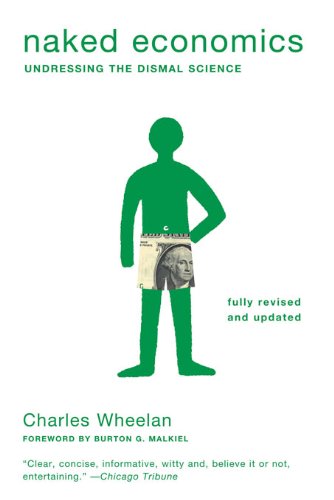
Ebook Info
- Published: 2010
- Number of pages: 385 pages
- Format: PDF
- File Size: 1.60 MB
- Authors: Charles J. Wheelan
Description
“Clear, concise, informative, witty and, believe it or not, entertaining.” —Chicago TribuneFinally! A book about economics that won’t put you to sleep. In fact, you won’t be able to put this bestseller down. In our challenging economic climate, this perennial favorite of students and general readers is more than a good read, it’s a necessary investment—with a blessedly sure rate of return. Demystifying buzzwords, laying bare the truths behind oft-quoted numbers, and answering the questions you were always too embarrassed to ask, the breezy Naked Economics gives readers the tools they need to engage with pleasure and confidence in the deeply relevant, not so dismal science.This revised and updated edition adds commentary on hot topics, including the current economic crisis, globalization, the economics of information, the intersection of economics and politics, and the history—and future—of the Federal Reserve.
User’s Reviews
Reviews from Amazon users which were colected at the time this book was published on the website:
⭐This book gives a simple way of understanding fundamental Monetary concepts. Some have mentioned a political bias but they fail to note that Wheeler is explaining basic concepts and how policy plays a role while noticing mistakes made by politicians by ignoring basic tenets of Economics and monetary common sense. Ultimately this books explains the fundamentals of money and it’s evolution from ancient times and trade.
⭐The commitment to meeting the promised deadline is amazing.
⭐This is an excellent introduction to economics and the broad range of issues informed by economics for the non-professional but interested reader. It is clear and accessible and punctuated by a breezy, witty style, and without a single equation or graph for those terrified of numerical relationships. The economics presented in this book is mainstream economics as befitting a journalist for The Economist and makes points that would satisfy those right-of-center and those left-of-center. For conservatives, the author reminds us (like Milton Friedman did in “Capitalism and Freedom”) that a heavily regimented economy would eventually come at a steep price in curtailed political / civil freedoms just to maintain the economic regimentation. In addition, the physical and human capital underlying productivity growth, and the economic self-interest that drives their application, are key components of economic well-being. On the other hand, liberals will appreciate his contention that government is a crucial catalyst for effective market functioning in that it provides (or can provide) a legal framework, a predictable regulatory regime, and a stable macroeconomic environment. Most of the national economic failures to which the author alludes are not the result of racial, ethnic, institutional, or cultural deficiencies but are simply a result of government incompetence and corruption (see Zimbabwe). And markets are not omniscient; we get the standard analysis for market prices not reflecting social costs / benefits (externalities) and the market’s failure to produce public goods.What I also liked about this volume was the way in which it extended economic analysis to many areas of social / human behavior, but then would go no further, i.e., the author recognizes that economic analysis informs much of our public policy debates but cannot settle value-laden issues. For example, in his chapter on “Productivity and Human Capital”, subtitled “Why is Bill Gates so much richer than you”, he acknowledges that economics can tell us about the production of income and the creation of wealth, but can’t really tell us how that income and wealth should be distributed. (Some prominent economists are on record as claiming that distribution issues are irrelevant.) This book maintains that these value-oriented issues are determined in the political process as shaped by our religious, moral, and cultural backgrounds.I enjoyed this book very much. But I would challenge the author on two points: (1) He asserts that social security is a “pyramid scheme.” While pay-as-you-go financing may superficially resemble a pyramid scheme, there are fundamental differences that any actuary at the SSA could tell you. Pyramid schemes are inherently unsustainable because of the geometric progression of the pool of investors. A pay-as-you-go system does not require increasing multiples of later-round investors but simply a stable relationship between workers and beneficiaries. Long-term economic growth and population growth would contribute to its sustainability. Our current problems refer to the demographic “bulge” of the baby-boomers which should disappear with their passing, (2) With regard to intellectual property (IP) the author (no surprise) comes down strongly for long-term protection for IP as an inducement to its creation, as opposed to less stringent protection that encourages the dissemination and use of IP. Obviously, there’s a trade-off between creation and dissemination, but the current stress on protection may inhibit economic growth and innovation. How many firms pay (or refuse to pay and thus not use the IP) royalties for the use of “patents” that many would consider belong in the public domain? Do we really need copyright protection for 70 years after the author’s death? Just one man’s opinion.
⭐An introductory book to the world of economics. Great writer.
⭐This is the first book that I read about Economics and I was surprised by all the things that it covered and how well explained were they, Charles Wheelan tried to create a book so even the person without the slightest knowledge of economics could read it and understand it, and as Burton Malkiel Said If I had wanted to write a book about Introduction to Economics, this is the book I’d have written.The first chapters cover the nature of markets and how is it possible to have so much organizations in a decentralized economy, it’s about satisfying consumer goods, there’s a great story about a Soviet Commander who once entered an American Pharmacy and amazed by all the quantity of the stuff asked the pharmacist, impressing, but how does the goverment manages to supply all of this things to all the pharmacies, like they did in the USSR, the answer was, they don’t, there’s not a law that indicates which things a pharmacy must have yet they all have almost the same kind of things, read the book to get the rest of the info on that and much more, believe it or not, interesting and enjoyable stories.He goes on to talk about How the financial system crashed by explaining how the financial system works and how the goverment did things it wasn’t supposed to do, what the goverment can do and what it can’t as opposed to the extremists who either want to get rid of the goverment completely or want it to control every aspect of our lives with detailed yet easy to understand explanaitions.Lastly and one of my favorite parts as I live in a developing country is the part about International Trade and Development Economics, he goes on to explain that globalization is not as bad as the anti globalization protesters want you to believe or as they believe, he also tackles the asian sweatshops problem and how closing them would cause much more damage to the workers because capitalism is about choices and if they had a better working opportunity they as rational individuals would take it, but they don’t because there are no better oportunities, obviously it has much more background than that, I just hope everyone read the book so we could unite to support the policies that help us all and stop the unrational prejudicing about things that benefit us all like Globalization and Free Trade.
⭐i read lots of popular economics booksmy favourite is the 1946 classic ECONOMICS IN ONE LESSONi have read many books since then. but it has never been outdone, or even parried. until now.i didn’t know wheelan. and i certainly didn’t agree with his centrist-leaning views.but this really is a gem of a book. plain language, VERY entertaining prose, great examples, great research, good analogies.in short, highly recommended.
⭐Nice reading for those who’ve never studied economics – equivalent of economics for dummies. For everybody else it is just a pleasant reading that does not attempt explaining complex things but reminds you of some basic principles and illustrates them with anecdotal facts – make sure you double check the facts if you decide to use them as some of them are ‘not entirely accurate’.
⭐Economics made easy
⭐A very great and entertaining read for absolute beginners such as myself. Will recommend this to all that want info.
⭐Fantastic book. Author writes really well and makes economics interesting and relevant. He also explains the most important concepts in a painless manner. No complicated maths. I have read a number of books on economics over the years and this is the one I would recommend if you want an introduction to economics.
Keywords
Free Download Naked Economics: Undressing the Dismal Science (Fully Revised and Updated) in PDF format
Naked Economics: Undressing the Dismal Science (Fully Revised and Updated) PDF Free Download
Download Naked Economics: Undressing the Dismal Science (Fully Revised and Updated) 2010 PDF Free
Naked Economics: Undressing the Dismal Science (Fully Revised and Updated) 2010 PDF Free Download
Download Naked Economics: Undressing the Dismal Science (Fully Revised and Updated) PDF
Free Download Ebook Naked Economics: Undressing the Dismal Science (Fully Revised and Updated)