

Ebook Info
- Published: 2009
- Number of pages: 256 pages
- Format: PDF
- File Size: 1.70 MB
- Authors: Loren Graham
Description
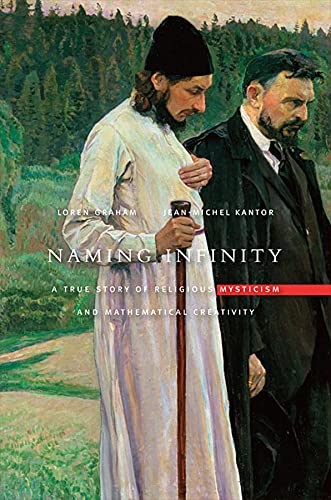
In 1913, Russian imperial marines stormed an Orthodox monastery at Mt. Athos, Greece, to haul off monks engaged in a dangerously heretical practice known as Name Worshipping. Exiled to remote Russian outposts, the monks and their mystical movement went underground. Ultimately, they came across Russian intellectuals who embraced Name Worshipping―and who would achieve one of the biggest mathematical breakthroughs of the twentieth century, going beyond recent French achievements.Loren Graham and Jean-Michel Kantor take us on an exciting mathematical mystery tour as they unravel a bizarre tale of political struggles, psychological crises, sexual complexities, and ethical dilemmas. At the core of this book is the contest between French and Russian mathematicians who sought new answers to one of the oldest puzzles in math: the nature of infinity. The French school chased rationalist solutions. The Russian mathematicians, notably Dmitri Egorov and Nikolai Luzin―who founded the famous Moscow School of Mathematics―were inspired by mystical insights attained during Name Worshipping. Their religious practice appears to have opened to them visions into the infinite―and led to the founding of descriptive set theory.The men and women of the leading French and Russian mathematical schools are central characters in this absorbing tale that could not be told until now. Naming Infinity is a poignant human interest story that raises provocative questions about science and religion, intuition and creativity.
User’s Reviews
Editorial Reviews: From Booklist *Starred Review* How did a country wracked by civil war, devastated by famine, and overshadowed by tyranny incubate a major breakthrough in modern mathematics? In the origins of descriptive set theory, Graham and Kantor (both self-described secular rationalists) confront the puzzling cultural dynamics that converted religious mysticism into mathematical insight. The authors particularly probe the surprising way that a religious heresy (Name Worshipping) emboldened the Russian mathematicians who finally surmounted the theoretical difficulties that had overwhelmed earlier pioneers in set theory. Though readers unschooled in higher mathematics may stumble over some concepts (such as denumberable subsets or the hierarchy of alephs), the authors generally succeed in translating principles into a nonspecialist’s vocabulary. Readers thus share in both the perplexities of the French rationalists defeated by the mysteries of infinite sets and the triumphs of the Russian scholars who penetrated those mysteries by deploying strategies strangely similar to devotional practices for naming the Divine. But the authors illuminate more than the psychology of a mathematical revolution; their narrative also exposes the tangle of ideological ambitions and sexual passions that transformed some brilliant researchers into treacherous tools of Soviet inquisitors and doomed others as their victims. A candid and searching analysis, restoring human drama to seemingly sterile formulas. Review “The intellectual drama will attract readers who are interested in mystical religion and the foundations of mathematics. The personal drama will attract readers who are interested in a human tragedy with characters who met their fates with exceptional courage.”―Freeman Dyson“At the end of the nineteenth century, three young French mathematicians–Émile Borel, René Baire and Henri Lebesgue–built on the work of Georg Cantor to conceive a new theory of functions that in a few years transformed mathematical analysis. When their work met with skepticism, they began to doubt it and abandoned further investigation. In Russia, under the leadership of Dmitry Egorov, a group of Moscow mathematicians picked up the torch. Animated by a mystical tradition known as Name Worshipping, they found the creativity to name the new objects of the French theory of functions. And they changed the face of the mathematical world.”―Bernard Bru, emeritus, University of Paris V“A passionate confluence of mathematical creation and mystical practices is at the center of this extraordinary account of the emergence of set theory in Russia in the early twentieth century. The starkly drawn contrast with mathematical developments in France illuminates the story, and the book is electric with portraits of the great mathematicians involved: the tragic, the unfortunate, the villainous, the truly admirable. The authors offer an account of Infinity that is brief, deft, serious, and accessible to non-mathematicians, and their evocation of the mathematical circles of the period is so intimately written that one feels as if one had lived, worked, and suffered alongside the protagonists. Graham and Kantor have given us an amazing piece of mathematical history.”―Barry Mazur, Harvard University“Last week I read one of the most interesting books I’ve encountered so far this year, Naming Infinity: A True Story of Religious Mysticism and Mathematical Creativity, by Loren Graham and Jean-Michel Kantor, just published by Harvard University Press. I’ll be writing more about this book, but in the meantime I wanted to let you know about it. Many books in the science-and-religion conversation tediously cover the same ground. This book comes from a fresh angle–the world of mathematics and the world of “science” are not the same, but they overlap–and it tells a fascinating story. I found it absolutely riveting. And it’s encouraging to see two secular scholars doing their best to be scrupulously fair in representing religious thinkers whose worldview is very different from their own.”―John Wilson, Books & Culture“It is a story of the persistence of intellectual life against the wrecking tide of history.”―Jascha Hoffman, Nature“In the early 20th century, mathematicians grappled with the concept of infinity, relying heavily on set theory to prove and define it. The French mathematicians, rationalists not fond of abstraction (particularly abstractions with spiritual overtones), went head-to-head with the Russians, who had always linked mathematics to philosophy, religion and ideology. Name Worshipping played a key role in bringing the two closer together. Graham and Kantor do a beautiful job of fleshing out the key players in this gripping drama–nothing less than a struggle to prove the existence of God.”―Susan Salter Reynolds, Los Angeles Times“This absorbing book tells astonishing stories about some of the most important developments in mathematics of the past century…Perhaps the most moving section of the book is that dealing with the famous Moscow School of Mathematics in Soviet times. Its origins are traced to the Lusitania seminar established by Egorov and Luzin (the source of the name “Lusitania” is obscure). The enthusiasm that these teachers inspired in their students is clearly conveyed, as is the atmosphere of intellectual excitement, despite the freezing lecture rooms (the rule that lectures could not take place if the room temperature fell below -5C was ignored)…This is a remarkable book, illuminating the history of 20th-century mathematics and its practitioners. The stories it tells are important and too little known. It is clearly a labor of love and deserves a wide audience: it is an outstanding portrayal of mathematics as a fundamentally human activity and mathematicians as human beings.”―Tony Mann, Times Higher Education“The most unusual book I have read this year.”―Alex Beam, Boston Globe“Fifty years ago, C. P. Snow gave a soon-to-be famous lecture on the “Two Cultures” of modern society, the culture of the humanities and the culture of science, and the need to bridge the gap between them. Today we are more likely to hear debates about the alleged gulf between science and religion. Both divides are bridged in this superb book, which takes us from French rationalism at the turn of the 20th century to a thriving center of world-class mathematics in Moscow, where the presiding figures were also devout Russian Orthodox believers of a mystical bent.”―John Wilson, Christianity Today“Naming Infinity is a short, accessible book about mathematical imagination…Naming Infinity is a straightforward, kinetic, and seductive read…In describing the life trajectories of their subjects, the authors are unafraid to take sides, show their sympathies, even judge. There is something refreshingly honest in their striving to be fair to their real-life characters without feigned impartiality. This considered generosity and the passion that shows itself in the copious quantities of documentary and anecdotal evidence gathered by Loren Graham in Russia, make the book a fascinating read…Just as a stimulating conversation, even when left incomplete, opens the mind to new ideas, Naming Infinity suggests new ways of thinking about mathematical creativity and intellectual excellence.”―Anna Razumnaya, theworld.org“This is not only a readable book, but a most worthwhile one, insofar as it offers a series of anecdotal life-stories of remarkable people, little known save to specialists, together with valuable insights into the Soviet Union of the 1930s.”―Robin Milner-Gulland, Times Literary Supplement“As Naming Infinity so sensitively shows, escaping the world we live in, and the exacting parameters of reason, can sometimes lead to surprising results. As powerful as the gift of rationalism may be, there is still more in heaven and earth.”―Oren Harman, New Republic About the Author Loren Graham is Professor Emeritus of the History of Science at the Massachusetts Institute of Technology.Jean-Michel Kantor is a mathematician at the Institut de Mathématiques de Jussieu in Paris. Read more
Reviews from Amazon users which were colected at the time this book was published on the website:
⭐This book attempts to dwell on a fascinating mathematical challenge, a profound philosophy, a bit of history and a bit of biography. Unfortunately, it succeeds in none.Its historical context is cursory, its mathematical treatise very superficial, its biographical effort incomplete and its understanding of the mystical issues practically nil.Curiously, the cover of the book shows Pavel Florenski and Sergei Bulgakov neither of whom had any significant involvement in the issue and consequently are mentioned only sparsely.But mainly, it fails to explain or even illustrate the connection between the specific mathematical problem and the mystical movement.I got the impression that in choosing these extremely complex subjects, the authors bit a lot more than they could chew and in the end just did not know how to handle them.This book is not a treatise of the subjects but rather a cursory preview; its only redeeming quality is that it may encourage the reader to look further into these fascinating and worthwhile subjects.
⭐This is a very helpful and well researched story of several gifted mathematicians who suffered in Russia in the early part of the last century for their philosophic and religious beliefs. Who can say that if God exists and was watching all of this if the tortured history of their country later in the century might have been less if these devoted believers in Him had not been so cruelly treated by the atheist communists. I don’t know this but I appreciate the authors careful work in documenting and honoring the souls of these believers with this book as they honored God’s name with their lives.
⭐Naming Infinity is a fascinating, if somewhat gossipy, account of the personal histories of the French predecessors and Russian mathematicians of the early twentieth century who pioneered transfinite set theory and came to be known as the “Moscow School” or “Lusitania.” The wonder is that it is as good as it is, given that the authors never tell us any of the theology underlying the “mystical” tendency or heresy which they credit with inspiring Egorov, Luzhin and Florensky. That would be important as well as interesting, given the need for a synthesis of the tradition from St. John’s theology of the Word through St. Dionysius the Areopagite (pseudo or not), to St. Gregory Palamas and finally Metropolitan Ilarion (the turn of the century one) and the monk Bulatovich. There is very little in English and hardly enough even in Russian. It would also help if the mathematical theories were more fully developed, and most especially if the connexion between the theology and the mathematics featured in the title were fully developed.Still it is a wonderful, humane book which opens the question of the role of theology in mathematics and rightly defends the connection. They call eloquently, if naively, for the book they have not yet written. They could have done a bit better simply by looking more actively into St. Pavel (Florensky’s) book, The Pillar and Ground of Truth, which they at least cite and thus gently recommend. I hope (and pray) that some Orthodox mathematician will take up the challenge they have left unfulfilled by their nevertheless lovely litte sketch of Lusitania and its heritage.
⭐My abilities in mathematics are decidedly pre-Euclidean. A scientist friend of mine used the visual metaphor of an established tree to explain mathematics: arithmetic, geometry, algebra and trig are the roots, the many developments in modern math are the branches and leaves. The trunk connecting roots and branches and supporting the tree is the calculus. Given this metaphor, I’m still scrambling among the roots for acorns of understanding from the top of the tree, because I never climbed past calculus. This limited my capacity to understand the math concepts Graham and Kantor describe in “Naming Infinity”. Other reviewers have commented on the book’s lack of equations to demonstrate the math propositions discussed in it. I wish some simple clear definitions of the building blocks of set theory had been available in an appendix. Beyond the few figures which elucidate Cantor’s discoveries in the second chapter, and a discussion of the conflict between Platonic and Aristotelian notions of mathematics and how these played out in both the French and Moscow Schools of math in the early XXth century, there are precious few tools to help the untutored reader develop a more profound comprehension of the subtleties of set theory and the mathematical continuum. It’s also true that I sometimes wished for the authors to return to topics briefly discussed in earlier chapters: did the religious practices of the Name-Worshippers persist through the post-Stalin era, for example? What was Luzin’s life like in his later years, after the discontinuity event of his pardon by Stalin? (Beyond his caustic insult to Kolmogorov, and his lover Bari’s suicide after his death, there is precious little here about Luzin’s twilight years.)These are minor cavils about a book which illumines an exciting time in European intellectual history. The history (indeed the existence) of the Name-Worshipper sect was unknown to me in Russian culture. The authors are to be thanked for their concise description of this movement’s history and its leading exponents. I am very fond of the Silver Age in Russian cultural history— and of the work of Symbolists like the remarkable Andrei Bely. Bely makes an appearance here, naturally, because he was the son of Nikolai Bugaev, the professor of mathematics at Moscow University who was the teacher of the trio of Russian mathematicians/name-worshippers considered in this book. The influence of the ideas propounded by the Name-Worshippers on Bely was another subject with which I was unfamiliar. Their obsession with “naming” does more to explain the numinous appeal of Bely’s difficult works than that author’s equally eccentric connection with the anthroposophy of Rudolf Steiner. The excerpts quoted from Bely’s “First Encounter” bring to life the cruelly extirpated world of Russia’s pre-revolutionary intelligentsia.Finally, this excellent small history vividly describes the lives of the protagonists of the Moscow School of Mathematics, especially those of Egorov, Luzin and Florensky. The film historian Herbert Marshall wrote a book a few decades ago called: “Masters of Soviet Cinema: Crippled Creative Biographies.” The second part of that title describes the lives, trials and deaths of these three great Russian mathematicians equally well. So many creative Soviet lives were crippled during those bloodthirsty backstabbing years under Stalinism. Graham and Kantor deepened my understanding of how advanced ideas in modern mathematics were developed by Russian men and women who sometimes bravely, sometimes timidly, sought simply to stay alive and work freely in their chosen field under one of the most despotic regimes in human history. Their lives were all crippled because of the Stalinist meat-grinder, and the creativity of their ideas is made greater by the poignancy their individual life stories present in this fine book.
⭐The book contains six mini-biographies of mathematicians. Three French (Borel, Lebesgue and Baire) and three Russian (Egorov, Luzin and Alexandrov). A priest (Florensky) gets thrown in for free.There’s also a plot somewhere in there about how the Russians picked up where the French left off and how this might be related to the fact that they were prepared to “name” a bunch of mathematical constructs. A claim is made that this is thanks to Egorov, Luzin and Florensky having been deeply religious “name worshippers”It’s tenuous.But it was informative, brief and entertaining, if a bit too gossipy for my taste.
⭐Creativity seems to set human beings apart from the rest of the animated world. Excessive creativity as embodied in Mathematics has puzzled many, especially outside the discipline itself. What special faculty is creativity and what sources does it tap? Modern mathematics was developed in the second half of the nineteenth century. It is distinguished by the creation of (formal) theories which, at least to an outsider, are not at first glance motivated by concrete problems (in physics, engineering or other disciplines). Thought itself seems to have erected enormous and in some cases intimidating intellectual buildings which in some cases later had a bearing on other sciences (such as non-euclidean geometry in relativity theory). The central purpose, pursued in the present book ‘Naming Infinity’, is to show that some of the drive in the building of what is known as set theory was derived from religious thought. Already the founder of set theory, Georg Cantor, has a strong religious views (see the seminal book
⭐Georg Cantor: His Mathematics and Philosophy of the Infinite
⭐). Here, the authors follow the lives and work of some of Cantor’s successors. The focal point of the author’s quest is to show that a particular mystical strand of Russian Orthodoxy, Name Worshipping, accounts at least to some extent for the deep understanding for the notion of infinity inherent in set theory as developed by Moscow School of Mathematics.The book sets out rather spectacularly by telling the story of Russian Imperial troops storming the monastery at Mt. Athos (Greece). Their task was to put an end to a heresy which threatened to counteract the Russian influence in the region. Much later, when the author’s advance their story to the Soviet Union of the 1920s and 30s, political issues will again play a prominent part in the book: Then Soviet hegemony even in the realm of the mind put a violent end to religion and freedom of thought. The victims of this repression will be the three mathematician of the Russian Trio of set theory (expression by the authors), Egorov, Florensky, and Luzin. Only the latter mathematician will survive his trial and its consequences. Much of the book is dedicated to their biographies and that of their opponents (in mathematics and in real life) such as Alexandrov, Kolomogrov, and Kol’man. The authors dwell mostly on the human side of the affair(s). Sex, betrayal, death, but also friendship and steadfastness loom large in the account.Before the Russian Trio the authors follow the biographies of the French Trio (the author’s expression) Borel, Lebesgue, and Baire. Again, mostly the human side of the story is told, but with less detail then in the Russian case because the French have to serve as examples of rationalist intellectuals who, unlike the religiously driven Russians, were not up the challenge posed by infinity.Naming notions, even before they have been fully understood, is an important part of the modern Mathematics referred to above. Things named seem to have existence even if these thing’s fabric is pure thought. In mathematics names do not appear from nowhere, they appear when thought begins to capture the general behind the specific, leading on to definitions (names), constructions, and conclusions (theorems). Exploring what is behind a name in mathematics will thus invariably involve constructive and deductive thought. The use of names in religious practice differs from this rational approach. A common denominator is, to name one, given by ontological speculation. It is the purported purpose of the book to pursue the meaning of names in mathematics and religious practice.It is then surprising that the book should spend so much time on very human affairs and avoid the discussion of philosophical, metaphysical amd mathematical topics. Set theory, which is so important to the account, is barely explained (the uninitiated reader will not be able to learn anything but a few buzzwords from the book), and Name Worshipping remains elusive throughout the book. Philosophical themes are barely touched. The authors do not use available sources such as the writings of the protagonists of their story to prove that religious outlook and practice on the one hand, and mathematical creativity on the other were indeed related. The only sources quoted at some length are notes by Luzin presented on just under four pages in an appendix. None of these sources proves the author’s case. No other useful sources are quoted, not even the important book
⭐The Pillar and Ground of the Truth: An Essay in Orthodox Theodicy in Twelve Letters
⭐by Florensky (for unknown reasons the authors refer to this book by another title). In consequence, the account, even when it makes brief excursions into set theory or religion, remains thoroughly this-worldly concerning itself more with human affairs than the world of thought and belief. The authors thus do not achieve their promise. Technical insufficiencies such as unnecessary repetitions mar the text and do not suit a book published by Harvard University Press.If the book is taken for what it is, a synoptic, short biography of some of the best minds in France and Russia in set theory, and their private and public tribulations, then it is still a worthwhile read, helping pass the time until a better account of the relation between Name Worshipping, naming in modern Mathematics and Infinity in set theory becomes available. The book is a history of human struggle, not a history of ideas.
⭐I started the initial reading. The topic of mathematics coupled to the religious is for me a fascinated aspect of filosophy.
⭐「光あれ」と言って神は光を誕生させた。つまり、光が誕生する以前に神は「光」という言葉を知っていたことになる。全ては「言葉」から始まった、と聖書は言う。なるほど、人間はやたらと全てに名前を付けて安心する。名前を付けることによって世界を支配する。そして、名前と実体を混同する。しかし名前があれば全てが存在する訳ではないことは常識で知ってはいる。「ユニコーン」という言葉はあってもユニコーンは存在しない。存在しないと証明することも可能だ。ユニコーン探索隊を派遣して世界中くまなく探せばよい。しかし数学において、観念と実在の距離はそのようには離れていない。数学的に使えるならば、その空間は存在するのである。数学的手続きによって、新しい位相を誕生させることが出来る。そしてそれに「名前」を付与すれば。アリストテレス以来2500年不動であった「無限」の概念に革命をもたらした19世紀の天才数学者カントールは、神の声を聞きながら「集合論」という新しい数学分野を創造した。まず、この新空間にフランスの若き数学者たちが挑み、撤退する。本書はその先を引き継いだモスクワ派の数学者たちにスポットライトを当てる。彼らは「Name Worshipping」という異端キリスト教の信者たちだった。神の名前をひたすらに唱え続け恍惚に至る、直観的、瞑想的、神秘主義的宗派である(スーフィズムに似ているような)。ロシア正教会に売られ、スターリズム弾圧に晒され、しかしその信仰と数学の不可分を手放さなかったロシア人数学者たちの悲劇が語られている。ある地点を超えると、言語と論理学と数学と神の領域が交じり合うような印象がある。言語不在の認識空間に数学は存在し得るのだろうか。中味は結構無難な数学者列伝になっており、「数学的創造力」を巡る考察にいまひとつ執拗さが足りないと感じたが、しかし徹底的に考察してしまったら、一般書の領域を外れただろう。純粋数学の世界の住人には食い足りない内容ではないかとは思う。しかし素人は数学史、哲学史、宗教史として堪能出来る。
⭐
Keywords
Free Download Naming Infinity: A True Story of Religious Mysticism and Mathematical Creativity in PDF format
Naming Infinity: A True Story of Religious Mysticism and Mathematical Creativity PDF Free Download
Download Naming Infinity: A True Story of Religious Mysticism and Mathematical Creativity 2009 PDF Free
Naming Infinity: A True Story of Religious Mysticism and Mathematical Creativity 2009 PDF Free Download
Download Naming Infinity: A True Story of Religious Mysticism and Mathematical Creativity PDF
Free Download Ebook Naming Infinity: A True Story of Religious Mysticism and Mathematical Creativity