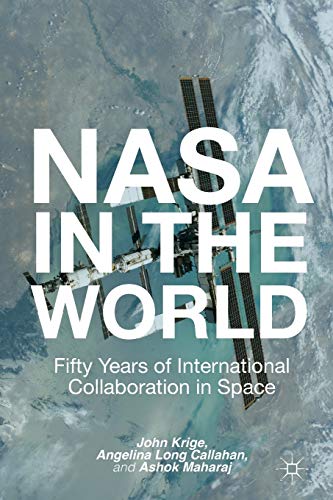
Ebook Info
- Published: 2013
- Number of pages: 370 pages
- Format: PDF
- File Size: 2.96 MB
- Authors: John Krige
Description
Since its inception, NASA has participated in over 4,000 international projects, yet historians have almost entirely neglected this remarkable aspect of the agency’s work. This groundbreaking work is the first to trace NASA’s history in a truly international context, drawing on unprecedented access to agency archives and personnel.
User’s Reviews
Editorial Reviews: Review “It tells the story of NASA’s collaboration with the European, Japanese, Indian and Soviet space programs in a series of case studies that vary in length and detail. The book analyzes the earthly side of the space agency, with much attention for the practical, every-day side of international cooperation. … NASA in the World provides important empirical studies of the political and practical sides of international science and technology.” (David Baneke, Minerva, Vol. 53, 2015)“NASA in the World is … extremely detailed, but it is a study of importance to the history of spaceflight and American diplomacy, European, Russian, Japanese, and Indian area studies, and transnational science and technology since 1958. … I recommend it.” (Michael J. Neufeld, Technology and Culture, Vol. 55, July, 2014)’Assertions of national pride and global leadership have thoroughly suffused, and often distorted, most US media and historical treatments of the space program. This volume is a long overdue corrective, written by a team led by the preeminent historian of European space exploration. Krige, Callahan, and Maharaj give us as thoroughly researched, complete, and readable an account as one could ask for.’ – Sylvia Kraemer, former NASA Chief Historian’Krige, Callahan, and Maharaj demonstrate that, since the start of the Space Age, NASA engineers and administrators sought to balance national leadership in space with their collaboration and cooperation with foreign partners. NASA in the World is a significant step in helping us see space exploration as both an expression of national foreign policy and a global endeavor.’ – W. Patrick McCray, Professor of History, University of California, Santa Barbara, USA’Far more attention has been paid to competition than cooperation in the history of spaceflight. In this excellent and engaging book, however, the authors make it very clear why studies of cooperation really do matter.’ – Robert W. Smith, Professor of the History of Science, University of Alberta, Canada’By documenting NASA’s international relations over its first 50 years, John Krige and his co-authors not only fill a huge gap in NASA history, they bring it to a new level of sophistication and current relevance. Moving beyond nuts and bolts history, the authors admirably succeed in their goal of firmly placing NASA on the world stage, reflecting both the ideals and contradictions of American foreign policy.’ – Steven Dick, former NASA Chief Historian About the Author John Krige is Kranzberg Professor in the School of History, Technology and Society at the Georgia Institute of Technology, USA, and the author of American Hegemony and the Postwar Reconstruction of Science in Europe (2006). An acknowledged expert on the history of the space program, he has appeared in recent years on American Public Radio, the BBC, and Swiss Radio.Angelina Long Callahan is Associate Historian at the Naval Research Laboratory in Washington, DC, USA, where she wrote her dissertation on meteorological satellites and the Cold War. She has a PhD from the Georgia Institute of Technology’s School of History, Technology, and Society. Her other research pursuits include the history of 1920-30s drone research and development and technological roots of the Vanguard satellite project.Ashok Maharaj has a PhD from the Georgia Institute of Technology’s School of History, Technology, and Society, USA. He lives and works in Chennai, India.
Reviews from Amazon users which were colected at the time this book was published on the website:
⭐Bought this book for my Dad and he found it very enjoyable. This informative book covers the first fifty years of NASA. From the Mercury missions to the Space Shuttle, this book covers it all.
⭐Let me begin with an admission; I am co-editor of the series in which this book was published, Palgrave Studies in the History of Science and Technology, and I am delighted that we were able to acquire this work for the series. Accordingly, my review is going to be quite positive. Moreover, I have known John Krige for many years and consider him a lifelong friend. Regardless of these personal connections to this book and its primary author, let me note that this study is very well researched, written, and analyzed.This book is important and path-breaking for three interrelated reasons. First, and foremost, this is an outstanding work—comprehensive and insightful—telling the exceptionally important story of NASA’s efforts to engage in collaborative activities in space with foreign nations. The Cold War context in which the U.S. civil space program arose in 1958 ensured that foreign policy objectives dominated the nature of the activity and this is reflected in NASA’s international efforts with other nations, largely as a means in cementing allied support for U.S. initiatives. The American Congress said as much in the National Aeronautics and Space Act of 1958, the legislation creating the National Aeronautics and Space Administration (NASA). In this chartering legislation Congress inserted a clause authorizing the new space agency to engage in international cooperation with other nations for the betterment of all humankind. This 1958 legislation provided authority for international agreements in the broad range of projects essential for the development of space science and technology in a naturally international field.NASA’s charter provided the widest possible latitude to the space agency in undertaking international activities as the means by which the agreed goals could be reached. The scope of NASA’s international program has been fortified since that time by repeated involvement with the United Nations, bilateral and multilateral treaties, and a host of less formal international agreements. Despite the primacy of this collaborative mandate for NASA, to date no one has engaged in a systematic effort to study the unfolding of this history until now. Krige, and his two co-authors Angelina Long and Ashok Maharaj, both former Ph.D. students, have rescued from obscurity this fundamental aspect of NASA’s history.Second, for the first time in this work we see a true appreciation for the incorporation of national narratives into a meaningful whole. While some historians have bowed in this direction, myself included, the history of spaceflight in the United States is largely driven by national themes and American priorities. Too often this has led to highly problematic linkages of American accomplishments in space with exceptionalistic perspectives on the nation’s past. Krige, Long, and Maharaj seek—and they are largely successful in this regard—in moving beyond the national spaceflight narratives to embrace transnational frameworks. In so doing they emphasize the interdependence and linkages between and among various modern states and how those interconnections have played out in relation to space exploration over the latter half of the twentieth century.This is not to say that all historians have completely ignored the international component of NASA’s activities, but those that have done so seem to concentrate on one of two aspects of this subject. They either focus on a single relationship between NASA and another nation for a specific project or they paint with a broad brush the background of Cold War competition as something that was a part of the story but did not require extensive explication. Thus, we have good book-length works on such projects as the American/Soviet collaboration that led to the Apollo-Soyuz Test Project of 1975. Accordingly, everyone who writes about Apollo discusses the Cold War impetus for the undertaking but largely ignores that aspect of the story the deeper they get into the details of the Moon landing effort. This work really sets about exposing the weaknesses of these approaches.And it is this emphasis on the transnational that offers the third reason why this book is significant. While there is some discussion of missions, projects, and the like, this work is very much driven by a broader perspective on the nature of international collaboration, emphasizing how scientific and technological issues have been resolved within the confines of broader political, industrial, and ideological issues. Of course, the Cold War looms large in this as decisions to embark on particular space ventures with foreign partners was shaped by the desire to ensure that allies remained allies and that non-aligned nations were brought more fully into the American camp. At sum, NASA’s spaceflight efforts acted in apposition and concordance with a multifaceted American foreign policy context which evolved—and in some instances engaged in disjunctive changes—in response to many stimuli from around the globe and at home.This fluidity ensured that NASA’s rational engineering types had to deal with numerous difficult and contested issues never envisioned when embarking on any given program. The authors of this study make clear that they are seeking to reinterpret NASA not as just a national space agency, but as an actor on the world stage and an exemplar of American interests around the globe. The confluence of NASA’s scientific and technological objectives with the nation’s foreign policy objectives, however poorly drawn and envisioned, makes this an especially interesting book. This story, in the authors’ views, explores the intersection between space science and technology and American diplomacy.Additionally, I want to say something about the nature of the research that went into this study. This book was completed under NASA contract; which meant that the authors had access to everything that was unclassified held by the space agency. More importantly, NASA was able to open doors in other nations to collections of material that are largely unavailable to other researchers. The authors also undertook extensive oral histories with a broad reach of key individuals from around the world. The result is the most comprehensive and exciting study of international relations in spaceflight ever undertaken.For all of the reasons listed above this book will have broad appeal, not only to historians, but also to practitioners of all types who have worked in the aerospace community. Just in the context of historians the reach of the book will go beyond space history to historians of science and technology, diplomatic historians, historians of globalism, historians of the Cold War, and historians of the recent past. It will, without question, become essential reading for scholars working in the field.
⭐Not found.
⭐Not found.
⭐Not found.
⭐Not found.
Keywords
Free Download NASA in the World: Fifty Years of International Collaboration in Space 2013th Edition in PDF format
NASA in the World: Fifty Years of International Collaboration in Space 2013th Edition PDF Free Download
Download NASA in the World: Fifty Years of International Collaboration in Space 2013th Edition 2013 PDF Free
NASA in the World: Fifty Years of International Collaboration in Space 2013th Edition 2013 PDF Free Download
Download NASA in the World: Fifty Years of International Collaboration in Space 2013th Edition PDF
Free Download Ebook NASA in the World: Fifty Years of International Collaboration in Space 2013th Edition