

Ebook Info
- Published: 2014
- Number of pages: 330 pages
- Format: PDF
- File Size: 12.97 MB
- Authors: Leon Golub
Description
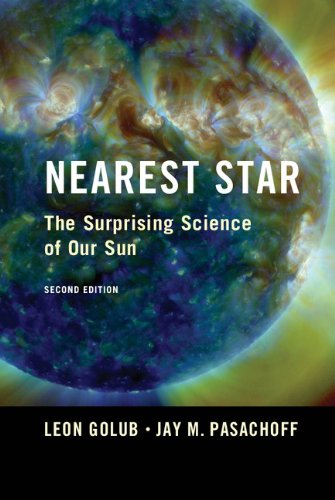
How did the Sun evolve, and what will it become? What is the origin of its light and heat? How does solar activity affect the atmospheric conditions that make life on Earth possible? These are the questions at the heart of solar physics, and at the core of this book. The Sun is the only star near enough to study in sufficient detail to provide rigorous tests of our theories and help us understand the more distant and exotic objects throughout the cosmos. Having observed the Sun using both ground-based and spaceborne instruments, the authors bring their extensive personal experience to this story revealing what we have discovered about phenomena from eclipses to neutrinos, space weather, and global warming. This second edition is updated throughout, and features results from the current spacecraft that are aloft, especially NASA’s Solar Dynamics Observatory, for which one of the authors designed some of the telescopes.
User’s Reviews
Reviews from Amazon users which were colected at the time this book was published on the website:
⭐I have just begun to read this book but find it very good indeed. It goes into great scientific detail and would be very valuable to anyone interested in learning about our nearest star from the scientific standpoint.
⭐Nice overview on the Sun. Provides an advanced layman’s view.
⭐An excellent summary of what we know–and have yet to learn–about our favorite star!
⭐Physics made intelligible
⭐We start at the universe and make our way towards the earth, a sensible approach that neatly describes Nearest Star. The sun is still several parts mystery, but the amount of knowledge we have distilled is gigantic. Golub and Pasachoff disburse it in an organized and immersing fashion.-It seems that all stars are powered by same process. A chart of tens of thousands of them shows a very tight, continuous grouping. They have the same patterns and processes of energy release. They are made of the same stuff.-Our sun is so dense it can take 110,000 years and possibly ten times longer for x-ray “light” to get from its core to its surface. The waves are scattered, absorbed and re-emitted many times before they see the dark of the universe.-Our sun is made up almost entirely of two common elements – hydrogen and helium – 99%. Everything else is just trace.-From our outpost here, the smallest thing we can see on the surface is a granule, a roughening of a tiny area, the size of the entire eastern US seaboard blurred into one spot, if that gives a better idea of the difference in scale between earth and the engine that powers it. Granules are boiling bubbles of gas, that cool and sink againThere remain numerous unsolved factors. Solar flares, for example, are the subject of almost as many theories as theorists, the authors say. They then go on to list a seemingly endless variety of projects, probes, satellites and telescopes all aimed at answering questions about the sun. They have long names that collapse into precious acronyms, like IMAGE, STEREO, TIMED, CORONAS and IRIS. We’re quietly on it, committing billions to get the answers.There follows an examination of auroras, the northern lights, which have finally ceased defying explanation. It seems there is a complete electrical circuit between the sun and our ionosphere, and when it is closed, the sky lights up. They explain the colors and the curtain effect such that it actually makes sense.And there is also the old saw of how the sun will swell up into a red giant and subsume the earth – in three billion years. But we will be long gone, because (although the book does not say, but) when our magnetic fields dissipate, the full force of the sun will hit earth relentlessly, and bake it. That we haven’t had a magnetic pole reversal in 700,000 years (normal is 100,000) is a good indicator that the georeactor powering our magnetic field is weakening. Measurements confirm this.It is also fascinating that just slight fluctuations in the tilt of the earth and the ellipse of its orbit are the entirely predictable sources of ice ages. The band of livable climate provided by the sun is incredibly narrow, can be upset by the slightest variation, and the changes incurred are extreme. Add pollution, and all bets are off.David Wineberg
⭐In the excitement of modern cosmology – when we can see back almost to the Big Bang itself, when we are discovering exoplanets with the capacity to sustain life, when mankind has just taken its first tentative robotic steps beyond the solar system – it can be easy to forget how much there still is to learn about the objects closer to hand. In this book, the authors set out to explain what we know, and what we don’t, about our own star, the Sun, and about its effects on us in the past, present and future. Originally published in 2001, this 2014 edition has been fully updated to take account of the most current knowledge on the subject. The book is presented as a series of eight chapters, each looking at a separate aspect of the science of the Sun.The first three chapters provide a general introduction to the Sun, explaining its origins and impact on the development of life here on Earth. The authors don’t just tell us what we know, however; they also tell us how we know it, showing how the science has gradually developed from naked eye observations through to the hugely sophisticated and complex space observatories we have become almost blasé about today. This is quite a technical book in parts, so there’s a lot of information on how these machines are built and controlled, even down to the size of lenses and lengths of exposures in the photography of the Sun. The fourth chapter takes us one step further, explaining the development of scientific methods to allow us to ‘see’ those things beyond our visual capacity and ‘look’ inside the Sun.The four remaining chapters each look in depth at a separate subject: eclipses, space missions, the effects of the Sun on Earth climate, and space weather. As is often the case with scientific books, the authors’ desire to inspire enthusiasm for their subject comes through very clearly in these chapters. As well as describing the complexities of cutting edge solar physics, they take the time to describe, for example, how an amateur photographer should go about getting the best photos of an eclipse with standard equipment. Solar winds, auroras, carbon-dating, even how winds are affected by the Sun, influencing trade routes throughout history – all of these diverse subjects and more find a place in here. And in the chapter on Earth climate, they explain some of the science that allows scientists to differentiate between the natural effects of solar cycles and the actions of mankind on the current trend of global warming.Popular science books have to tread a fine line between being so simplified that they irritate anyone with any level of scientific education or being so ‘sciency’ that they lose the novice completely. This book steps over that line several times in the direction of too sciency for this uneducated reader. While the authors carefully avoid bringing in too many mathematical formulae etc., they do use fairly technical language a lot of the time and though they are very good at explaining a technical term on first usage, they then assume the reader will remember that concept chapters later. I don’t know about other casual science readers but I really don’t take in scientific concepts that easily and found that more and more I was having to backtrack or go to the (very useful) glossary of terms at the back – or, being something of a lazy reader, beginning to skip the passages that would have required too much work. That’s not a fault of the book – I would not for one moment suggest that all science books should be written simplistically enough for the novice. But I would say that this book is probably more suited to someone with an existing familiarity with physics to at least high school standards. I was a little hampered by the fact that in the ARC copy I was given to review many of the graphs were not included – I would think they would probably have been very helpful in clarifying some of the more complex stuff.Having said all that, despite getting lost along the way a few times, I learned a lot from the book and on the whole found it an enjoyable and very informative read. So highly recommended to anyone with a reasonable basic knowledge of physics or to anyone who, like me, is happy to skim through the more difficult bits and enjoy the rest. 4½ stars for me, so rounded up.NB This book was provided for review by the publisher, Cambridge University Press.
⭐Like it says in the title, this book is full of surprises. Not the least is the ease of reading in this well illustrated and enjoyable book. As science books go, this is far from dense and continually engaging publication. Despite being a bit out of date (it’s a fast moving field, after all) it doesn’t feel dated and us a good introduction to solar astronomy for the amateur and serioys student alike.
⭐I thought this was a very good and informative book. However, the units are very muddled in that they are sometimes given in imperial and at other places in metric. Degrees are sometimes F, C or K but sometimes as just degrees which is confusing.
⭐Excellent read! Full of mind blowing information about our nearest star. Changes the way you look at the Sun and all of the stuff we are made of. Really fascinating and well presented book.
⭐A very interesting read highly recommend
⭐Grea book, thanks
Keywords
Free Download Nearest Star: The Surprising Science of our Sun 2nd Edition in PDF format
Nearest Star: The Surprising Science of our Sun 2nd Edition PDF Free Download
Download Nearest Star: The Surprising Science of our Sun 2nd Edition 2014 PDF Free
Nearest Star: The Surprising Science of our Sun 2nd Edition 2014 PDF Free Download
Download Nearest Star: The Surprising Science of our Sun 2nd Edition PDF
Free Download Ebook Nearest Star: The Surprising Science of our Sun 2nd Edition