

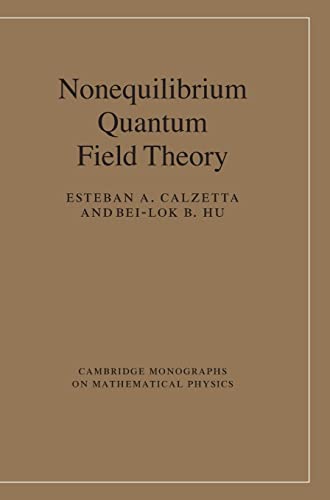
Ebook Info
- Published: 2008
- Number of pages: 552 pages
- Format: PDF
- File Size: 3.53 MB
- Authors: Esteban A. Calzetta
Description
Bringing together the key ideas from nonequilibrium statistical mechanics and powerful methodology from quantum field theory, this book captures the essence of nonequilibrium quantum field theory. Beginning with the foundational aspects of the theory, the book presents important concepts and useful techniques, discusses issues of basic interest, and shows how thermal field, linear response, kinetic theories and hydrodynamics emerge. It also illustrates how these concepts and methodology are applied to current research topics including nonequilibrium phase transitions, thermalization in relativistic heavy ion collisions, the nonequilibrium dynamics of Bose-Einstein condensation, and the generation of structures from quantum fluctuations in the early Universe. Divided into five parts, each part addresses a particular stage in the conceptual and technical development of the subject.
User’s Reviews
Editorial Reviews: Review “Nonequilibrium Quantum Field Theory by Calzetta and Hu is a very well written book which covers thoroughly various formalisms for studying nonequilibrium statistical mechanics and nonequilibrium.quantum field theory. It then uses these methodologies to address various important philosophical questions such as entropy generation, and quantum decoherence. Finally the authors show the relevance of these formalisms for addressing very current problems such as the dynamics of Bose-Einstein condensates, phase transitions following relativistic heavy ion collisions and nonequilibrium quantum processes in the time evolution of the early universe. The authors have written many of the seminal papers and the book is a masterpiece of pedagogy, explaining and resolving very clearly many of the technical issues that had to be overcome in the development of this subject. It should prove essential reading to anyone venturing to work in this important new field.” Fred Cooper, Program Director Theoretical Physics, National Science Foundation”A valuable reference for graduate students and researchers in particle physics, gravitation, cosmology, atomic optical and condensed matter physics.” Book News”This book is an exhaustive and up-to-date treatment of non-equilibrium quantum field theory, also considering its quite extensive lists of references. The coverage is excellent. The presentation is very detailed.” Axel Maas, Mathematical Reviews Book Description Reference for graduate students and researchers in particle physics, gravitation, cosmology, atomic-optical and condensed matter physics. About the Author Esteban Calzetta is a Professor in the Departamento de Fisica at the Universidad de Buenos Aires and Researcher at CONICET, Argentina.Bei-Lok Hu is a Professor in the Department of Physics and a Fellow of the Joint Quantum Institute at the University of Maryland, College Park. Read more
Reviews from Amazon users which were colected at the time this book was published on the website:
⭐What does it mean to say that a relativistic quantum field or a collection of interacting relativistic quantum fields is not in equilibrium? It would be expected that any definition would involve concepts from classical non-equilibrium statistical mechanics such as the Boltzmann equation and use insights gained from the theory of many-particle (nonrelativistic) quantum mechanics. But can phenomena such as dissipation, coarse-graining, and diffusion really be exhibited in relativistic quantum field theory or quantum gauge theories? And practically speaking, can one perform calculations in nonequilibrium quantum field theory, given that calculating anything in (ordinary) quantum field theory is challenging, especially in the non-perturbative realm?The authors of this book, which is clearly written and targeted to advanced readers with a solid background in nonequilibrium statistical mechanics, quantum field theory, and gauge theory, take these kinds of questions head on. They make it clear in the preface of the book that its focus is on using concepts from quantum field theory to understand the nonequilibrium dynamics of relativistic many-particle systems and how phenomena such as dissipation, entropy, and noise can be understood in these systems. Therefore, the book really exemplifies a strategy, namely that of using quantum field theory to understand nonequilibrium quantum processes of relativistic many-body systems. Hence, it is fair for a reader to expect the authors to give a well-defined definition of what a ‘nonequilibrium’ quantum process is, how its time evolution can be described, and most importantly how explicit calculations can be done with the formalism that is derived.This formalism is based on the (closed time path) Schwinger-Keldysh effective action and that of the Feynman-Vernon influence functional. In a nutshell, these formalisms approach calculations in non-equilibrium quantum field theory for a given initial density operator in terms of a generating functional for correlation functions, which is like the case of ordinary quantum field theory. In this case however, the time argument of the field operator is evaluated along a closed real-time contour, which allows a description of both vacuum quantum field theory as well as thermal and nonequilibrium systems, and is a generalization of the ordinary scattering theory approach where matrix elements between asymptotic incoming and outgoing states are calculated. Both the closed time path and influence functional constructions are discussed early in the book, in the context of quantum open systems. In these discussions the authors treat the case where the environmental action is quadratic to derive an expression for the influence action in terms of what they call ‘dissipation’ and ‘noise’ kernels. Readers should pay attention to this elementary example because the dissipation and noise kernels are used widely throughout the book. The reviewer found it difficult at times to understand the physical interpretation of these quantities, as contrasted with their mathematical use.The Feynman-Vernon influence functional appears in the field theory context when the authors discuss the interactions of two scalar fields, one of which is taken to be the environment field, and the other the system field. This example somewhat clarifies the ‘doubling of degrees of freedom’ that is frequently imputed to the closed-time formalisms. The reviewer found it helpful to study the original papers of Schwinger and Keldysh for further clarification and insight. The authors procedure in the rest of the book boils down to an argument by analogy, in that they are basing their analysis on the physical insights gained from the study of quantum open systems. These systems display the interesting phenomena of decoherence, dissipation, diffusion, and renormalization, and they are given a well-motivated discussion early in the book.One discussion of interest to the reviewer concerned the idea of using field theory in 0 + 1 dimensions to gain insight into the dynamics of quantum field theory, in particular the degree to which a quantum system whose underlying Hamiltonian displays chaotic behavior can itself have chaotic dynamics. The reviewer instigated this study in his dissertation using an approach involving the Gaussian effective potential, and it instigated further studies some of which are quoted in this book. These references point out correctly that the effective Hamiltonians derived from Gaussian (Hartree) approximations display chaotic behavior, but this behavior is merely an artifact of this type of approximation.Studying this book reveals that the dynamics of quantum field theory, whether in equilibrium or nonequilibrium is very complex, even more so when one attempts to go beyond perturbation theory and try to understand non-perturbative phenomena. The authors of this book have given an overview of some of the techniques involved in studying non-equilibrium quantum field theory but not touching on numerical and computational approaches. Readers who want an overview of the latter will have to look elsewhere. But suffice it to say that quantum field theory remains a subject of great interest with many outstanding problems remaining, all of them extremely difficult.
⭐This is a very good reference book, summarizing the work that the authors have done. Nonequilibrium quantum field theory is something new to many physicists, and this book provides a very clear explanation about the basic formalisms, physics, and its application in condensed matter physics, high energy physics and cosmology.
Keywords
Free Download Nonequilibrium Quantum Field Theory (Cambridge Monographs on Mathematical Physics) in PDF format
Nonequilibrium Quantum Field Theory (Cambridge Monographs on Mathematical Physics) PDF Free Download
Download Nonequilibrium Quantum Field Theory (Cambridge Monographs on Mathematical Physics) 2008 PDF Free
Nonequilibrium Quantum Field Theory (Cambridge Monographs on Mathematical Physics) 2008 PDF Free Download
Download Nonequilibrium Quantum Field Theory (Cambridge Monographs on Mathematical Physics) PDF
Free Download Ebook Nonequilibrium Quantum Field Theory (Cambridge Monographs on Mathematical Physics)