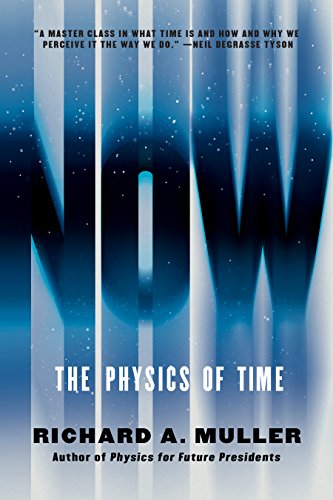
Ebook Info
- Published: 2016
- Number of pages: 381 pages
- Format: PDF
- File Size: 12.93 MB
- Authors: Richard A. Muller
Description
From the celebrated author of the best-selling Physics for Future Presidents comes “a provocative, strongly argued book on the fundamental nature of time” (Lee Smolin).You are reading the word “now” right now. But what does that mean? “Now” has bedeviled philosophers, priests, and modern-day physicists from Augustine to Einstein and beyond. In Now, eminent physicist Richard A. Muller takes up the challenge. He begins with remarkably clear explanations of relativity, entropy, entanglement, the Big Bang, and more, setting the stage for his own revolutionary theory of time, one that makes testable predictions. Muller’s monumental work will spark major debate about the most fundamental assumptions of our universe, and may crack one of physics’ longest-standing enigmas.
User’s Reviews
Reviews from Amazon users which were colected at the time this book was published on the website:
⭐I enjoyed reading Muller’s book, maybe as much for its loose ends as its clear discussions along the way. He combines a reconstruction of some basics of relativity and quantum physics with an over-riding question — time’s arrow and our experience of a “now” in time — and a general, philosophical position on the limits of scientific knowledge. And, despite the subject matter, it’s written in an almost breezy manner, although you’ll certainly find yourself going back to read passages a second or third time to understand subtle points.The bulk of the book really is Muller’s laying out of his own understanding of the current landscape of physics and cosmology.It deserves being called a “reconstruction” because he seeks to overturn some popular scientific misconceptions along the way. The expansion of the universe, for example, does not mean that galaxies are moving away from one another, but that the space between them is expanding. That may seem like a difference between two ways of describing the same thing, but the difference will become important later when Muller addresses the question of time, “now”, and time’s arrow. Just as space is continually created by cosmological expansion, he will claim that time is also expanding.He also corrects the popular construction of space-time as three axes of space and a fourth time axis, similar to the spatial axes. That popular picture gives us the impression of a linear expanse of time — past, present, and future — on which we just happen to sit at a point we call the present, as if future and past also existed as accessible points, at least in principle. Again, correcting this picture will play an important part in his own conception of time later in the book.Muller devotes extensive discussions to indeterminacy and entropy. He recounts Einstein’s opposition to indeterminacy as an objective characteristic of reality. This is part of his general argument that physics is “incomplete”. Despite Einstein’s protests, indeterminacy actually does turn out to be a feature of objective reality. The common sense determinism of scientific thought, that the past determines the future, turns out to be false. Physics, in turn, is incomplete, in that it cannot compute the future even given complete knowledge of the past and present. The idealized “complete” knowledge of the past and present — the position and velocity of all particles — is unobtainable, because there simply are no such determinate, objective positions and velocities.His discussion of entropy takes up the perhaps dominant explanation of time’s arrow, by Arthur Eddington — that the arrow of time is the arrow of increasing entropy. Muller considers Eddington’s account in some interesting discussions of the relation between local entropy and cosmological entropy. Certainly we, through intentional activity, can decrease local entropy. Our experience of time’s arrow is not one of ever-increasing entropy. Muller wants us to see that, in an important sense, the idea that time as entropy cannot go backwards is illusory — local entropy certainly does go backwards. The familiar illustration of entropy’s direction — reversing the film sequence of a cup breaking, now showing the pieces of the cup bizarrely flying together — is misleading. Cups do actually come together, reversing entropy, when we make them.I’m unsure exactly how to understand the relation between the problem of time’s arrow in physics and the importance that Muller gives to the human experience of time (and local entropy). But he certainly does mean to claim that physics turns out to be incomplete in another sense beyond that implied by objective indeterminacy. That other sense of incompleteness has to do with conscious experience, such as our conscious experience of time.Muller is a scientist who does not think the reach of scientific knowledge is complete — there are phenomena beyond the reach of scientific knowledge. In particular, science cannot grant us knowledge of conscious phenomena, e.g., what it is like to see blue. We can certainly have scientific accounts of what happens when we are conscious (e.g., that certain areas of the brain are active), but that is not a description of the conscious experience itself (see Thomas Nagel’s classic paper, “What Is It Like to be a Bat?” for a fuller treatment of the problem, although Muller doesn’t cite Nagel).All of these themes come together toward the end of the book in Muller’s speculations about “now”. The direction of time, and our position at “now”, are not adequately explained by our current physics. Our experience of “now” is likewise unaccounted for in physics (actually our conscious experience of anything is unaccounted for by physics).We do however, from quantum physics, have a way of distinguishing the past from the present and the future. What separates the past from “now” is the determination of the past — quantum uncertainty has been resolved in the past (through “measurement” — a still mysterious natural process that collapses the wave function of quantum physics). In the present, and in the future, no such determination has occurred. In fact, Muller thinks that time is continuously created, just as space is, in the cosmological expansion of the universe.The claim is speculative, and probably requires a lot more physics (especially concerning measurement). But Muller offers some thoughts on experiments we might make to go forward.Muller’s claims on indeterminacy, local entropy, and the unattainability of scientific accounts of conscious experience also lead him to some conclusions about free will. Certainly indeterminacy is not the same thing as free will — indeterminacy has nothing to do with intentional behavior. But indeterminacy at least may remove one obstacle to accepting free will, that our future actions are not strictly determined by the past or present. His account of free will is, like his account of the continuous creation of “now”, speculative, but interesting. He would like to say that, since “now” and the future are undetermined, in the physical sense, they are open to willful determination — explained by him as generation of local decreases in entropy. Those local decreases are the province of life and its productions (order, structure, intentional action . . . civilization).In my own understanding, from reading Muller, the marriage of all of these themes isn’t really consummated. The flow of time, free will, and what blue looks like are all phenomena that appear not to be well understood, certainly by science, and possibly will never be understood by scientists. I’m just not sure how all are related to one another, or if “now” does not turn out to be inextricable from the conscious experience that Muller thinks cannot be adequately described in scientific terms.But Muller is refreshingly provocative. And I think it is especially refreshing, in not only a scientific but a scientistic age, to find a physicist who does not think that physics can encompass everything.One minor quibble. Well maybe not minor. Muller delves deeply into some important philosophical problems — the status of conscious experience, free will, the limits of objective knowledge. And he does discuss some philosophical treatments of those issues. But, given that he teaches at a university with one of the world’s leading philosophy departments, there’s no evidence (that I could find in the book) that he’d actually walked over to the philosophy department to find out what they thought. Doing so may have substantially enriched and applied additional rigor to his treatments of those issues.
⭐Do humans have souls? Do they transcend our physical bodies? Why does Richard A. Muller spend a significant fraction of the text of this new popular level book about the physics of time discussing this?The answer seems to simply be that the question of whether he has a soul is one that is dear to the author’s heart. I’ve tried to figure out if there is any link between this subject and the main purpose of the book but I failed.The primary purpose of the book is to introduce a new and still speculative theory of Muller’s that our sense of ‘now’ and of our involuntary ‘motion’ along the arrow of time is a result of new time being created moment to moment. We ‘travel’ to this new time and occupy it as it is created, and the old time becomes the past. The future really does not exist, as it is not yet created.I like the idea. It feels right to me, and Muller proposes a few thoughts about how his theory might be falsified. But it is early days—way too soon to tell whether this or alternate hypotheses might be the path to better understanding the mystical and perplexing nature of time in our reality.Muller is an experimentalist, and he repeatedly insists that theoretical physics—manipulating equations using advanced math—is a waste of time unless the resulting theory is rooted in the physical world in such a way that it can be tested. Indeed he gets rather curmudgeonly about it in places. His belittling of 1933 Nobel Prize winner Paul Dirac is rather unbecoming and speaks more about Muller than Dirac.Setting that aside as an anomaly, or as hasty writing and editing, I found most of Muller’s book a fascinating read. It carefully develops and clearly explains the physics relevant to our understanding of time. Einstein’s relativity is explained and the subsequent development of quantum physics and its various interpretations are explained well.Then in Part IV of the book he goes on this strange walk-about into ‘not-physics’. I call it that because that is really his point. Things that are ‘not-physics’—not science—are real and are important.Despite the disconnect with the rest of the book, it’s a point worth making, and I’m glad he made it, and I guess I understand why it’s in this book. If Muller had written a book devoted entirely to his untestable beliefs and perceptions (his favorite example is “what does ‘blue’ look like?”) nobody would take it seriously, and probably no publisher would even consider it. At least this way he gets his message in print.And yes, it feels like he’s preaching here in Part IV. His main point is succinctly summarized by this quote from page 266:“Physics itself is not a religion. It is a rigorous discipline, with strict rules about what is considered proven and unproven. But when this discipline is presumed to represent all of reality, it takes on aspects of religion. … The dogma that physics encompasses all reality has no more justification than the dogma that the Bible encompasses all truth.”I agree. Muller argues that there is a huge body of knowledge that is not testable, but which nevertheless guides us successfully through our daily lives. (‘My boss hates chocolate’ is an example of such knowledge.) The target audience of his argument is the not inconsiderable group of physicists who ascribe to Physicalism/Reductionism—the idea that there is nothing real beyond what can be observed and characterized using science.I guess if there is a connection between his beliefs and Physics it comes from the fact that science has proven that some things cannot be observed and characterized, even in principle. He runs with the idea that reality is not amenable to logic or experiment (for example, the delicious paradox that there is no such thing as simultaneity of an event to different observers and yet quantum fields collapse instantaneously everywhere in the observed universe, to use an example relevant to the rest of this book) and uses it to justify injecting unprovable belief systems into that void.Such as believing that he has a soul. By ‘soul’ Muller specifically means the “I” that processes and acts upon physical inputs to the body—the ‘location’ of the mind.Muller has a peculiar fear of Star Trek style-beaming, or cloning. He asks “would the re-assembled physical body be ‘me’”? I find this odd, given that, as he points out, our current body consists of almost no atoms that we were originally made of. I think where he went wrong is thinking that the “I” is somehow sacrosanct. I believe that I would be a different “me” if I drove to Cleveland vs. if I didn’t.That brings up another point that Muller insists on. He is convinced that humans have ‘free will’. Personally, I think exercising my free will by choosing to drive to Cleveland tells all that needs to be told. No, seriously. Free will is not an absolute. We have choices, but we are denied most that we might imagine and many more that God might have.Regardless, I have no true objection to Muller’s beliefs, or to his inclusion of them in this book. From my perspective, that void of logic stands at the very core of reality and defines it. The universe, via its Big Bang, has emerged from it as an island of simple objective rule-following processes, but they are not fundamental, and physicists are now finally beginning to realize that. Life emerged as an island of self-replicating, self-preserving information (DNA), but it is no more fundamental than the universe it happens to find itself in. Its massive complexity does seem amenable to effectively tapping into the ‘free will’ fountain flowing from the quantum field. The emergence of useful information out of incoherent, indifferent uncertainty is what life does best. And that achievement is worth celebrating—worth formulating any number of religious beliefs around. But outside of our safe, limited realm, in the incomprehensible chaos of the vacuum, it is Paradox that rules supreme.
⭐I started this book with high hopes and found the first half really interesting, then it went downhill fast. Muller is obviously an excellent experimental physicist and has understood Einstein’s theories of relativity, at least, really well. He also gives workmanlike accounts of large parts of particle physics and the basics of quantum theory, albeit with all the standard metaphors and anecdotes that regular readers of pop physics books will have read a dozen times before, up to and including the tired tale of Schrödinger’s cat. He seems to be aiming his book at readers for whom all this would be new, so this much is forgivable.Muller is surely right to direct serious doubt at claims (originating with Arthur Eddington) that the arrow of time is set by the direction of rising entropy. Both Brian Greene (in his 2004 book The Fabric of The Cosmos) and Sean Carroll (in his 2010 book From Eternity to Here) raise doubts too, and explain why in persuasive depth. But Muller adds something new to the debate with the idea that if time ends now and expands as the future unfolds, the entropy of our universe can be said to shrink, as negentropy, also known as information, increases to reflect the accumulation of new facts. This is exciting (for me at least, since I aired the same idea in a paper on time in 2006).Unfortunately, Muller goes on to flunk his discussion of quantum mechanics with the disarming admission that since no one understands it (citing Richard Feynman and John Wheeler to this effect) he can be forgiven for bugging out too. In fact he fails to explain how good recent work by Dieter Zeh and others on decoherence (see Greene’s book or indeed many more recent popular accounts) both gets rid of the old confusions about Schrödinger’s cat and sheds new light on the measurement problem, which Muller makes heavy weather bewailing. As for the Everett interpretation, which people like David Deutsch and Max Tegmark have begun to take seriously, Muller seems to think that his dislike of the idea that people like himself might go their own way in parallel universes is enough to dismiss the interpretation.Then things go downhill. Part IV of Muller’s book give what for any philosopher must count as an atrociously poor account, in a personal and folksy but blunt and emphatic manner, of everything beyond physics, including the mind and free will. His editors or early readers should have quietly advised him to dump the entire section. It adds nothing of value to the book.That said, the denouement in Part V is an utter disappointment. There is no theory of now on offer, beyond the suggestion that time expands just as space does, and now is its leading edge, plus a few proposed tests indicated without proper explanation. To make this suggestion do real work in modern physics takes a lot of technical care, as he should know very well. Unforgivably, he has totally ignored all the recent work in neuroscience on the specious present and how the brain manages to give us a sense of the here and now. Given that his hero Einstein said the passage of time was a psychological phenomenon, and that this fact sufficed to explain how the underlying time symmetry of the relativistic block universe was unmoved by our sense of now, this oversight on Muller’s part is hard to explain except on the assumption that he shares with Feynman a robust contempt for psychology. This fact alone should inhibit him from making such big claims for now.In short, Muller is out of his depth in the latter half of this book. He is a senior and distinguished physicist who has devoted his life to doing solid work in experimental physics and to teaching others at the highest level, so I do not want to write the book off as a mess. As I said, the first half is really good. But the last quarter is just bad.
⭐I bought this book for my husband as something a bit different from the usual theoretical physics books that he reads. The book is interesting and well written, my husband has enjoyed it and learnt some new things about time, although he very much likes things based in fact and has found some of the philosophical content (particularly about souls and free will) along with the author’s opinion on things a bit hard going – he remarked that the author should stick to science! I think it looks like a very interesting book though and would recommend it to people who wish for a book which goes beyond what has been proven and would like a read which makes them think about the basics of what it means to exist and be human.
⭐A fascinating book. I am not a specialist in this subject but am a scientist in a different field, with a deep and lifelong interest in cosmology. In particular, I have long been preoccupied by ‘now’ and why it does not feature in any theories of physics. Delighted to see that Professor Muller, from his much more informed standpoint, shares my concern. Likewise I have always had problems with using increasing entropy to determine the direction of time, and was pleased to see he demolishes that idea very neatly. Instead… well, I won’t give the game away, just to say that I find his proposals for now and time’s arrow intuitively appealing (and he proposes ways to test and possibly refute them – yay!). I also like his stance on religion and free will. Everything is clearly and beautifully explained. I would strongly recommend this book.
⭐I loved this book. There’s so much in here to write about but the parts on godel’s incompleteness theorem and trying to give a better understanding of time drew me in and made me more curious. Brilliant book, I can’t recommend it enough.
⭐The best ever in the modest opinion of this compulsive reader of popular science (and philosophy)books.
Keywords
Free Download Now: The Physics of Time in PDF format
Now: The Physics of Time PDF Free Download
Download Now: The Physics of Time 2016 PDF Free
Now: The Physics of Time 2016 PDF Free Download
Download Now: The Physics of Time PDF
Free Download Ebook Now: The Physics of Time