

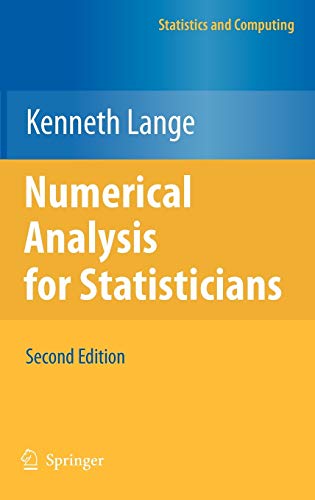
Ebook Info
- Published: 2010
- Number of pages: 620 pages
- Format: PDF
- File Size: 5.39 MB
- Authors: Kenneth Lange
Description
Numerical analysis is the study of computation and its accuracy, stability and often its implementation on a computer. This book focuses on the principles of numerical analysis and is intended to equip those readers who use statistics to craft their own software and to understand the advantages and disadvantages of different numerical methods.
User’s Reviews
Editorial Reviews: Review From the reviews:”This book provides reasonably good coverage of numerical methods that are important in statistical applications. …but overall the text serves as a good introduction to computational statistics.” – MATHEMATICAL REVIEWSFrom the reviews of the second edition:“The theory and equations are well defined and easy enough to read. … This book gives you all the details you need for choosing formulas and libraries when implementing Fourier Transforms. … this is a good book … .” (Cats and Dogs with Data, maryannedata.wordpress.com, July, 2013)“The aim and scope of this edition is to provide upper level undergraduate students, graduate students and even researchers the understanding and working knowledge of different numerical methods. … The book is organized sequentially and is well structured. … The book can be served as a textbook and equally as a reference book. … the book will appeal to a broad interdisciplinary research community. It can also successfully be used as a reference book for practitioners, providing concrete examples, data and exercises of statistical applications.” (Technometrics, Vol. 53 (2), May, 2011)“This is a comprehensive handbook for anyone with an interest in computational statistics, such as instructors, statisticians, modelers, data mining analysts, and software designers. For a reader with good working knowledge of numerical analysis, the book is useful for understanding the advantages and disadvantages of different numerical methods. … also suitable for students interested in refining their knowledge: a list of problems with gradually increasing difficulty is available, in addition to a list of very carefully chosen references (a real support for the reader).” (Dragos Calitoiu, Mathematical Reviews, Issue 2011 g)“Numerical Analysis for Statisticians is a wonderful book. It provides most of the necessary background in calculus and enough algebra to conduct rigorous numerical analyses of statistical problems. … I simply enjoyed Numerical Analysis for Statisticians from beginning until end. … Numerical Analysis for Statisticians also is recommended for more senior researchers, and not only for building one or two courses on the bases of statistical computing. … an essential book to hand to graduate students as soon as they enter a statistics program.” (Christian Robert, Chance, Vol. 24 (4), 2011) From the Back Cover Every advance in computer architecture and software tempts statisticians to tackle numerically harder problems. To do so intelligently requires a good working knowledge of numerical analysis. This book equips students to craft their own software and to understand the advantages and disadvantages of different numerical methods. Issues of numerical stability, accurate approximation, computational complexity, and mathematical modeling share the limelight in a broad yet rigorous overview of those parts of numerical analysis most relevant to statisticians. In this second edition, the material on optimization has been completely rewritten. There is now an entire chapter on the MM algorithm in addition to more comprehensive treatments of constrained optimization, penalty and barrier methods, and model selection via the lasso. There is also new material on the Cholesky decomposition, Gram-Schmidt orthogonalization, the QR decomposition, the singular value decomposition, and reproducing kernel Hilbert spaces. The discussions of the bootstrap, permutation testing, independent Monte Carlo, and hidden Markov chains are updated, and a new chapter on advanced MCMC topics introduces students to Markov random fields, reversible jump MCMC, and convergence analysis in Gibbs sampling. Numerical Analysis for Statisticians can serve as a graduate text for a course surveying computational statistics. With a careful selection of topics and appropriate supplementation, it can be used at the undergraduate level. It contains enough material for a graduate course on optimization theory. Because many chapters are nearly self-contained, professional statisticians will also find the book useful as a reference. Kenneth Lange is the Rosenfeld Professor of Computational Genetics in the Departments of Biomathematics and Human Genetics and the Chair of the Department of Human Genetics, all in the UCLA School of Medicine. His research interests include human genetics, population modeling, biomedical imaging, computational statistics, high-dimensional optimization, and applied stochastic processes. Springer previously published his books Mathematical and Statistical Methods for Genetic Analysis, 2nd ed., Applied Probability, and Optimization. He has written over 200 research papers and produced with his UCLA colleague Eric Sobel the computer program Mendel, widely used in statistical genetics.
Reviews from Amazon users which were colected at the time this book was published on the website:
⭐I bought this book for Kindle, believing that I would get the (recent) second edition – Amazon’s Kindle page for this item has as illustration the cover of the second edition! However the ten year old “first edition” was delivered to my Kindle. I later also found out that one could by an eBook second edition directly from Springer publishers for less than half the price.Fortunately it turned out that it is not so difficult as I thought to “return” a mistaken Kindle purchase, via the “Manage my Kindle” page.In conclusion: fantastic book, but make sure you get the second edition, and if you want an eBook version, don’t buy it on Amazon for the time being!
⭐Somehow, I had missed the first edition of this book and thus I started reading it this afternoon with a newcomer’s eyes (obviously, I will not comment on the differences with the first edition, sketched by the author in the Preface). Past the initial surprise of discovering it was a mathematics book rather than an algorithmic book, I became engrossed into my reading and could not let it go! Numerical Analysis for Statisticians, by Kenneth Lange, is a wonderful book. It provides most of the necessary background in calculus and some algebra to conduct rigorous numerical analyses of statistical problems. This includes expansions, eigen-analysis, optimisation, integration, approximation theory, and simulation, in less than 600 pages. It may be due to the fact that I was reading the book in my garden, with the background noise of the wind in tree leaves, but I cannot find any solid fact to grumble about! Not even about the MCMC chapters! I simply enjoyed Numerical Analysis for Statisticians from beginning till end.From the above, it may sound as if Numerical Analysis for Statisticians does not fulfill its purpose and is too much of a mathematical book. Be assured this is not the case: the contents are firmly grounded in calculus (analysis) but the (numerical) algorithms are only one code away. An illustration (among many) is found in Section 8.4: Finding a Single Eigenvalue, where Kenneth Lange shows how the Raleigh quotient algorithm of the previous section can be exploited to this aim, when supplemented with a good initial guess based on Gerschgorin’s circle theorem. This is brilliantly executed in two pages and the code is just one keyboard away. The EM algorithm is immersed into a larger MM perspective. Problems are numerous and mostly of high standards, meaning one (including me) has to sit and think about them. References are kept to a minimum, they are mostly (highly recommended) books, plus a few papers primarily exploited in the problem sections.While I am reacting so enthusiastically to the book (imagine, there is even a full chapter on continued fractions!), it may be that my French math background is biasing my evaluation and that graduate students over the World would find the book too hard. However, I do not think so: the style of Numerical Analysis for Statisticians is very fluid and the rigorous mathematics are mostly at the level of undergraduate calculus. The more advanced topics like wavelets, Fourier transforms and Hilbert spaces are very well-introduced and do not require prerequisites in complex calculus or functional analysis. (Although I take no joy in this, even measure theory does not appear to be a prerequisite!) On the other hand, there is a prerequisite for a good background in statistics. This book will clearly involve a lot of work from the reader, but the respect shown by Kenneth Lange to those readers will sufficiently motivate them to keep them going till assimilation of those essential notions. Numerical Analysis for Statisticians is also recommended for more senior researchers and not only for building one or two courses on the bases of statistical computing. It contains most of the math bases that we need, even if we do not know we need them! Truly an essential book.
⭐Ron Thisted’s book on computing algorithms for statisticians was one of the most useful and clearly written texts on the topic. There have also been a few other good ones. Lange brings to the table a more current book that deals with the key new methods such as resampling, Markov chain Monte Carlo, Fourier series and wavelets,the EM algorithm and extensions of it. He also includes useful but uncommon results for power series, exponentiating matrices and continued fraction expansions.The usual matrix algebra stuff for linear models is also there. You will also find a chapter on nonlinear equations and a chapter on splines. There are asymptotic expansions in Chapter 4 and Edgeworth expansions in Chapter 17. Almost everything that is important in statistical computing today is included.This book can be used as for a graduate course in statistical computing and is a valuable reference for any statistical researcher.
⭐I bought the first edition and I was happy with it until I saw a very knowledgeable review by an anonymous reviewer, who was very critical of the implementations. More recently I saw a very favourable review of the second edition on Christian Robert’s blog and I have a very high regard for his views. I took a look at the second edition and it was greatly improved in all the areas the reviewer wasn’t happy with. I bought it and I can say that It has gone from being a good book to a great one.
Keywords
Free Download Numerical Analysis for Statisticians (Statistics and Computing) in PDF format
Numerical Analysis for Statisticians (Statistics and Computing) PDF Free Download
Download Numerical Analysis for Statisticians (Statistics and Computing) 2010 PDF Free
Numerical Analysis for Statisticians (Statistics and Computing) 2010 PDF Free Download
Download Numerical Analysis for Statisticians (Statistics and Computing) PDF
Free Download Ebook Numerical Analysis for Statisticians (Statistics and Computing)