

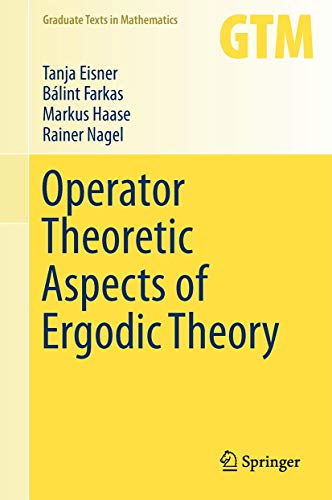
Ebook Info
- Published: 2015
- Number of pages: 646 pages
- Format: PDF
- File Size: 6.73 MB
- Authors: Tanja Eisner
Description
Stunning recent results by Host–Kra, Green–Tao, and others, highlight the timeliness of this systematic introduction to classical ergodic theory using the tools of operator theory. Assuming no prior exposure to ergodic theory, this book provides a modern foundation for introductory courses on ergodic theory, especially for students or researchers with an interest in functional analysis. While basic analytic notions and results are reviewed in several appendices, more advanced operator theoretic topics are developed in detail, even beyond their immediate connection with ergodic theory. As a consequence, the book is also suitable for advanced or special-topic courses on functional analysis with applications to ergodic theory.Topics include:• an intuitive introduction to ergodic theory• an introduction to the basic notions, constructions, and standard examples of topological dynamical systems• Koopman operators, Banach lattices, lattice and algebra homomorphisms, and the Gelfand–Naimark theorem• measure-preserving dynamical systems• von Neumann’s Mean Ergodic Theorem and Birkhoff’s Pointwise Ergodic Theorem• strongly and weakly mixing systems• an examination of notions of isomorphism for measure-preserving systems• Markov operators, and the related concept of a factor of a measure preserving system• compact groups and semigroups, and a powerful tool in their study, the Jacobs–de Leeuw–Glicksberg decomposition• an introduction to the spectral theory of dynamical systems, the theorems of Furstenberg and Weiss on multiple recurrence, and applications of dynamical systems to combinatorics (theorems of van der Waerden, Gallai,and Hindman, Furstenberg’s Correspondence Principle, theorems of Roth and Furstenberg–Sárközy)Beyond its use in the classroom, Operator Theoretic Aspects of Ergodic Theory can serve as a valuable foundation for doing research at the intersection of ergodic theory and operator theory
User’s Reviews
Editorial Reviews: Review “This book can serve as a good introduction to an active research area. Each chapter ends with a nice list of exercises. At the end of the book complementary material can be found on measure theory, functional analysis, operator theory, the Riesz representation theorem, and more. This makes the book self-contained. The book has the potential to become a basic reference in this field.” (Idris Assani, Mathematical Reviews, January, 2017) From the Back Cover Stunning recent results by Host–Kra, Green–Tao, and others, highlight the timeliness of this systematic introduction to classical ergodic theory using the tools of operator theory. Assuming no prior exposure to ergodic theory, this book provides a modern foundation for introductory courses on ergodic theory, especially for students or researchers with an interest in functional analysis. While basic analytic notions and results are reviewed in several appendices, more advanced operator theoretic topics are developed in detail, even beyond their immediate connection with ergodic theory. As a consequence, the book is also suitable for advanced or special-topic courses on functional analysis with applications to ergodic theory.Topics include:•an intuitive introduction to ergodic theory•an introduction to the basic notions, constructions, and standard examples of topological dynamical systems•Koopman operators, Banach lattices, lattice and algebra homomorphisms, and the Gelfand–Naimark theorem•measure-preserving dynamical systems•von Neumann’s Mean Ergodic Theorem and Birkhoff’s Pointwise Ergodic Theorem•strongly and weakly mixing systems•an examination of notions of isomorphism for measure-preserving systems•Markov operators, and the related concept of a factor of a measure-preserving system•compact groups and semigroups, and a powerful tool in their study, the Jacobs–de Leeuw–Glicksberg decomposition•an introduction to the spectral theory of dynamical systems, the theorems of Furstenberg and Weiss on multiple recurrence, and applications of dynamical systems to combinatorics (theorems of van der Waerden, Gallai, and Hindman, Furstenberg’s Correspondence Principle, theorems of Roth and Furstenberg–Sárközy)Beyond its use in the classroom, Operator Theoretic Aspects of Ergodic Theory can serve as a valuable foundation for doing research at the intersection of ergodic theory and operator theory About the Author Tanja Eisner is a Professor of Mathematics at the University of Leipzig. Bálint Farkas is a Professor of Mathematics at the University of Wuppertal. Markus Haase is a Professor of Mathematics at the Delft Institute of Applied Mathematics. Rainer Nagel is a Professor of Mathematics at the University of Tübingen. Read more
Reviews from Amazon users which were colected at the time this book was published on the website:
⭐The outstanding feature of this book is doing ergodic theory using the Koopman operator. For a function T from a set to itself, the Koopman operator of T is a linear operator on the linear space of functions from T to the scalars. This is a standard thing to work with, but this book fully works out this theory instead of dipping into it in passing. Chapter 4 covers the case where T is a continuous transformation of a compact Hausdorff space K, for which the Koopman operator of T is a linear operator on C(K). The Gelfand theory of Banach algebras is developed, and it is proved that any endomorphism of the Banach algebra C(K) is the Koopman operator of a continuous transformation, and characterizes when a dynamical system is minimal in terms of the algebra ideals of C(K). I think this book will feel more naturally interesting as an introduction to ergodic theory for students of operator theory than Walters’ standard book will. This is a sprawling book with many examples and it is written in a friendly way, and if I were giving lectures on ergodic theory I would browse through this.
Keywords
Free Download Operator Theoretic Aspects of Ergodic Theory (Graduate Texts in Mathematics, 272) in PDF format
Operator Theoretic Aspects of Ergodic Theory (Graduate Texts in Mathematics, 272) PDF Free Download
Download Operator Theoretic Aspects of Ergodic Theory (Graduate Texts in Mathematics, 272) 2015 PDF Free
Operator Theoretic Aspects of Ergodic Theory (Graduate Texts in Mathematics, 272) 2015 PDF Free Download
Download Operator Theoretic Aspects of Ergodic Theory (Graduate Texts in Mathematics, 272) PDF
Free Download Ebook Operator Theoretic Aspects of Ergodic Theory (Graduate Texts in Mathematics, 272)