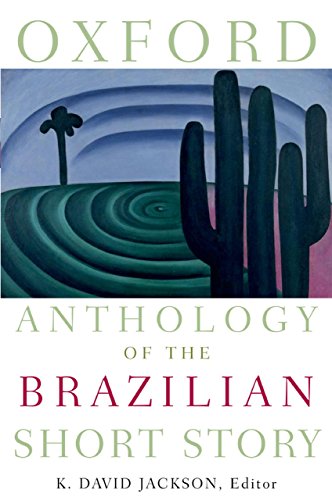
Ebook Info
- Published: 2006
- Number of pages: 539 pages
- Format: PDF
- File Size: 1.91 MB
- Authors: K. David Jackson
Description
The Oxford Anthology of the Brazilian Short Story contains a selection of short stories by the best-known authors in Brazilian literature from the late nineteenth century to the present. With few exceptions, these stories have appeared in English translation, although widely separated in time and often published in obscure journals. Here they are united in a coherent edition representing Brazil’s modern, vibrant literature and culture. J.M. Machado de Assis, who first perfected the genre, wrote at least sixty stories considered to be masterpieces of world literature. Ten of his stories are included here, and are accompanied by strong and diverse representations of the contemporary story in Brazil, featuring nine stories by Clarice Lispector and seven by João Guimarães Rosa. The remaining 34 authors include Mário de Andrade, Graciliano Ramos, Osman Lins, Dalton Trevisan, and other major names whose stories in translation exhibit profound artistry.The anthology is divided into four major periods, “Tropical Belle-Époque,” “Modernism,” “Modernism at Mid-Century,” and “Contemporary Views.” There is a general introduction to Brazilian literary culture and introductions to each of the four sections, with descriptions of the authors and a general bibliography on Brazil and Brazilian literature in English. It includes stories of innovation (Mário de Andrade), psychological suspense (Graciliano Ramos), satire and perversion (Dalton Trevisan), altered realities and perceptions (Murilo Rubião), repression and sexuality (Hilda Hilst, Autran Dourado), myth (Nélida Piñón), urban life (Lygia Fagundes Telles, Rubem Fonescal), the oral tale (Jorge Amado, Rachel de Queiroz) and other overarching themes and issues of Brazilian culture. The anthology concludes with a haunting story set in the opera theater in Manaus by one of Brazil’s most recently successful writers, Milton Hatoum.
User’s Reviews
Reviews from Amazon users which were colected at the time this book was published on the website:
⭐This book was published in 2006. It’s the largest anthology of Brazilian writers published in English translation thus far, the product of careful research by the editor. It’s worth reading for this reason alone, despite some drawbacks.It contained 72 works by 37 writers, starting with Machado de Assis in the 1880s and ending with Milton Hatoum in the 1990s. Each decade in between was covered.More than half of the writers were represented by one story, with the rest given two works or more. A generous number of stories (7-10 each) was included for three major authors: Machado de Assis, Guimarães Rosa and Lispector. Much space was devoted to works published in the 1960s, by Guimarães Rosa, Amado, Lispector, Trevisan, Piñon, Scliar, Lins, Fagundes Telles and Cony. And the 1970s, by Veiga, Rubião, Lispector, Fonseca, Dourado, Hilst, Giudice and Salles Gomes. Coverage of Brazilian writing after 1979 was thin, with just four authors: Abreu, Hatoum, Van Steen and Scliar. Maybe this imbalance reflected the lack, at the time the anthology was published, of translations to draw from for recent years.For this reader, the stories that stood out were “The Fortune-Teller,” one of Machado’s best ironic tales. “The Baby in Rose Tarlatan” by Paulo Barreto, a chilling piece set during Carnaval. And “Whale” by Graciliano Ramos, written from the perspective of a dog. This was one of the saddest and most moving chapters from Barren Lives (1938), the novel of linked stories.“Sardanapalo” by João Alphonsus and “The House of the Melancholy Angel” by Erico Veríssimo were tales of magical realism from the 1930s and 40s; one violent, one poignant. A quietly moving remembrance told by a Brazilian abroad was “Marta: A Souvenir of New York” by Orígenes Lessa. “Fandango” by Erico Veríssimo showed a gaucho character from the narrator’s childhood, a salt of the earth type.“Miss Algrave,” about a sexually repressed Englishwoman, was one of Lispector’s clearest stories. “Large Intestine,” by Fonseca, read like an interview of the author in which he replied to his real-life critics. Tales by Mario de Andrade, Giudice and Scliar were memorable stories about various forms of injustice. In “The Misplaced Machine” by Veiga, locals tried to understand the arrival of a mysterious contraption in their backwater town. What all these stories had in common was entertaining narratives, and strong impressions produced clearly with concision. Such tales comprised about a third of the collection.***Among the drawbacks were that, as the editor noted in his preface, nearly all of the translations had been previously published elsewhere; virtually none were commissioned for this book. It was good that the anthology collected in one place so many previous translations, a number of them from academic journals. But an opportunity was missed to translate new authors and works judged by the editor to be worth reading.A better balance could have been struck between stories with strong, readable narratives, of which there were too few, and avant-garde stories that were mainly of interest for their experiments with form. The latter are doubtlessly fascinating to a scholar, but maybe not as enthralling for a general reader. This was a particular drawback with some of the longer selections. And with too many of the works from the 1950s onward, under the influence of modernism that led to fragmented, tortuous narratives and meandering explorations of the stream of consciousness. These amounted to another third of the collection, and unfortunately they felt tedious in the extreme. In my opinion a better balance was achieved in The Oxford Anthology of American Short Stories, which was assembled by an academic who’s foremost a novelist.There were too many stories by Machado, Lispector and Guimarães Rosa — despite the importance of these authors — with themes and styles that repeated themselves. In place of 7-10 stories each by them, I would’ve appreciated more than one tale by authors such as Fonseca or the magical realist Veiga. Or just one work by authors who were left out of the collection: Raimundo Magalhães Júnior, José Cavalcanti Borges, Carlos Vasconcelos Maia, Marília Penna e Costa and João Ubaldo Ribeiro.Lively, clear stories by such authors, which would’ve added much to this anthology, can be found in Modern Brazilian Short Stories (1967) and A Hammock beneath the Mangoes (1991). An anthology published after the Oxford collection, Brazil: A Traveler’s Literary Companion (2010), introduced a large number of writers — nearly as many as in Oxford — including a lot of works from the 1990s and 2000s.The Borzoi Anthology of Latin American Literature (1977, in two volumes) included a number of Brazilian authors mainly from the 1850s to 1960s — not just short stories as in the Oxford collection but also poetry and excerpts from novels. A handful of Brazilian writers from before 1980 are also in The Oxford Book of Latin American Short Stories (1997), with about half of the same tales appearing in the Oxford collection on Brazil.
⭐This extensive book (roughly 400 pages of prose, plus references and an introductory section) focuses on short stories by Brazilian authors. It divides them into 4 historical sections, starting with the oldest (Belle Epoque) first and then proceeding through Modernism, Mid-Century, etc. Each section contains stories by several authors considered key to Brazilian literature, with a short introduction of the significance of each author. Sometimes several stories by a single author are included in a section. Although the book is not specifically about Brazil, I learned a lot about the social history of Brazil through these short stories, which largely deal with interpersonal relationships and the challenges of a modernizing country. Well-researched and organized.
⭐
Keywords
Free Download Oxford Anthology of the Brazilian Short Story 1st Edition in PDF format
Oxford Anthology of the Brazilian Short Story 1st Edition PDF Free Download
Download Oxford Anthology of the Brazilian Short Story 1st Edition 2006 PDF Free
Oxford Anthology of the Brazilian Short Story 1st Edition 2006 PDF Free Download
Download Oxford Anthology of the Brazilian Short Story 1st Edition PDF
Free Download Ebook Oxford Anthology of the Brazilian Short Story 1st Edition