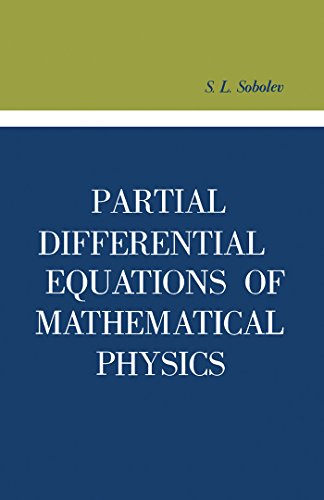
Ebook Info
- Published: 2014
- Number of pages: 440 pages
- Format: PDF
- File Size: 27.15 MB
- Authors: S. L. Sobolev
Description
Partial Differential Equations of Mathematical Physics emphasizes the study of second-order partial differential equations of mathematical physics, which is deemed as the foundation of investigations into waves, heat conduction, hydrodynamics, and other physical problems. The book discusses in detail a wide spectrum of topics related to partial differential equations, such as the theories of sets and of Lebesgue integration, integral equations, Green’s function, and the proof of the Fourier method. Theoretical physicists, experimental physicists, mathematicians engaged in pure and applied mathematics, and researchers will benefit greatly from this book.
User’s Reviews
Reviews from Amazon users which were colected at the time this book was published on the website:
⭐Quite frankly, I had almost forgotten about this book. However, while working my way through Gabriel Barton’s Book, Elements Of Green’s Functions And Propagation, then his references, I was struck by what he wrote regarding this text: “accessibly written…a truly exceptional text, head and shoulders above most others with similar titles.” Thus, I retrieved the book from my bookshelf. I confess to having ignored it for some time. The reason is obvious, as it is decidedly much more advanced than others “with similar titles.”(1) Sobolev is advanced, this implies that a course in analysis has already been assimilated. Happily, if you have gone through much of Weinberger’s text, A First Course in Partial Differential Equations, Sobolev will be easier to assail. Onward, then:(2) Of particular note is chapter six: multiple integrals and lebesgue integration (this is a “measure theory first,” introduction). Also, if a sentence such as “any closed set can always be taken to be the intersection of a nest of open sets” is unfamiliar, this will be a tough chapter. On the positive side, the exposition is exceptionally lucid, and the initial five chapters (referred to by Sobolev as “lectures”) are, as a whole, easier than the sixth lecture.(3) Surprisingly few intermediate steps are left for the reader. Two examples: glance at pages,134 and 135. Here you find the computations pedestrian and spelled-out for the reader (this is lecture eight, heat conduction). If you have glanced at Weinberger, then lectures eight and nine will not pose too much of an issue.(4) You meet interesting approaches in Lecture fifteen, properties of potentials. A glance at this chapter affords an opportunity to observe interplay between inequalities and differential geometric analysis. A most interesting analysis.(5) Next up, integral equations. Read: “the properties of potentials which we established in the last lecture enable us to solve the Dirichlet and Neumann problems by reducing the problems to the form of integral equations.” (page 225). Lectures 18 and 19 revisit this theme. That is, lecture 18 will present theory, lecture 19 presents applications.(6) Green’s Functions, next: “we will begin with a very simple case.” (page 265). Green will occupy two chapters.These two chapters are ancillary to Barton’s textbook.(7) Lecture twenty-two: The lecture has a major theme, inequalities: Of Minkowski and Schwarz. A fine exposition.(8) Fourier and separation-of-variables. We read: “the reader who has mastered the arguments set out in the previous lectures will have no difficulty in understanding immediately how and in what circumstances the Fourier method enables the solution of a problem to be found.” (page 327).(9) Next, examining more general integral equations. So you will for three chapters following. After that, more Fourier methods, culminating in an exposition of spherical functions and harmonics–the final two lectures.(10) Concluding: Given adequate preparation (a first course in analysis) Sobolev is a fine text (no student exercises).In conjunction with Barton’s text (with its copious supply of student exercises) a sound foundation is achieved.The exposition is exceptional, most intermediate steps are made explicit, the analysis (the proofs) fascinating.As preliminary, read Sobolev’s fine forty-five page exposition of partial differential equations in Mathematics:Its Content, Methods and Meaning (volume two, MIT Press).Highly recommended for advanced students.
⭐I find this book to deal adequately with PDEs and enough rigor
⭐This very useful book was delivered in time, in good condition. Satisfied
⭐no puedo opinar, me censuran los censores de amazon.es
⭐
Keywords
Free Download Partial Differential Equations of Mathematical Physics: Adiwes International Series in Mathematics in PDF format
Partial Differential Equations of Mathematical Physics: Adiwes International Series in Mathematics PDF Free Download
Download Partial Differential Equations of Mathematical Physics: Adiwes International Series in Mathematics 2014 PDF Free
Partial Differential Equations of Mathematical Physics: Adiwes International Series in Mathematics 2014 PDF Free Download
Download Partial Differential Equations of Mathematical Physics: Adiwes International Series in Mathematics PDF
Free Download Ebook Partial Differential Equations of Mathematical Physics: Adiwes International Series in Mathematics