

Ebook Info
- Published: 1998
- Number of pages: 144 pages
- Format: PDF
- File Size: 11.01 MB
- Authors: Abraham Pais
Description
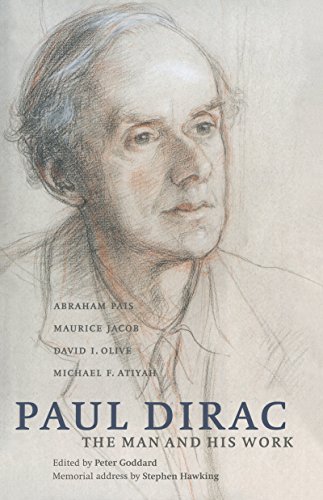
Paul Adrien Maurice Dirac was one of the founders of quantum theory. He is numbered alongside Newton, Maxwell and Einstein as one of the greatest physicists of all time. Together the lectures in this volume, originally presented on the occasion of the dedication ceremony for a plaque commemorating Dirac in Westminster Abbey, give a unique insight into the relationship between Dirac’s character and his scientific achievements. The text begins with the dedication address given by Stephen Hawking at the ceremony. Then Abraham Pais describes Dirac as a person and his approach to his work. Maurice Jacob explains how Dirac was led to introduce the concept of antimatter, and its central role in modern particle physics and cosmology, followed by an account by David Olive of the origin and enduring influence of Dirac’s work on magnetic monopoles. Finally, Sir Michael Atiyah explains the deep and widespread significance of the Dirac equation in mathematics.
User’s Reviews
Reviews from Amazon users which were colected at the time this book was published on the website:
⭐The book was a good examination of Dirac’s life and work. If one is looking for a more complete biography I would recommend ” The Strangest Man”. If however, you want a more in depth look at his work on magnetic monopoles, anti matter and their place in the world of particle physics then this book is a good choice. A background in advanced mathematics and fundamental physics will help in following some of the concepts.SCSWestlake, Ohio
⭐I have ofter wondered about Dirac who I consider the mystery man of quantum physics. He seemed to be totally consumed my the underlying mathematics of physics, at the same time he was so naive about the trifles of human interchanges. This is a concise and illuminating history and I assume, the one that another recent book about Dirac is based. The book clears the clouds.
⭐Paul Dirac and Albert Einstein realized that Physics was so very incomplete and worked tirelessly to bring more clarity to the subject matter.
⭐Purely based on the merit of Abraham Pais’ contribution to this work, this is a five-star book, even if nothing else be considered. Stachel once remarked about Pais’ book on Einstein, “Subtle is the Lord,” that everyone should read as much of it as they can. The reason is clearly that Pais has a wonderful grasp of the technical aspects of physics, and possesses a high degree of competency within the discipline of history, that he is able to canalize an enormous amount of content and detail into an easily digestible piece of literature. That’s his brilliance: converting complexity into simplicity, and organization via insightful reflection. Such is the case with his article in this work. In fact, anyone who has read a modest amount of literature on Dirac will instantly become keenly aware of just how insightful this essay is. On top of that, Pais knew Dirac, so his perspective is complemented by the authority of experience. Therefore, being accessible to the layperson and valuable (because of copious citations) to the scholar, I have the highest praise for the essay.The rest of the book isn’t bad either. Hawking does a nice job establishing some context for the book. The second chapter on antimatter is a little on the sorry side, because of the lack of citations and the misleading history it presents. (The author of this section is, quite obviously, a physicist without training in history.) The conceptual presentation on antimatter is fine, though I have seen better. The remain two chapters can be very valuable. The third chapter, on monopoles, can be understood by the undergraduate who has gone through Griffith’s “Introduction to Quantum Mechanics,” and may even be intelligible to the layperson (but maybe not). The last chapter on the Dirac equation, because of ideas that would probably be new to the undergraduate in physics, such as Clifford algebras, may be limitedly intelligible, but there is still value in the text, beyond the mathematical exposition.I definitely recommend the this book on the basis of the section by Pais, and the rest is worth thumbing through to see if it is of additional value to the reader.
⭐Purely based on the merit of Abraham Pais’ contribution to this work, this is a five-star book, even if nothing else be considered. Stachel once remarked about Pais’ book on Einstein, “Subtle is the Lord,” that everyone should read as much of it as they can. The reason is clearly that Pais has a wonderful grasp of the technical aspects of physics, and possesses a high degree of competency within the discipline of history, that he is able to canalize an enormous amount of content and detail into an easily digestible piece of literature. That’s his brilliance: converting complexity into simplicity, and organization via insightful reflection. Such is the case with his article in this work. In fact, anyone who has read a modest amount of literature on Dirac will instantly become keenly aware of just how insightful this essay is. On top of that, Pais knew Dirac, so his perspective is complemented by the authority of experience. Therefore, being accessible to the layperson and valuable (because of copious citations) to the scholar, I have the highest praise for the essay.The rest of the book isn’t bad either. Hawking does a nice job establishing some context for the book. The second chapter on antimatter is a little on the sorry side, because of the lack of citations and the misleading history it presents. (The author of this section is, quite obviously, a physicist without training in history.) The conceptual presentation on antimatter is fine, though I have seen better. The remain two chapters can be very valuable. The third chapter, on monopoles, can be understood by the undergraduate who has gone through Griffith’s “Introduction to Quantum Mechanics,” and may even be intelligible to the layperson (but maybe not). The last chapter on the Dirac equation, because of ideas that would probably be new to the undergraduate in physics, such as Clifford algebras, may be limitedly intelligible, but there is still value in the text, beyond the mathematical exposition.I definitely recommend the this book on the basis of the section by Pais, and the rest is worth thumbing through to see if it is of additional value to the reader.
⭐An excellent collection of recollections about the great man! Dirac had a remarkable life. After growing up in a small terraced house in Bristol -where he lived for 21 years – he went to Cambridge and within two years he was working on the foundations of quantum theory and produced his generalisation of Schrodinger and Heisenberg’s work by the age of 24!!!
⭐Pais is a little dull in this work, not one of his best. Or is it Dirac who is a little dull.
Keywords
Free Download Paul Dirac: The Man and his Work 1st Edition in PDF format
Paul Dirac: The Man and his Work 1st Edition PDF Free Download
Download Paul Dirac: The Man and his Work 1st Edition 1998 PDF Free
Paul Dirac: The Man and his Work 1st Edition 1998 PDF Free Download
Download Paul Dirac: The Man and his Work 1st Edition PDF
Free Download Ebook Paul Dirac: The Man and his Work 1st Edition