Ebook Info
- Published: 2008
- Number of pages: 160 pages
- Format: PDF
- File Size: 2.00 MB
- Authors: Maurice Robinson
Description
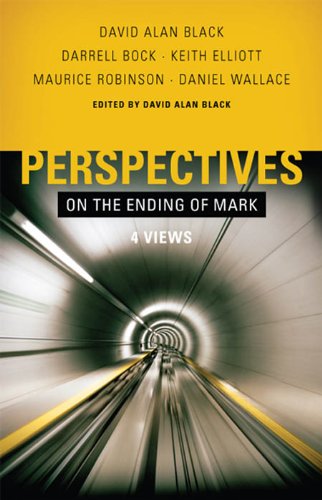
Because it is conspicuously absent from more than one early Greek manuscript, the final section of the gospel of Mark (16:9-20) that details Christ’s resurrection remains a constant source of debate among serious students of the New Testament.Perspectives on the Ending of Mark presents in counterpoint form the split opinions about this difficult passage with a goal of determining which is more likely. Southeastern Baptist Theological Seminary professors Maurice Robinson and David Alan Black argue for the verses’ authenticity. Keith Elliott (University of Leeds) and Daniel Wallace (Dallas Theological Seminary) contend that they are not original to Mark’s gospel. Darrell Bock (Dallas Theological Seminary) responds to each view and summarizes the state of current research on the entire issue.
User’s Reviews
Reviews from Amazon users which were colected at the time this book was published on the website:
⭐An excellent overview of the issues surrounding the difficulty of the ending of the Gospel of Mark. As a pastor preparing to preach on the ending of the Second Gospel, I found this resource highly valuable in understanding the issues behind the simple note in most modern translations regarding vv. 9-20. My only disappointment was how fanciful some of the contributors became in their theories: sometimes they seemed to be stretching quite a bit too make their perspective fit the available facts.The exploration of this material left me with two questions. First, did Mark intend to end his Gospel at 16:8 or with 16:9-20? After considering what the various authors had to say, I remain convinced that Mark intended to end at 16:8. This fits best with the external and internal evidences presented and creates the least interpretive problems.Second, if with 16:8, then are vv. 9-20 to be considered Scripture or not? The authors bring up this question indirectly, but a full explain of it was no doubt beyond the scope of this work. That question is more penetrating and I am still wrestling with given the possibilities raised in these papers.Overall, a great work to bring out the competing views on the textual evidence regarding the ending of Mark’s Gospel.
⭐This review only covers Daniel Wallace’s contribution to the book and only his presentation of Greek Manuscript evidence. Wallace is one of two authors in the book who argue that 16:8 is the original ending of GMark. Two other authors in the book argue that 16:20 is the original ending.I’m only going to review Daniel Wallace because he is considered the top Textual Critic here and I’m also only going to review his presentation of The External evidence category of Manuscripts (and only in the original language Greek) because that is the only category of evidence where supporters of 16:8 as the original ending are traditionally on the defensive.Wallace concedes that quantitatively, the overwhelming majority of Manuscripts support 16:9-20 (LE) as original. Most of his related writing then involves the qualitative. Traditional Textual Criticism has the following qualitative attributes for Manuscripts:1. Age2. Reputation3. Independent Confirmation4. Direction of ChangeAGE -Wallace points out that the two oldest extant manuscripts, Sinaiticus and Vaticanus, c. 350, both end at 16:8 (SE). This identifies the advantage of the SE here in absolute terms but Wallace does not go on to measure the advantage in relative terms. GMark was relatively unpopular in the early Church so there are fewer extant early Manuscripts. While Sinaticus and Vaticanus are c. 350, the next earliest relevant Manuscript here is Codex Washingtonianus (W), c. 400. W has an expanded version of the LE so while it does support the LE over the SE it is not absolute support. Next is Codex Alexandrinus, c. 425, Codex Bezae, c. 450 and 3 Codexes c. 550. The next Codex is c. 700. All of these have the LE.In comparison then, there are only 2 Manuscripts with the LE that are within 100 years of Sinaticus and Vaticanus and 3 more within 200 years. No others are closer than 350 years. Sinaiticus and Vaticanus were written approximately 250 years after GMark was written while the 3 Codexes written c. 550 were written approximately 450 years after GMark or close to twice as long after compared to Sinaticus and Vaticanus. So while there are thousands of Greek Manuscripts with the LE, there are only 2 of these that compare with Sinaiticus and Vaticanus as to age and only 5 total that are within 350 years. So in terms of Age only, Sinaiticus and Vaticanus are a significant percent of the early Greek Manuscripts here.REPUTATION -Wallace notes the following qualitative advantages of Sinaiticus and Vaticanus based on reputation:1) Alexandrian Text-type which Bible scholarship generally thinks is the highest quality Text-type.2) Earlier papyri support the Alexandrian Text-type over other Text-types.Wallace does spend too much time in general trying to establish the Sinaiticus/Vaticanus text as a second century text. The lack of quality evidence to support makes his arguments speculative. Likewise speculative is his attempt to make P75, an early papyri, some type of witness to SE, because even though it lacks the end of GMark it supports Vaticanus in general. He also spends too much effort trying to defend against the spaces after the SE in Vaticanus and Sinaiticus (after the Gospels). The related scribes may very well have not only been aware of endings to GMark other than the SE since Eusebius famously identified the LE long before and a few Patristics before also appear to have quoted it, but actually intended the blank spaces to be an invitation to add an ending. This is even better evidence against the LE than no space as it is evidence of attitude. An acknowledgement that the exemplars/tradition is SE but it would be acceptable to add an ending. Same as with the Age attribute, Wallace should have spent more time trying to measure the relative advantage of the witness for SE as to Reputation.Nestle-Aland (NA) is the most popular critical apparatus for Textual Criticism. NA rates Sinaiticus and Vaticanus as Category 1 witnesses in general, the highest rating. No other witness to the end of GMark has a Category 1 rating. For other witness to the end of GMark, the next highest rated witness is Codex Regius, c. 700, with a Category 2 rating. Codex Regius has a separation after 16:8 and indicates that most earlier manuscripts ended at 16:8. It then provides an Intermediate ending followed by the Long Ending. Because of this Text Critical commentary it not only provides better witness for the SE than the LE but since it is referring to multiple known Manuscripts and not just a decision relating to one Manuscript, it is a witness with scope. No other witness to the end of GMark has a Category 2 rating. Thus the top 3 witnesses by reputation all support the SE.The next highest rated witness, at Category 3, is Codex Washingtonianus, which as previously mentioned, has an expanded version of the LE. The only other Category 3 witness here is Codex Alexandrinus which is the highest rated witness to have absolute support for the LE. There is only 1 witness to the LE with a Category 4 rating and only 3 with a category 5 rating. In summary, the top 4 rated witnesses by reputation all either support SE or lack absolute support for the LE and of the thousands of Manuscripts with the LE only 5 have absolute support and at least a Category 5 rating. So the qualitative advantage for SE by Reputation is even larger than the qualitative advantage for SE by Age.INDEPENDENT CONFIRMATION -The primary criticism by proponents of the LE against the quality Manuscript evidence for SE is that the Sinaticus and Vaticanus witness lacks independent confirmation because both are the same text-type and similar time period indicating a geographical relationship. While not directly noting that it is a criticism Wallace defends against at the larger Category level by demonstrating that among the Manuscript Versions and Patristic categories there is support for the SE among all text-types.Again, Wallace does not directly defend, but does provide a defense even at the Greek manuscript level, without noting as such, by pointing out that some later Greek Manuscripts indicate varying levels of evidential support for the SE by either an explicit note or likely text critical symbol at/by 16:8. Most of these Manuscripts are Byzantine text-type, the bulk of the thousands of Manuscripts with the LE.DIRECTION OF CHANGE -The key underlying question when there are two candidates for original, is the Direction of Change question. What is the evidence indicating the direction of change? Direct evidence is especially valuable. Good indirect evidence also has weight. Again, Wallace repeatedly asks this question throughout but does not formally summarize the related evidence in one place.1) As noted earlier the earliest extant manuscripts, Sinaiticus and Vaticanus, both have the SE. Clearly the earlier extant candidate is evidence of change from it and here the measurement is the maximum, not just earlier but earliest.2) Regarding the blank space following GMark in Vaticanus and the blank space following the Gospels in Sinaiticus , Wallace is on the defensive arguing that these spaces are unreMarkable and not necessarily evidence that the Copyist was aware of and considered adding the LE. It’s reasonable though to think that at a minimum the blank space in Vaticanus was just such evidence as there are only a few such spaces in Vaticanus and the ending of GMark issue was already famously identified by Eusebius about fifty years earlier. So to have such a space exactly there seems like more than a coincidence.The blank space then is an invitation to add an ending by the user or at least related notes that there are existing endings. This in fact was Eusebius’ attitude. The exemplars, in quality and quantity, had 16:8, but it was acceptable to add/use 16:9-20. Good indirect evidence for Direction of Change. The exemplars, tradition and Scribes had 16:8 as original but it was acceptable to change to the LE.3) Wallace does a good job identifying another ending to GMark, The Intermediate Ending (IE) and explaining how the related evidence, within the Manuscript category, indicates the IE was generally earlier in the textual tradition than the LE.4) Wallace also does a good job identifying and explaining Scribal notes that indicate either the SE was in earlier Manuscripts or at least there is textual variation for the ending of GMark.5) Wallace does not formally conclude with the consistency of the evidence for Direction of Change. The above indicate that all related evidence for Direction of Change indicates change from the SE and to the LE. There is no related evidence for change in the other direction.6) Likewise Wallace does not formally recognize the coordination of the Manuscript evidence with the other categories of evidence:1. The Difficult Reading Principle makes it more likely at the start that the SE was original.2. The Patristic category with Eusebius and Jerome provides not only support for SE but evidence of the timing of Change. C. 300-400 the SE dominates in every way, confirmed with Sinaiticus and Vaticanus, the only extant Manuscripts for that time, but Patristic attitude is that it is acceptable or even preferable to change to LE. This also helps explain the rarity of Manuscripts with the SE. They were not wanted by subsequent Christianity.3. The Manuscript tradition becomes exclusively LE but refers to earlier manuscripts that have SE.CONCLUSIONWallace does a very good job of identifying and explaining in detail the basic evidence supporting the SE as likely original. The criticism of Wallace and where he could have done an even better job is:1) Wallace should have made more of an effort measuring the relative qualitative advantage of the SE.2) Wallace’ presentation of The Direction of Change issue should have been more formal and better summarized.3) Likewise Wallace could have done a better job regarding the Consistency and Coordination categories.Wallace defends well against the huge quantitative advantage of the Manuscript evidence for LE, but the defensive evidence available is even better than what Wallace presents.
⭐The four essays and one response contained in this volume were informative, concise, edifying and accessible. As a pastor who aims to preach every verse and word of scripture, it is vital to understand the nature of the text you preach or teach. The strengths of this book were fourfold. First, the contributors believed that the chief purpose of textual criticism is to gain access to the wording and order of the original manuscripts. Secondly, all five contributors represented the entire spectrum of scholarly opinion on this subject, thus making for a stronger and more interesting read. Thirdly, the closing essay by Dr. Darrell Bock summarized the four contributing essays with precision and accessible insight. Then fourthly, the vast end notes at the end of each essay enables the reader to dig further and get a sample of the relevant findings of scholarship on this issue.The only weaknesses that this reviewer would cite for the book would be twofold. First, Dr. Elliot’s Essay (essay #3) was the least convincing and somewhat inconsistent. Secondly, it might had been helpful to include ways to more readily apply the otherwise excellent research in the areas of preaching and teaching in the local church. Dr. Black’s essay (essay #4) did close with a section on the applicability of the discussion on the subject of missions, which this reader felt was commendable in light of the aim of Mark’s Gospel. Overall this book is well worth the time and effort for anyone wanting to better understand how to approach this difficult subject. As Dr. Darrell Bock notes, regardless of which view one takes on the ending of Mark’s Gospel, no major doctrine, teaching of scripture or the church will be in anyway be affected or overturned. Thus the reason for rating this book a five star rating
⭐This book is a good introduction not only to the various scholarly perspectives on the issue of Mark’s ending, but also to how textual issues in general are decided. It becomes clear that the presenters are all drawing on the same body of evidence. The issue at hand is the best way to explain the evidence and answer the question of what Mark originally wrote. The scholars involved here serve as great examples of the perspectives they represent and between them the issues involved become quite clear.What would have improved the book would have been to allow the contributers a brief oppertuntiy to respond to one another’s essays. I believe the reader and the discussion would have benefited from the interaction. Still, its a fine volume to get started in working through this issue.
⭐The ending of Mark is the most significant textual issue in the NT. Despite this, nothing fundamental hinges on whether the last twelve verses are canonical or not, so the Christian can breathe easy and evaluate the evidence objectively.This book is a good resource in that regard. It is a collection of papers (lectures) given on the subject, with contributions from one who thinks Mark intended his Gospel to end at 16:8, one who believes the long ending is canonical, one who believes that the original ending has been lost, and one who believes up to 16:8 was Peter’s work with the remaining twelve verses being Mark’s work.Unfortunately the contributors don’t interact with the others’ papers, but Darrell Bock’s summary at the end briefly engages with each view.I enjoyed the read. I think if you came to this book with a settled conclusion on the view you would be pleased with how your man presented it and would not be shaken from it. Since I wasn’t coming at it with a dogmatic view I finished the book still not dogmatic on it (although I think my (hopefully) scripturally-grounded convictions about the nature of Scripture would mean I have to reject view three).Lots of food for thought. A good read.
⭐Great insights into the external evidence and internal evidence for the different endings of marks gospel. This books gives brief outlines of all the major arguments for each ending.
⭐I found this very helpful in preparing to preach on Mark 16. It presented the views clearly and helped me come to a confident acceptance of one of them.
⭐Good outline of all the main positions, some more convincing than others. Has the overall effect of strengthening confidence in the Gospels and the process by which we came to possess them.
Keywords
Free Download Perspectives on the Ending of Mark: Four Views in PDF format
Perspectives on the Ending of Mark: Four Views PDF Free Download
Download Perspectives on the Ending of Mark: Four Views 2008 PDF Free
Perspectives on the Ending of Mark: Four Views 2008 PDF Free Download
Download Perspectives on the Ending of Mark: Four Views PDF
Free Download Ebook Perspectives on the Ending of Mark: Four Views