Ebook Info
- Published: 1970
- Number of pages: 287 pages
- Format: PDF
- File Size: 13.89 MB
- Authors: J. O. Urmson
Description
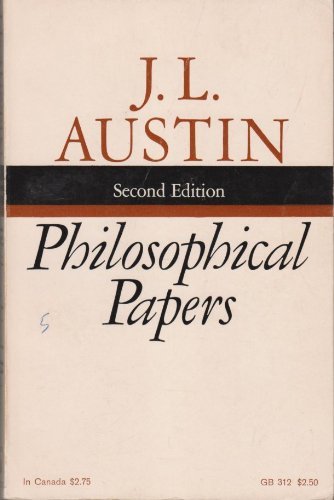
Philosophical Papers – J.L. Austin Paperback – 1970 by J. O. Urmson (Editor), G. J. Warnock (Editor)
User’s Reviews
Reviews from Amazon users which were colected at the time this book was published on the website:
⭐John Austin, Professor of moral philosophy at Oxford, died in 1960 before reaching age 50. He was possibly one of the most influential abstract thinkers who ever thought an abstraction, but we have to gain our own knowledge of this brilliant mind from collections of his lectures and his articles in philosophical journals. The Philosophical Papers is a miscellaneous assemblage of his writings on a number of topics, and it has grown by several items since I last and first read it 45 years ago. The articles are of differing degrees of complexity, but Austin is never obscure and he has a delightful turn of phrase. Two pieces here partly address a couple of my own favourite conundrums – free will vs determinism is touched on in Ifs and Cans, and the first piece deals with a number of the questions that bother me in Aristotle’s supposed identification of `happiness’ as being the `end’ or main objective of life. I would also have loved to set an exam question inviting candidates to discuss the proposition on p34 `myths are invented about our “contemplation” of ursaneivls’ for the sake of seeing someone set about it; but alas this unfamiliar term is only a printer’s pie for `universals’.Whether or not Austin pronounced any doctrines, he certainly established a method. The great philosophers have in general tried to create or identify some over-arching theoretical scheme for organising human thought, and in general they finish up like mechanics with several parts left over after supposedly completing their work on the car – it never seems to fit exactly. You can read Austin’s own basic manifesto here in A Plea for Excuses, the most relaxed and informal item in this collection. Human language, says he, has had time to make any distinctions humanity has yet thought worth making – `words are our tools and, as a minimum, we should use clean tools.’ This and the chapters following (excluding the one on Plato) are probably the easiest to follow as examples of his approach in action, and the earlier How to Talk-Some Simple Ways is actually the hardest. It all depends on an acute ear for language and meaning, but the least of us ought to be able to get the hang of Austin’s approach, observing in passing the ruins of more traditional theories. In the Plea for Excuses he toys with the idea of cataloguing our language systematically, but I doubt he really believed that this would do the work of his own presence of mind and accuracy of aim, the very qualities that Housman praised in Bentley’s genius for the sister science of textual criticism.Specious assumptions are dispersed like chaff, e.g. does a statement have to be either true or false? Even if we throw in intermediate gradations such as `likely’, ‘apparent’, `misleading’ etc, can we deal with `A cat sat on a mat’ on this basis? This is an example of an elementary sentence for infants, and to ask whether it’s `true’ is nonsensical – it’s committing what Ryle calls the category-error, and the same goes regarding any work of fiction. Ifs and Cans is not basically concerned with free will and determinism, but it contains enough about them to whet my appetite. Austin claims that determinism has not been properly defined, but I take it to mean that anything that happens, including our own actions, could not have happened otherwise, and that it is all the result of an incalculably large network of causes and effects. I have seen one scientist try to get us off this hook by appealing to a randomness in the behaviour of subatomic particles, but I can’t see that that helps. Either we are glorified machines or we are not, and if we are there can, logically, be no validity in a guilty verdict in a trial as the prisoner’s action was predetermined. Austin clearly doubts determinism, and he makes the valuable point that `free’ as in `free will’ is a device for discounting alternative possibilities, as `real’ also is. Free will as opposed to what kind of will? The difficulty is in `will’ not in `free’ — what is it? Can thoughts and associated concepts such as choices and decisions be classified as `events’ like the weather, subject to causes? If detective D decides that suspect S1 is guilty of the crime because S1’s eyes are too close together we can `account for’ or `explain’ D’s view by his temperament or his upbringing or his experience of life and so on, but do any of these `cause’ his opinion? It makes good sense to say that D later `forces himself’ to take account of the evidence that the guilty party is really suspect S2 and changes his mind against his natural inclination. This is my own idea of `will’ in action, but can evidence (which is not an `event’ anyhow) be said to have `caused’ the change?Can you make yourself believe that Aristotle said that happiness is the main objective in life and that it is defined as `a sort of activity of the spirit in accordance with complete virtue’? Neither can I, but a lot of his translators and commentators can. Happiness is something that Aristotle or any of us take when we can get it, and it is no sort of activity. Richard Robinson (in Definition) says briskly that Aristotle is really defining the means towards happiness, but I believe Aristotle meant what he said, and I don’t believe he said `happiness’. To his credit Austin has some doubts about this standard translation. He tries `success’, but on balance makes do with `happiness’ after all. I’ll try `wellbeing’. This makes sense as `a sort of activity’, sc the non-intellectual aspect of life, well encapsulated in the Greek `eudaimonia’ or `enjoying the favour of the gods’ – the Greek for `happy’ is `olbios’ not `eudaimon’. Take `eu prattein’ in its sense of `faring well’ rather than `behaving well’, and take this `virtue’ as `finest characteristic’ (as in `the virtue of soya is in its nutritional properties not in its flavour of which there is none’) and it all seems to make better sense.I find it all wonderful and liberating to the mind and spirit. This does not involve agreeing with everything, indeed Austin often marks his thoughts as tentative or provisional. It is all about how to think not what to think, and Austin’s own beautiful aphorism makes a good summing-up for the activities of the mind `Neither a be-all nor an end-all be.’
⭐This is a simple and straightforward presentation of several papers by J.L. Austin. The anthology covers the full range of his career, including a few essays on topics in ancient philosophy. The editors add very little to the work, which offers a ‘clean’ look at the work, but it wouldn’t hurt to offer some sort of introduction.
⭐The great philosopher’s ollected papers
⭐いわば落穂ひろいであり、主著ほどの重量感はありません。しかし価値はそれに劣らない…などとは言いますまい。まずHow to do things with wordsを読み込むべきでしょう。ただし、今後彼の仕事の価値が間違いなくあがると思われるので、最高評価をつけます。彼の理論展開は実に地味で、対象をじかに取り上げず、それを表現する言い回しのわずかな差異をことさらあげつらっているだけのように読めます。こんなもんが役に立つのか、もっと科学的にズバッと切り込んだほうが良いだろうともどかしく、日常言語学派は所詮傍流だなと見くびっておりました。しかしその後科学者の論文、エッセイなどを読みながら、オースティンの重要性にようやく思い至ります。たとえばシュレーディンガーのネコで知られるミクロ・マクロのギャップを、もし量子論に従う形で解決するなら多世界解釈になります。しかしそれはありそうになく、われわれは単純に「矛盾がある」と言うでしょう。これをマレイ・ゲルマンに論じさせると、微視化、粗視化という言葉を使い、それぞれの歴史が干渉しあうかどうか、という語り方になる。これは一見量子論に精通した人間が正しい「理論」を述べているようですが、じつは多世界解釈を単なるイメージで現実に重ね合わせているだけで、われわれが矛盾と呼ぶものと、説得力において少しも変わっていないのです。それは彼自身の、フィクションの納得の仕方の問題に過ぎない。マレイ・ゲルマンは自分の言葉遣いに騙されているだけです、たぶん。この部分に異論はあるでしょう(特に科学畑の人には)。しかしウィトゲンシュタインからオースティンに至る流れを読み込んだ上で、改めて考えてみて下さると、あるいは何割かの人は私に賛成してくれるかもしれません。まあ、こんな言い方に腹が立ったなら、ぜひ彼の本に直接当たってみてください(笑)。
⭐
Keywords
Free Download Philosophical Papers – J.L. Austin in PDF format
Philosophical Papers – J.L. Austin PDF Free Download
Download Philosophical Papers – J.L. Austin 1970 PDF Free
Philosophical Papers – J.L. Austin 1970 PDF Free Download
Download Philosophical Papers – J.L. Austin PDF
Free Download Ebook Philosophical Papers – J.L. Austin