

Ebook Info
- Published: 2001
- Number of pages: 256 pages
- Format: PDF
- File Size: 18.51 MB
- Authors: Alexander George
Description
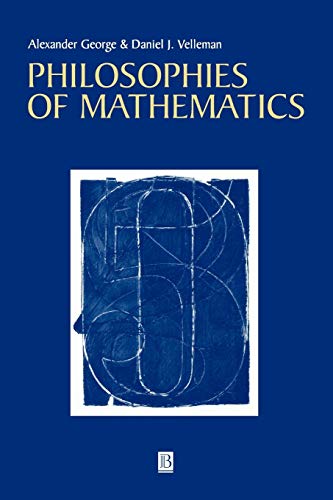
This book provides an accessible, critical introduction to the three main approaches that dominated work in the philosophy of mathematics during the twentieth century: logicism, intuitionism and formalism.
User’s Reviews
Editorial Reviews: Review “George and Velleman manage to accomplish a difficult feat: on the one hand, they explain, clearly and rigorously, a number of highly technical accomplishments of twentieth-century mathematical logic, making plain the relevance of the mathematical work for philosophy; yet, on the other, they presuppose little more from their readers than a first course in basic logic. The examples they choose to explicate their points are carefully selected and illuminating. This is a splendid book.” William Ewald, University of Pennsylvania “This book includes just the right mix of helpful historical exposition and clear, tight philosophical argument. It is extremely well written and does an excellent job of making difficult material accessible. There is nothing else currently available that discusses in a single volume such a wide range of important material. The authors are to be commended for a job well done.” Andrew Irvine, University of British Columbia “This is a well-written, informative and innovative introduction to philosophies of mathematics. It is a very valuable addition to the existing literature.” Wilfried Sieg, Carnegie Mellon University From the Inside Flap During the first few decades of the twentieth century, philosophers and mathematicians mounted a sustained effort to clarify the nature of mathematics. This led to considerable discord, even enmity, and yielded fascinating and fruitful work of both a mathematical and a philosophical nature. It was one of the most exhilarating intellectual adventures of the century, pursued at an extraordinarily high level of acuity and imagination. Its legacy principally consists of three original and finely articulated programs that seek to view mathematics in the proper light: logicism, intuitionism, and finitism. Each is notable for its symbiotic melding together of philosophical vision and mathematical work: the philosophical ideas are given their substance by specific mathematical developments, which are in turn given their point by philosophical reflection. This book provides an accessible, critical introduction to these three projects as it describes and investigates both their philosophical and their mathematical components. Solutions manual is available upon request. From the Back Cover During the first few decades of the twentieth century, philosophers and mathematicians mounted a sustained effort to clarify the nature of mathematics. This led to considerable discord, even enmity, and yielded fascinating and fruitful work of both a mathematical and a philosophical nature. It was one of the most exhilarating intellectual adventures of the century, pursued at an extraordinarily high level of acuity and imagination. Its legacy principally consists of three original and finely articulated programs that seek to view mathematics in the proper light: logicism, intuitionism, and finitism. Each is notable for its symbiotic melding together of philosophical vision and mathematical work: the philosophical ideas are given their substance by specific mathematical developments, which are in turn given their point by philosophical reflection. This book provides an accessible, critical introduction to these three projects as it describes and investigates both their philosophical and their mathematical components. Solutions manual is available upon request. About the Author Alexander George is Associate Professor of Philosophy at Amherst College. He is editor of Reflections on Chomsky (1989) Western State Terrorism (1991) and Mathematics and Mind (1994). Daniel J. Velleman is Professor of Mathematics at Amherst College. He is author of How to Prove It: A Structured Approach (1994) and co-author of Which Way Did the Bicycle Go? And Other Intriguing Mathematical Mysteries (with Joseph Konhauser and Stan Wagon, 1996). Read more
Reviews from Amazon users which were colected at the time this book was published on the website:
⭐A few days ago, I favorably reviewed
⭐, on the same subject. I now almost regret giving that book 4 stars, since the book by George and Velleman is so much better. I am tempted to call it the perfect introduction to the subject for the philosophically inclined mathematician.Most mathematicians are put off by lengthy discussions of irrelevant looking details that never seem to go anywhere, of the type that is commonly found in more philosophically oriented books. The present book avoids these pitfalls. It presents the main ideas of the three classical approaches to the foundations of mathematics: logicism, intuitionism, and formalism (called finitism in the book). In each case, there is a no-nonsense style general presentation that seeks to extract the key ideas, what seems worth preserving. The authors’ decision to leave matters of historical scholarship completely aside (who thought what when?) works extremely well.These chapters are followed by meaty mathematical chapters that show what these theories amount to when you actually, as the phrase goes, “do the math.” The finitism chapter, with a very careful discussion of Gödel’s two incompleteness theorems, is outstanding, and the other two are also very good. Maybe the authors could have added some more detail on how one would go about formalizing classical mathematics in ZFC set theory; here the discussion becomes somewhat informal very soon.In summary, this is a fantastic book on a fascinating subject. Unfortunately, it will probably only appeal to a very narrow target audience. You will probably need a solid graduate level math background to get anything out of the technical chapters (but then, without that background, you probably wouldn’t be interested in the subject in the first place). For the chapter on Gödel’s Theorems, some prior exposure to first order logic will definitely be helpful, or at least you want to keep a logic textbook nearby.
⭐Most philosophy of mathematics survey books give a general account of various theories and programs without actually getting into technical details or doing some math. What distinguishes this book is it actually gets into the technical details. Instead of just saying “logicists derived math from logical principles” it shows how this was attempted. The same goes for deriving mathematics from set theory, and deriving it from intutuionistic logic, etc. This is not a breezy read and needs to be studied closely, but for someone who wants more substance after reading some non-detailed introductory accounts of philosophy of mathematics, it’s an excellent book.
⭐Readers disappointed with this book may find that William Byers’ How Mathematicians Think may be a better title, when it comes to range and depth of insight about mathematics.This title is clearly ‘philosophy of mathematics’.I found the articles stimulating and not off-topic.An enjoyable read, and professionally done, with many takeaway points.
⭐Arrived very quickly! Completely satisfied!
⭐If you want to become or are a practicing Mathematician and want to get a acquainted with what is really going on underneath the naive and mechanical side of Mathematics, do yourself a favor an read/study this book. In some 200 pages the authors give you so much content!!! I know this will be one of the books I keep reading and which content I will keep thinking about, so I heavily earmarked and annotated it.~ The only two issues I have with this book after my first thorough read are:~ 1) what I believe to be a mistake on page 136 while presenting -choice sequences- it is stated on the 3rd paragraph : “It might help to think of choice sequences as a sequence of rational numbers that is generated by someone else”; now look closely at the definition of Cauchy sequences (32) on page 72. Is it safe to assume, that the totality of real numbers can be covered by an infinite, converging sequence of -rational- numbers?~ 2) on page 148 in which the authors mentioned David Hilbert’s somewhat semiotic view of the foundations of Mathematics “In the beginning was the sign” … they say that “Much scholarship has been devoted to fine questions regarding this intuition”, but then they end their reference to it by saying “we will not delve to deeply into these matters here”. Why not giving the interested readers some more information about where all the scholarship devoted to these fine questions can be found?~ Please, if you know better about any of these questions , I am asking for clarification/help! Thank you
⭐この本は数学の哲学の基本的な知識を、哲学的な議論と共に最低限必要な数学的議論を交えて教えてくれる。数学の哲学を理解する為には,その背景となっている数学,論理学についてある程度理解していないと,単なるお話になってしまう.だから,数学の哲学の専門書や論文は技術的な知識を背景にして議論に進んでいく.そうしたスタイルに慣れるためにも,この本はいいと思う.数学的議論に関しては入門書だから完全に厳密ではない箇所もあるかもしれないが、エッセンスは十分わかる。いきなり雑誌論文や専門書は難しいと思う人でも、この本なら読めるだろう。前提となっている知識としては、一階述語論理の初歩程度であるように思う。
⭐
Keywords
Free Download Philosophies of Mathematics 1st Edition in PDF format
Philosophies of Mathematics 1st Edition PDF Free Download
Download Philosophies of Mathematics 1st Edition 2001 PDF Free
Philosophies of Mathematics 1st Edition 2001 PDF Free Download
Download Philosophies of Mathematics 1st Edition PDF
Free Download Ebook Philosophies of Mathematics 1st Edition