

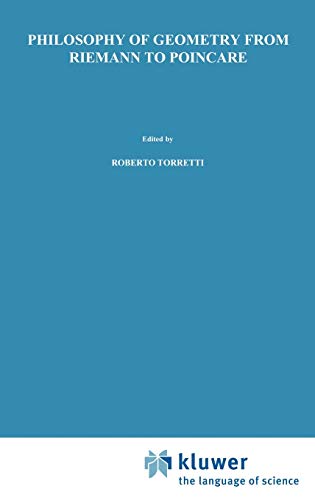
Ebook Info
- Published: 1978
- Number of pages: 474 pages
- Format: PDF
- File Size: 12.30 MB
- Authors: R. Torretti
Description
Geometry has fascinated philosophers since the days of Thales and Pythagoras. In the 17th and 18th centuries it provided a paradigm of knowledge after which some thinkers tried to pattern their own metaphysical systems. But after the discovery of non-Euclidean geometries in the 19th century, the nature and scope of geometry became a bone of contention. Philosophical concern with geometry increased in the 1920’s after Einstein used Riemannian geometry in his theory of gravitation. During the last fifteen or twenty years, renewed interest in the latter theory -prompted by advances in cosmology -has brought geometry once again to the forefront of philosophical discussion. The issues at stake in the current epistemological debate about geometry can only be understood in the light of history, and, in fact, most recent works on the subject include historical material. In this book, I try to give a selective critical survey of modern philosophy of geometry during its seminal period, which can be said to have begun shortly after 1850 with Riemann’s generalized conception of space and to achieve some sort of completion at the turn of the century with Hilbert’s axiomatics and Poincare’s conventionalism. The philosophy of geometry of Einstein and his contemporaries will be the subject of another book. The book is divided into four chapters. Chapter 1 provides back ground information about the history of science and philosophy.
User’s Reviews
Editorial Reviews: Review `…a carefull and scholarly discussion of the history and philosophy of geometry from the 1850’s, marked by Riemann’s generalized conception of space, and ending with Hilbert’s axiomatics and Poincaré’s conventionalism at the beginning of the century.’ The Modern Schoolman `This is a deeply learned, scrupulously careful, very informative book which was well worth writing… In sum, Toretti has written carefully, with much insight, deep and broad learning, and sober judgement on a topic of profound difficulty and interest.’ Australian Journal of Philosophy `Torretti has written a very useful book which helps fill a large gap in the literature on the philosophy of mathematics.’ The Philosophical Quarterly `It delves into the contributions of many neglected writers and dispells myths concerning the contributions of others, which have too often been perpetuated in the philosophical literature… I suggest that it deserves to become a standard word.’ Dialogue
Reviews from Amazon users which were colected at the time this book was published on the website:
⭐This is an extremely prejudiced history of the foundations of geometry. Torretti is a modernist through and through, incapable of empathy for anyone except Riemann. He goes down the list of contributors to the foundations of geometry, summarises their work haphazardly, translates it into pretentious modern terminology and notation, and proclaims that they were stupid whenever their ideas differ from his own, often imagining himself slaying their entire argument by some trivial observation or other.An example of the latter phenomena is Helmholtz’s discussion of the role of rigid motions in geometry. This Torretti dismisses in two lines, using the analogy of two-dimensional creatures living on a surface. “If they happen to live, say, upon an egg, they will be unable to build transportable rigid figures, and, consequently, according to Helmholtz, they will be incapable of defining a geometry. Though Helmholtz introduces the example of an egg, he does not draw the latter consequence; had he drawn it, it would probably have shocked him out of his operationist bias” (p. 392).It’s the same with Poincaré. “Though Poincaré was well acquainted with Minkowski’s work—indeed he even anticipated some of its technical aspects—he apparently failed to appreciate its great significance for the philosophy of geometry” (p. 333), explicitly stating the opposite (p. 414).These, then, are two instances where Torretti imagines himself to have refuted two of the greatest thinkers in the book by counterexamples that were well known and even discussed by these thinkers themselves. If Torretti was not so quick to dismiss everyone’s understanding as inferior to his own, this should perhaps have suggested to him that he had not fully grasped their arguments.Torretti maintains this condescending attitude throughout. Frege, for example, “shows a lack of understanding … that is indeed astonishing” (p. 251). Only Riemann is worthy of some praise. Unfortunately, “Riemann’s broadminded conception of geometry” was replaced by “Helmholtz’s dogma of complete free mobility” (p. 185). Klein, too, in foolishly discussing spaces of constant curvature even though more general spaces can be defined, “loses sight of the full scope of Riemann’s conception” (p. 138), and so on.Unlike Helmholtz, Torretti himself is of course not dogmatic in the least. For example, he is of the balanced opinion that “an axiomatic characterization of projective space would provide the best approach to such a thoroughly unintuitive geometry” (p. 110). Alas, the greatest minds of the century were too stupid to understand that this is the “best” approach; “neither Klein nor his predecessors judged [an axiomatic approach] necessary or even useful” (p. 110), because they were not “aware that their true concern was with abstract structures, not with particular things” (p. 190). Some readers may have been uncomfortable with Torretti’s frequent confessions that he “fail[s] to see” (p. 149) the value of so many of the arguments under discussion—indeed, some may wonder why he chose write a book about something he admittedly understands so little about—but now it is all clear. Poor Torretti has to deal with authors who are “not aware” what their “true concern” is. No wonder he does not understand. Of course Torretti knows the “best” way to understand these “true concerns,” so his confessions of confusion constitute legitimate criticism.Now let us look at Torretti’s treatment of a specific issue: to what extent Euclidean geometry should be considered an empirical theory. “Paradoxically, the propositions of [geometry do] not seem to be liable to empirical corroboration. Since the times of the Greeks, no geometer had ever thought of subjecting his conclusions to the verdict of experiment.” (p. 254). Now this is just ridiculous, even for Torretti. Geometry is plainly the most empirically well-corroborated theory ever created. Torretti, however, in line with his view that the “true concern” of geometry is axiomatics, believes that “Greek mathematicians did not care to determine whether their basic premises were true or not” (p. 9). Torretti then goes on to scorn that proposed proofs of the parallel postulate “depended always explicitly or implicitly upon new assumptions, no less questionable than the postulate itself” (p. 40), and is disappointed that “surprisingly … no attempt at bringing out every presupposition of Euclid and filling all the gaps in his proofs was carried out in earnest until the end of the 19th century” (p. 189). In other words: Torretti has decided that geometry is about axiomatics and has nothing to do with empiricism, which forces him to look down on every mathematician who ever worked on the parallel postulate and indeed also on everyone else for not doing axiomatics the way he wants. Is there perhaps another way of viewing the history of geometry that does not require us to have contempt for every single mathematician between Euclid and Riemann? Let us assume for the sake of argument that the essence of geometry is not axiomatics but empiricism. First of all, how would Euclid’s axioms appear from this point of view? Postulates 1 to 4 are very convincing empirically, even in a finite universe bounded by the sphere of the fixed stars, contrary to Torretti’s assertions (pp. 8-9; his main argument in support of his view quoted above); for example, postulate 3 does not require that “every point can be the centre of a circle of any arbitrary radius,” but rather that one can construct a circle with a given centre and a given radius (given as in ‘from here to here’). The parallel postulate, however, is not empirically convincing. It makes perfect sense, then, that mathematicians should concentrate on the parallel postulate. It is not “surprising” that they did not bother spelling out all of Euclid’s assumptions since these are all empirically convincing (e.g., triangle congruencies, etc.). Indeed, from the empirical point of view, work on the parallel postulate was by no means a naive failure leading only to “new assumptions, no less questionable than the postulate itself.” Instead, such work was remarkably successful in reducing the empirically intractable parallel postulate to more tangible assumptions. Wallis, for example, derived the parallel postulate from the existence of similar figures, i.e., in effect, from the existence of squares, since “these figure can obviously be multiplied through mere juxtaposition” (p. 45).
⭐
Keywords
Free Download Philosophy of Geometry from Riemann to Poincaré (Episteme, 7) in PDF format
Philosophy of Geometry from Riemann to Poincaré (Episteme, 7) PDF Free Download
Download Philosophy of Geometry from Riemann to Poincaré (Episteme, 7) 1978 PDF Free
Philosophy of Geometry from Riemann to Poincaré (Episteme, 7) 1978 PDF Free Download
Download Philosophy of Geometry from Riemann to Poincaré (Episteme, 7) PDF
Free Download Ebook Philosophy of Geometry from Riemann to Poincaré (Episteme, 7)