

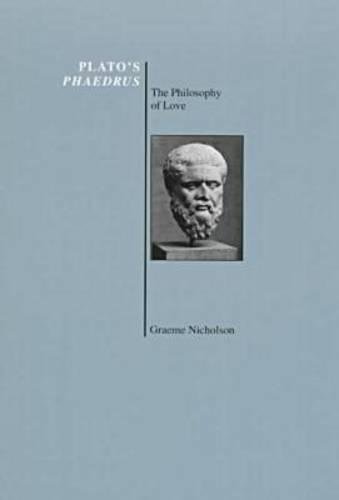
Ebook Info
- Published: 1999
- Number of pages: 231 pages
- Format: PDF
- File Size: 6.63 MB
- Authors: Graeme Nicholson
Description
The Pbaedrus lies at the heart of Plato’s work, and the topics it discusses are central to his thought. In its treatment of the topics of the soul, the ideas and love, it is closely tied to the other dialogues of Plato’s “middle period,” the Pbaedo, the Symposium, and the Republic.
User’s Reviews
Editorial Reviews: Review “I know of no other treatment, commentary, or analysis of the Phaedrus that manages to be quite as accessible or successful on the questions [that Nicholson discusses].” (Kevin Corrigan) About the Author Graeme Nicholson’s areas of research include ontology and hermeneutics, Plato, and philosophical theology. His previous publications include Seeing and Reading, a study in hermeneutics, and Illustrations of Being, a book devoted to ontology. He is a coeditor of the book series Contemporary Studies in Philosophy and the Human Sciences (Humanities Press).
Reviews from Amazon users which were colected at the time this book was published on the website:
⭐The Phaedrus is among Plato’s deepest and most moving dialogues. It is full of myth, poetry, insight and thought. Even more than is the case with most of Plato, it is difficult to pin this work down to consider it as a treatise on a single subject matter. The dialogue form and Plato’s own thinking do not allow such reduction. Broadly speaking, the dialogue deals with the nature of love with this question threaded in with a discussion of the nature of speech and writing and their respective roles in thinking about important questions (such as the nature of love.) The main body of the dialogue consists of three speeches, one a written speech by Lysias, and two oral speeches by Socrates. The speech by Lysias and the first speech of Socrates argue that it is more advangateous for a young person to be wooed by a person who does not love him. Socrates second speech, the pivotal portion of the dialogue, strongly takes issue with this in a discussion of the nature of love, passion (madness), the human soul, and the world of Platonic form.Graeme Nicholson is a professor of philosophy at the University of Toronto and a fellow of Trinity College. His book is a study of the Phaedrus prepared as part of a series of Purdue University Press’ History of Philosophy Series, each volume of which is devoted to a detailed consideration of a specific philosophical text. The Phaedrus has received such consideration in other studies (by Charles Griswold, Luc Brisson, Seth Bernadette, among other scholars), but the work is inexhaustible and well deserves the extended treatment it receives here. Nicholson, properly and commendably, philosophizes with Plato. He sees the ancient character of the texts but does not stop there. He tries to show how the Phaedrus, with all its antiquity, addresses problems of modern readers in an important an elucidating way.Nicholson’s focus is on the nature of love. Many readers understand Plato to argue that eros is a step on the way to a broader, rationalistic understanding of the ideas. But Nicholson argues well that the Phaedrus reverses this pattern. Plato here sees eros and passion – a commitment to study and to understanding and a fire within one — as a precondition to any serious endeavor, philosophical or otherwise. Nicholson proceeds to show how this understanding of eros allows Plato in the Phaedrus to take a broader view of the nature of myth, poetry, rhetoric, and music as themselves contributing to and enabling the process of philosophical understanding. I find this a valuable insight into the Phaedrus.Nicholson also has challenging things to say about Plato’s concept of being (or of being-beyond-being). He sees this as a spritual and valuable concept, to simplify broadly, and as an important and, with current explanations and explications, viable antidote to much of the scientism and materialism in contemporary thought and in the assumptions of many people. This too is a valuable and thoughtful way of approaching the Phaedrus.The core of Professor Nicholson’s study is Socrates’s great speech on love which he presents in Part II of the book in a fresh translation. This translation is followed by a long, careful, exploration in Part III of the various themes of the book. Part I of the book gives backround on Plato and on the Phaedrus’s relationship to Plato’s body of work. There are introductory chapters on myth, rhetoric, dialectic, and writing. All these themes are important to the Phaedrus and they are developed with good use of authority to other Platonic and Greek texts, and to the work of modern philosophers and scholars.The book suffers somewhat but ignoring Plato’s own order of presentation. There is this a lack of attention to the dramatic development — to the manner in which Plato tries to show the interrelationship of the themes of the Phaedrus — how one leads into another. This is no small task. Thus in the early sections of the book, Professor Nicholson discusses themes that Plato reserves for the end of the dialogue — such as the nature of dialectic and the relative merits of writing and discussion. (The story of the god Theuth and his gift of writing to the King of Egypt is discussed early in Nicholson, for example, but it appears only at the end of the Phaedrus.) The presentation thus misses some of the opportunities to discuss how Plato and the reader should view the development of the themes in the dialogue.It is good to read the Phaedrus — or to reread it as the case may be — in the context of reading and studying this book. I thought the book helped me understand and appreciate the Phaedrus and Plato. This great ancient philsopher has much to teach us.
⭐As Luc Brisson eloquently observed, ‘Plato was a mythmaker.’ So why make myths? The most obvious answer is that a ‘myth’ provides the vehicle for expressing what cannot be simply and memorably expressed in any other way. Almost every dialogue has a myth within it; the Phaedrus opens with the myths associated with the local setting of the dialogue. Socrates clearly knows the details, but he declines exploring them with Phaedrus because his bottom line for any inquiry is: ‘Is this inquiry going to contribute to my self-knowledge?’ (re. the oracular statement at Delphi: ‘know thyself.’) After reading the Phaedrus, the image that is remembered is not some vague image concerning love, but the image of man’s soul as a composite – a pair of winged horses and a charioteer, and while the charioteer might be said to represent reason, the two horses represent the two natures of man – the earthly and the divine, and the soul, with other souls, may follow the chariots of the gods to the rim of being, or the wings become damaged and the soul returns to another embodiment.There are almost, by convention, three ways of approaching a Platonic dialogue for translating and publishing, taking the Phaedrus as an example: the first is the most obvious and aimed perhaps, at the more general reader; a straight forward translation like the Waterfield translation, with an introduction which picks out salient features, and a running system of footnotes, often appended after the translation; there may also be a glossary: accessible, but does not really prompt questions on the reader’s part. The second, assumes some familiarity with Plato like the Hackforth translation, so that the introduction will be wider than the immediate context of the text; the footnotes may include points of more academic interest, such as the reading of particular parts of the text, or cross references. The actual translation may be continuous or it may have been broken down into thematic of sequential sections – as it is in the Hackforth translation, and each section is notated individually: accessible on a different level, and encourages reflexive questions. The third kind is where the dialogue itself is the focus of a study, where the translation takes the form of a reflexive commentary, such as Ferrari’s ‘study’ (Listening to the Cicadas), where direct references to the text will be anything from a phrase to a whole sentence – with the relevant Stephanus pagination, and footnotes are much more specific to issues raised by the discussion. It is to this ‘genre’ that Nicholson’s Phaedrus could be assigned.Many if the Dialogues have an opening question which as it were, sets the theme, so one can say with the Theaetetus, that the opening question ‘What is knowledge?’ sets up the dominant theme of knowledge. The Phaedrus opens with a discussion on Myth, before moving onto rhetoric – a subject that like of the Sophists comes up in many of the Dialogues as objects of Socrates’s criticism. The central section of the Phaedrus blurs the distinction between myth and memory, so to open with myth is very relevant. The Phaedrus could be read as a sequence of chapters, each with one main topic, and this is the pattern that Nicholson follows: Myth; Rhetoric; Dialectic; writing; Socrates’s Great Speech; and then the remaining half, dealing with the Philosophy of Love: Two speeches against love; the Gods; the human soul; Truth; Love and beauty; and politics. Nicholson suggests that the Socratic elenchus provoked more resentment than stimulating conversation, but the style of writing here is reflexive, in places insightful – at least to me – for example the triad of the two horses and the charioteer as being a variant of the concept of the tripartite soul found in the Republic and the Timeaus but not in the Symposium. And to make sure that historical contexts do not elude us, he frequently makes observations like – when contrasting the Symposium and the Phaedrus: ‘Plato in the Phaedrus is something like Hegel, for Hegel postulated Verstand, intellect, as one power within Geist, one that had to kept from insisting on its own primacy. The barren intellectualism of Lysias’s address [which Phaedrus so admires], devoid of aphrodosisia and indeed all forms of eros would signify the deviant situation in which the whole soul was overshadowed by, subordinated to, logos. Applying divine madness as the corrective to such intellectualism, we see the liberation of a soul that is whole and integrated.’ (p. 197-8) A different approach to reading Plato, and in particular the Phaedrus, even if Nicholson does raise questions that he does not offer answers to, which is of course, very much in the tradition of the Socratic elenchus.
⭐
Keywords
Free Download Plato’s Phaedrus: The Philosophy of Love (Purdue University Press Series in the History of Philosophy) in PDF format
Plato’s Phaedrus: The Philosophy of Love (Purdue University Press Series in the History of Philosophy) PDF Free Download
Download Plato’s Phaedrus: The Philosophy of Love (Purdue University Press Series in the History of Philosophy) 1999 PDF Free
Plato’s Phaedrus: The Philosophy of Love (Purdue University Press Series in the History of Philosophy) 1999 PDF Free Download
Download Plato’s Phaedrus: The Philosophy of Love (Purdue University Press Series in the History of Philosophy) PDF
Free Download Ebook Plato’s Phaedrus: The Philosophy of Love (Purdue University Press Series in the History of Philosophy)