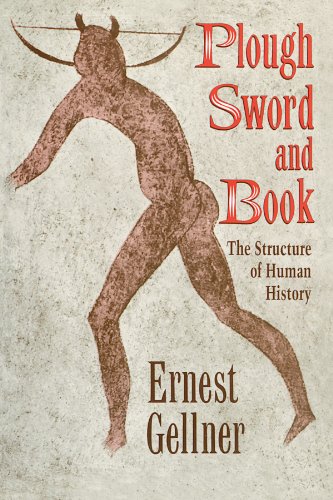
Ebook Info
- Published: 1990
- Number of pages: 288 pages
- Format: PDF
- File Size: 1.56 MB
- Authors: Ernest Gellner
Description
Philosophical anthropology on the grandest scale. . . .Gellner has produced a sharp challenge to his colleagues and a thrilling book for the non-specialist. Deductive history on this scale cannot be proved right or wrong, but this is Gellner writing, incisive, iconoclastic, witty and expert. His scenario compels our attention.—Adam Kuper, New Statesman”A thoughtful and lively meditation upon probably the greatest transformation in human history, upon the difficult problems it poses and the scant resources it has left us to solve them.”—Charles Larmore, New Republic
User’s Reviews
Editorial Reviews: From Publishers Weekly Dividing world history into three phases (hunting/gathering, agriculture and industry), this study asserts that most agrarian civilizations are too self-limiting for the leap into capitalism and a market economy. “Gellner’s ambitious theory smacks of Eurocentric hubris, and . . . his prose is turgid and portentous,” chided PW. Copyright 1990 Reed Business Information, Inc.
Reviews from Amazon users which were colected at the time this book was published on the website:
⭐Plough, sword and book – sounds like the title of another easily digested history of humanity, but don’t be mistaken. Ernest Gellner never wrote a book just to restate the familiar and obvious. His style is intellectually challenging and not intended for leisurely reading.This book presents a theory of history utilizing mostly sociological tools, but also with many elements from the history of philosophy. Gellner finds unique perspectives by combining material from different fields in his analysis, but quite a bit of background knowledge is assumed. It seems to me that the reader should have some familiarity at least with the classic works of sociology (Durkheim, Weber) and/or the history of philosophy (Plato, Descartes, Kant). This book is of course not a detailed study of any of those classics, but much of the text proceeds by discussing platonic, cartesian and weberian ways of thought on an abstract level, so you do need to have some understanding of the associated terminology before you start reading this book.However, while abstractions can be useful for seeing the big picture, in this book they are sometimes simply confusing. Some historical exemplification in between the theorizing would have been very helpful. Too many times Gellner flies so high in his abstractions that the reader has no chance of connecting his ideas to any real event or movement in world history. This is the case especially for his analysis of Cognition, where the argument is framed with strange phrases like “Platonism is the supreme expression of agro-literate man” (p.118). It is actually difficult to understand what Gellner means by “Platonism” in this context since his usage is unconventional and historical examples are not offered.In my opinion, the analysis of the other main topics of the book (Coercion and Production) stands on a firmer basis than the theory about Cognition. Towards the end of the book some of the material is actually a bit outdated since Gellner discusses the contemporary “marxist state” and the like (the book was written in 1988).So this book has some minor flaws, but the great majority of it is still very interesting and useful for people who want to study our contemporary world from a critical and historical perspective. The breadth of material is very impressive, ranging from the dynamics of agrarian societies to problems of modern democracy and colonial legacies. And for such a short book, it’s important that Gellner manages (most of the time) to produce well-structured accounts of the human past while also recognizing its diversity.For people with the some background in these topics, this is a book which can be read several times, providing new questions with each reading.
⭐Insightful overview of human history. Thought-provoking.
⭐Ernest Gellner’s philosophy of human history as discussed in Plough, Sword, and Book offers readers a view of human history that is unique and comprehensive. The author aims to outline human history with theories and models that employ a method of deductive reasoning. Specifically, Gellner wishes to offer his readers a “clear and forceful” view of his philosophy so that it may be examined critically (page 13). Gellner’s model of human history entails a society passing through three principal stages: hunting and gathering, agrarian society, and industrial society (pages 16-17). The author enlists a number of sources from which he derives his philosophic analysis of humanity’s development and evolution. Gellner’s discussion of Platonism with respect to cultural intuition and adoption of an explicit theory stating what had previously been a mere practice (pages 76-77) mingles with Hegel and Marxist theories on thought and politics (pages 142-143). His variety of sources allow for a wide range of both philosophic input and debate. Essentially, the author pushes for a philosophic historical outline that depicts hunting and gathering groups of humans who eventually initiate an agricultural community stemming from a sense of long-term obligation to their individual group (page 33). Agrarian societies-Gellner’s plough-then pass into an industrial or urban society which allows for the entry of a class system in which social order must be maintained through defensive groups or order-enforcers (page 145)-Gellner’s sword. The transitions between stages could not be possible without the cognitive development of mankind through the introduction of literacy (page 71) through religious scriptures-Gellner’s book. In Gellner’s model of human history, religion also provides legitimization of the social system (page 99) leading to modern society. As the author discusses the shift between the three principle stages of human history, he outlines the major activities that pushed society through the industrial and agricultural revolutions, or “great leaps” of human history. These activities fall into three main groups identified by Gellner as production, coercion, and cognition (page 20-23). Agrarian societies focused mainly on the production and storage of food (page 16) while Industrial societies focused on the production of wealth and weapons, or means of coercion, and the production of food becomes a lesser focus (page 17). One of the most important elements in the evolution of human history, cognition, occurred at the point when “the genetic equipment of man became so permissive as to allow the wide range of social comportment” that we can observe in the modern society (page 67). For the average reader, Gellner’s “clear and forceful” statement (page 13) within the pages of Plough, Sword, and Book can be a bit overwhelming in that it provides a great deal of philosophic idea applied to history between the Neolithic age and the present. At times, Gellner’s text may also seem overwritten which could muddle his “clear” statement to scholarly readers. Perhaps Gellner’s most successful element within his text was his execution and compilation of so many philosophic thinkers’ ideas into a single outline. Gellner includes ideas from Aristotle to Weber and from Kant to Kuhn making his philosophic vision of human history a scholarly work indeed. Although the future of human history cannot, according to Gellner (page 15), be predicted, Plough, Sword, and Book can help scholars understand the evolution of our past so that we may better understand the future though the greater possibility of comprehension provided by Gellner’s scholarly efforts.
⭐Too many words, too few thoughts.
⭐Ce livre est un classique. Si on est interessé en anthropologie, sociologie, histoire ou en une interpretation globale de l’Histoire ondoit le lire.
⭐
Keywords
Free Download Plough, Sword and Book: The Structure of Human History in PDF format
Plough, Sword and Book: The Structure of Human History PDF Free Download
Download Plough, Sword and Book: The Structure of Human History 1990 PDF Free
Plough, Sword and Book: The Structure of Human History 1990 PDF Free Download
Download Plough, Sword and Book: The Structure of Human History PDF
Free Download Ebook Plough, Sword and Book: The Structure of Human History