

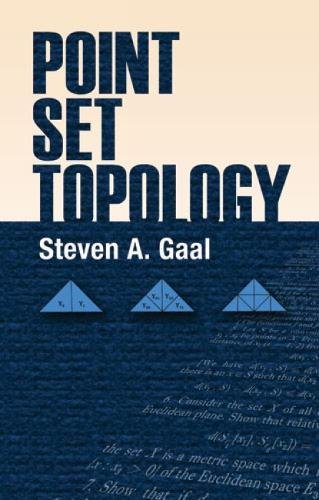
Ebook Info
- Published: 2009
- Number of pages: 336 pages
- Format: PDF
- File Size: 18.93 MB
- Authors: Steven A. Gaal
Description
An understanding of topology is fundamental to the grasp of most branches of mathematical analysis and geometry. This wide-ranging treatment opens with basic concepts of set theory and topological spaces; it concludes with the rudiments of functional analysis. Its remarkable depth contributes to its versatility as a classroom text, a guide for independent study, and a reference. Suitable for advanced undergraduates and graduate students, this volume can serve as a text for a complete course in topology. Its comprehensive scope and coherent presentation make it equally valuable as a self-contained guide for those wishing to study at their own pace. Additional enrichment materials and advanced topic coverage—including extensive material on differentiable manifolds, abstract harmonic analysis, and fixed point theorems—constitute an excellent reference for mathematics teachers, students, and professionals.
User’s Reviews
Editorial Reviews: About the Author Steven Gaal is Professor Emeritus in the Department of Mathematics at the University of Minnesota.
Reviews from Amazon users which were colected at the time this book was published on the website:
⭐This book by Steven Alexander Gaal (spelled István Sándar Gál in Hungarian) is truly modern, excellent, useful, and comprehensive within its scope. There is no real excuse for not having this book on your shelf. It’s packed with theorems on topological classes and properties. On the other hand, it is written largely in the modern language of uniformities and other abstract concepts, whereas many other books are written mainly in the language of topological spaces and metric spaces, which are more familiar to practically-minded people like me.I personally avoid uniformities, nets, Cauchy filters, paracompact spaces, ultrafilters, and some other related concepts because of their excessive abstraction and lack of practical applicability. This book gives you all of these as core concepts, without which you will not get much value from reading it. Even though the uniformity was invented by Weil in 1937, it still seems to me like an excessively modernistic idea which has meagre practical applications. I can’t think of any useful spaces which have an explicit uniformity without being explicitly metrizable. In my topology books, I can find only pathological examples, nothing which arises naturally. (Maybe some kinds of distributions are uniformizable but not metrizable. But don’t quote me on that.)If you look on pages 112-115 of Gaal’s book, you will see a proof that a space is uniformizable if and only if it is T3½, which means roughly “completely regular”. This property is implied by the T1+T6 property without the axiom of choice. Otherwise you need non-constructive AC methods to get from T4 or T5 to T3.5. But T6 is very close to metrizable. This explains why only fairly pathological kinds of spaces are uniformizable but not metrizable.Even though this book does not do point-set topology the way I like it, it does correspond very closely the standard modern approach to topology which is being taught in universities. So it’s ideal for that. This book is excellent for explaining the current orthodoxy in point-set topology. And if you convert all of the uniformity-related concepts in this book to metric-space concepts (and convert Cauchy filters to Cauchy sequences etc.), then this book is useful even for old-fashioned practical people like me.Conclusion:I do highly recommend Gaal’s book. It contains many theorems (with proofs) which I couldn’t find in my other 20 topology textbooks. And it gives clear explanations of many difficult concepts. It’s just packed with knowledge!
⭐While reading books on topological vector spaces, I found the need for a good reference book on topology at the level of, say, Bourbaki. I found that Gaal contains a lot of the material I needed, particularly advanced concepts that the popular textbooks omit. Gaal introduces filters and uniform spaces from the beginning, and uses these concepts intensively throughout the book. The treatment is clear and insightful, and at the same time thorough and efficient. It reads easily, and at Dover edition prices it has little competition.
⭐Good
Keywords
Free Download Point Set Topology (Dover Books on Mathematics) 2009th Edition in PDF format
Point Set Topology (Dover Books on Mathematics) 2009th Edition PDF Free Download
Download Point Set Topology (Dover Books on Mathematics) 2009th Edition 2009 PDF Free
Point Set Topology (Dover Books on Mathematics) 2009th Edition 2009 PDF Free Download
Download Point Set Topology (Dover Books on Mathematics) 2009th Edition PDF
Free Download Ebook Point Set Topology (Dover Books on Mathematics) 2009th Edition