

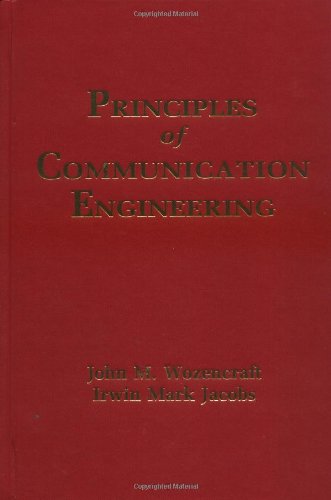
Ebook Info
- Published: 1990
- Number of pages: 720 pages
- Format: PDF
- File Size: 15.47 MB
- Authors: John M. Wozencraft
Description
The content and scope of this highly regarded book–the first overall synthesis of its kind–is reflected in three important objectives: (1) to establish a sound frame of reference for further study in communication, random processes, and information and detection theory; (2) to make the central results and concepts of statistical communication theory accessible and intuitively meaningful to the practicing engineer; and (3) to illuminate the engineering significance and application of the theory and to provide a quantitative basis for the compromises of engineering design.
User’s Reviews
Editorial Reviews: From the Back Cover “This classic text in communication theory retains its value completely today. I prefer it to many newer books.” — L. B. Levitin, Boston University “I’m glad it is still available. It is very readable and covers the basic ideas with reasonable notation.” — Filson Glanz, University of New Hampshire “This is my favorite communications textbook. Despite its age, the material covered in the book is very much relevant to modern communications systems.” — Venugopal Veeravalli, Cornell University “An indispensable classic treatment of the basic concepts of communication engineering; a must for serious researchers in the field.” — Ernest L. Walker, West Virginia University “I like the text’s systematic treatment of the concept of signal space, which I find most students struggle to grasp.” — Jing Jiang, North Carolina A&T State University “In my opinion, nobody has written a text that reflects the development of an emerging technology the way Wozencraft and Jacobs did for communications/telecommunication technology.” — Behnam Kamali, Mercer University “The rigorous treatment of optimum signaling schemes is superb and should be required reading for advanced graduate students working in communication theory.” — Vijaya Kuman, Carnegie Mellon University “Your company was wise to reprint this great book. The price is very reasonable and the quality of print is excellent.” — Mohsen Kavehrad, Penn State University “Students like the textbook because it is easy to read and focuses on fundamentals without the usual clutter.” — Costas N. Georghiades, Texas A&M University “One cannot help to be impressed by the accomplishments of these authors. It is hard to overestimate the importance of this book. It is one of the basic books used by every communication engineer involved in research and design.” — George Zrilic, New Mexico Highlands University “I like the book best because it describes the key points immediately and focuses on the most important concepts. Students learn quickly and solidly.” — Henry Yeh, California State University, Long Beach
Reviews from Amazon users which were colected at the time this book was published on the website:
⭐What would be really nice is if a more modern edition could contain the solid theoretical treatment of optimum receivers, Shannon channel capacity, and coverage of signaling schemes, with more modern developments in modulation and coding, including the Viterbi algorithm.Chapters 2 & 3 on Probability and Random Waveforms provide background for the rest of the text. However, when I used this book in a graduate communication theory course, we only covered chapters 4,5, and 6 as background in random processes was already assumed. However, we did rely somewhat on the treatment of Gaussian processes in Part I of Van Trees classic work.Chapter 4 gives the student a solid mathematical understanding of optimum receiver design, that is still valid today. In Chapter 5, I particularly liked the treatment of Time, Bandwidth, and Dimensionality in Section 5.3. Section 5.5 provides outstanding treatment of the Channel Capacity Theorem, including a solid proof that aids in the proper understanding of the theorem.Although Chapter 6 on coding has been overtaken by modern developments in this area it still serves as a high quality introduction to the basic concepts of coded systems. This material needs to be understood in order to better grasp more recent developments of the past few decades.All in all, my recommendation would be for someone to write a textbook wich covers the basics of communication theory as well as this book does, and then to include content on more modern coding topics, spread spectrum communications, and fading channels.
⭐This is one of the best technical/theoretical books I have ever read. It sets the example for teaching the fundamentals of communication theory to a capable audience without diluting the content. Yes it is old, but OLD is GOLD in this case.This book (combined with Van Trees’ “Detection, Estimation, and Modulation Theory, vol.1) is an excellent manuscript for a fundamental understanding of communication theory.(1) Especially valuable is the chapter 4 (about optimum receiver principles), that makes this book a great buy. For the more enthusiastic student,(2) Chapter 5 gives the derivation of the Shannon Capacity Theorem, a concept that makes one proud to understand.(3) Chapters 2 & 3 provide very strong background on probability and random processes. You may have had these on your other courses, but this is a very nice treatment and referred by the later chapters.(4) Chapter 6,7,8 are about implementation, channel models, and waveform communications, and they are obviously outdated, (e.g., Viterbi algorithm was not invented yet when this book was written) . However, if you feel the need to implement a Fano decoder, this is the best place to look, explanations by other books appear to be wrong!RECOMMENDATION:***************This is one of the most valuable books for me in my personal library. Definitely buy it, you will not regret it.This book sets the standard so high that other contemporary books on communication theory in general (examples: Proakis, Sklar) look like second rate, and rush job, copy and paste books on certain specialties such as space-time coding, MIMO (example: Paulraj et. al.) recyclable paper quality.LONG LIVE: Wozencraft and Jacobs!
⭐As so many here have said, this is THE book from which to learn Communications theory. Not that you’ll emerge as a pure theoretician. Quite the contrary, the priceless insights you’ll gain into the underlying essence of the discipline will help catalyze your creativity in innovating advanced communications system solutions. (Of course, you’ll need to continually supplement this with the wide variety of literature in the field, including the pertinent IEEE Transactions.)
⭐I used parts of this book in a digital communications course at UIUC. The book is written in a very lucid manner, atleast the chapters that I referred to – 3, 4 & 5. They provide a solid understanding to the subject material and it may seem mind boggling that even though the book was written way back in 1965 it is still a classic and is considered as one of the best references for optimum receiver principles. It makes for some smooth and sufficient reading (chaps. 3,4,5) when compared to other books such as that by Proakis etc. A must buy for any person in the Communication Area!
Keywords
Free Download Principles of Communication Engineering in PDF format
Principles of Communication Engineering PDF Free Download
Download Principles of Communication Engineering 1990 PDF Free
Principles of Communication Engineering 1990 PDF Free Download
Download Principles of Communication Engineering PDF
Free Download Ebook Principles of Communication Engineering