

Ebook Info
- Published: 2018
- Number of pages: 276 pages
- Format: PDF
- File Size: 1.63 MB
- Authors: Geoffrey Grimmett
Description
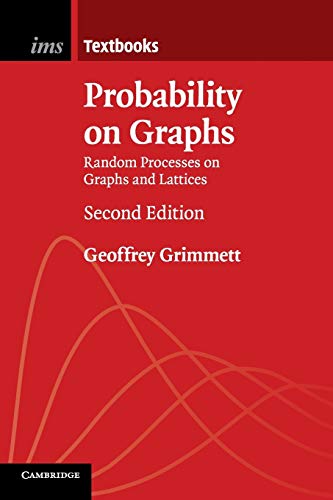
This introduction to some of the principal models in the theory of disordered systems leads the reader through the basics, to the very edge of contemporary research, with the minimum of technical fuss. Topics covered include random walk, percolation, self-avoiding walk, interacting particle systems, uniform spanning tree, random graphs, as well as the Ising, Potts, and random-cluster models for ferromagnetism, and the Lorentz model for motion in a random medium. This new edition features accounts of major recent progress, including the exact value of the connective constant of the hexagonal lattice, and the critical point of the random-cluster model on the square lattice. The choice of topics is strongly motivated by modern applications, and focuses on areas that merit further research. Accessible to a wide audience of mathematicians and physicists, this book can be used as a graduate course text. Each chapter ends with a range of exercises.
User’s Reviews
Editorial Reviews: Book Description A user-friendly introduction for mathematicians to some of the principal stochastic models near the interface of probability and physics. About the Author Geoffrey Grimmett is Professor of Mathematical Statistics in the Statistical Laboratory at the University of Cambridge. He has written numerous research articles in probability theory, as well as popular research books on percolation and the random-cluster model. In addition, he is a co-author, along with David Stirzaker and Dominic Welsh, of two successful textbooks on probability and random processes at the undergraduate and postgraduate levels. He has served as Master of Downing College since 2013 and was elected to the Royal Society in 2014.
Reviews from Amazon users which were colected at the time this book was published on the website:
⭐This book covers exactly what the title promises: Various applications of random prozesses ‘living’ on graphs.The mathematical background is not very demanding. Other than some terminology nothing is really needed from graph theory. A good background of probability theory (but not the measure theoretic part) and some knowledge of Markov processes will be helpful, but not absolutely required.The proofs are not too hard, but at times an additional word of explanation would have rendered them a bit easier.Unfortunately, some important proofs are given as excercises – a bad habit in my opinion, mostly if no solutions to the excercies are given.The chapter of the “Quantum Ising Model” was incomprehensible for me, too much physics required…A book with such a broad topic is either too big, or else is touches many details only in a very cursory manner – the latter is the case here. However, the bibliography seems excellent, making up for this lack.The book contains virtually no typos – important for self study.Overall, a good, solid book!
⭐excellent
⭐現在、大学院のゼミで使用させていただいています。論理の繋がりが見やすく図が多いので、ノベルの様に読みやすい良書です。ランダムウォーク初学者には、特にオススメです。1人でも多くの人の手に渡ることを願い、レビューさせて頂きました。
⭐
Keywords
Free Download Probability on Graphs: Random Processes on Graphs and Lattices (Institute of Mathematical Statistics Textbooks, Series Number 8) 2nd Edition in PDF format
Probability on Graphs: Random Processes on Graphs and Lattices (Institute of Mathematical Statistics Textbooks, Series Number 8) 2nd Edition PDF Free Download
Download Probability on Graphs: Random Processes on Graphs and Lattices (Institute of Mathematical Statistics Textbooks, Series Number 8) 2nd Edition 2018 PDF Free
Probability on Graphs: Random Processes on Graphs and Lattices (Institute of Mathematical Statistics Textbooks, Series Number 8) 2nd Edition 2018 PDF Free Download
Download Probability on Graphs: Random Processes on Graphs and Lattices (Institute of Mathematical Statistics Textbooks, Series Number 8) 2nd Edition PDF
Free Download Ebook Probability on Graphs: Random Processes on Graphs and Lattices (Institute of Mathematical Statistics Textbooks, Series Number 8) 2nd Edition