

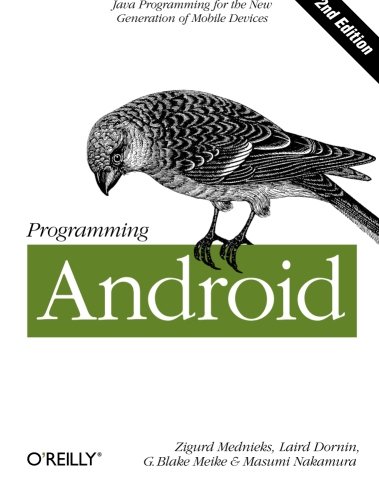
Ebook Info
- Published: 2012
- Number of pages: 566 pages
- Format: PDF
- File Size: 10.49 MB
- Authors: Zigurd Mednieks
Description
Get thoroughly up to speed on Android programming, and learn how to create up-to-date user experiences for both handsets and tablets. With this book’s extensively revised second edition, you’ll focus on Android tools and programming essentials, including best practices for using Android 4 APIs. If you’re experienced with Java or Objective-C, you’ll gain the knowledge necessary for building well-engineered applications.Programming Android is organized into four parts:Part One helps programmers with some Java or iOS experience get off to a fast start with the Android SDK and Android programming basics.Part Two delves into the Android framework, focusing on user interface and graphics class hierarchies, concurrency, and databases. It’s a solid foundation for understanding of how the most important parts of an Android application work.Part Three features code skeletons and patterns for accelerating the development of apps that use web data and Android 4 user interface conventions and APIs.Part Four delivers practical coverage of Android’s multimedia, search, location, sensor, and account APIs, plus the Native Development Kit, enabling developers to add advanced capabilities.This updated edition of Programming Android focuses on the knowledge and developer priorities that are essential for successful Android development projects.
User’s Reviews
Editorial Reviews: About the Author Zigurd Mednieks is a consultant to leading OEMs, enterprises, and entrepreneurial ventures creating Android-based systems and software. Previously he was Chief Architect at D2 Technologies, a voice-over-IP (VoIP) technology provider. There he lead engineering and product definition work for products that blended communication and social media in purpose-built embedded systems and on the Android platform.Laird Dornin is a mobile development architect with extensive experience in Java, Android, J2ME, SavaJe, and the webkit browser library. He was a member of the J2SE development team at Sun Microsystems specializing in java.rmi and Jini technology. Laird is currently a Senior Engineer at a major wireless carrier, where he provides Android architectural guidance and Network API support to members of the carrier’s developer community.Blake Meike, Senior Software Development Engineer at Amazon, has more than 10 years of experience with Java. He’s developed applications using most of the GUI toolkits and several of the Java mobile device platforms.With over a decade of software engineering experience, Masumi Nakamura has worked in various positions within the mobile technology arena, from building out mobile infrastructure to founding his own mobile company. He was one of the primary Android developers of the Where Android app and now is Principal Architect for the Big Data and Recommendations Group at Where, Inc. Outside of coding, he spends his time practicing Ba Gua Zhang and caring for his two cats.
Reviews from Amazon users which were colected at the time this book was published on the website:
⭐I really, really wish I could give this five stars. There’s so incredibly much useful information in this book that it pains me not to. Even if it were just the theoretical introductions to all the various parts of the Android framework, development environments, and associated ecosystems, best practices, etc., without the code, I would.But there it is. The code. While it’s generally good (despite sometimes ignoring its own best practices and showing inconsistencies likely due to multiple revisions), it’s incomplete. You’re shown -most- of what you need to implement anything more than the most basic of examples; the rest is left up to you to go find on the web.When I initially decided I had a problem with this, I made myself stop and think, and it occurred to me that this is not a reasonable complaint. The book is packed with information; asking the author to pad it out with ridiculous amounts of Java — which is already plenty verbose — just doesn’t make sense. But then I looked back over what I had been reading for the last several hours. There is so much “we’re overriding this just to put in a conditional log statement” with every single available life cycle method in so many fragments and activities that there’s honestly no excuse for not dropping that and adding in the actual, useful parts — the entire fragments and layouts — that were left out.It’s good that the code is made available online and maintained. But copying and pasting into Eclipse is not educational. Reading and retyping while navigating with autocomplete and learning the more important methods and their arguments is a whole lot more beneficial — for any language or framework — than it seems until you’ve tried it. It’s invaluable. But this book lets you get about a third of the way through that process before telling you that, no, we’re not going through the whole thing. Go download it.I docked another star for dependence on Android API 11+ code. As of this writing — and I’ve had this book for a year already — over a quarter of active Android devices are, according to Google, still running API 10 or less. This means at least some of these examples are just plain useless if you want to learn to code in a way that’s reasonably backwards compatible. Fragmentation is not a huge problem, but it’s made a problem here by a really strange reliance on API’s that are too new to be realistic for most Android developers.While this concentrates on the (very real) problems the book has, it is still a solid text/reference, and I’m certainly not sending it off for recycling. It just fails at such strange points that it’s hard not to think it could’ve very easily been so much better.
⭐This book is very likely one of the best resources out there for any developer who’s new (or even reasonably experienced) with Android and wants to start making non-trivial apps.I am an absolute fan.Believe me, I wasted so much of my time reading the other highly rated / best selling Android book on Amazon – “Android Wireless Application Development Part-1”. That book was ok in its own right but for a developer new to Android, it was organized like crap and was not at all cohesive and didn’t give you the bigger picture to make useful apps.This book on the other hand…* Is geared towards the professional from cover to cover* Has excellent structure and organization of information* Indicates paradigms and best practices everywhere and explains by all kinds of analogies to things like web frameworks and apps, etc etc. You will have no issues understanding anything* Most importantly, it has clear, HIGHLY useful, COHESIVE and INCREMENTAL example app code where they build up each sample app gradually with the introduction of new concepts, making the app more useful and feature rich.I can’t stress enough the value of this since it helps explain how to effectively USE the concepts / features taught and is kinda similar to how one would develop an app of their own – starting with a simple version and iteratively adding complexity and features to create more and more useful versions.* Is very comprehensive and covers enough of the OS to get you making productive, useful apps rather than naive crap that you can anyways do using the thousands of scattered tutorials on the web.* Even gives you brief and highly useful primers on the concepts / technologies that are pre-requisites for using the book effectively (eg. Java, MVC patterns, SQLite queries, etc etc)You obviously do need to have some programming background and at least basic Java knowledge (like me) to make the best use of the book.That’s 6 stars already.I’m reading this now when Android 4.4 just got released, but still find this book very relevant since it covers versions beyond Android 4.0 tooHighly highly recommend !
⭐The authors delight in confusing examples in the book that are close to, but don’t match, the downloadable code. The names are different, the modularity of the code stinks, and little use is made of object inheritance.I found it hard to use the chapters on implementing a RESTful Web Service as the basis for my own service. While not a book about TCP/IP and HTTP, it simply ignores the requirement of most Web Services to use SSL and https:. Not one hint.The book also contains “marketing humma-humma” about how great some developments are/were.It also describes all programming in terms of using Eclipse, which I don’t want to spend time learning as it’s about to be replaced by a much more modern IDE, Android Studio.I don’t what to leave the impression that I didn’t learn anything from the book. I did. It’s just that I expected more and didn’t get it.
⭐This is the most frustrating technical book I have read in years. It manages to be long-winded and pedantic in areas that are peripheral to its main topic, such as the basics of Java and the intricacies of using Eclipse, whilst being brief and obtuse as to how to build Android applications.The authors obsess over the importance of MVC to the maintainability and flexibility of their code but skimp on explaining the use of SQLite.Given their patchy approach, it’s crucial that the example code they use to support the book is clear and high quality. Unfortunately, it falls down on both counts – it requires three different versions of Android to be included in Eclipse, and even then comes pre-loaded with errors, such as faulty graphical layouts for Android 2.1. The code itself seems designed, to my eyes at least, to demonstrate the depth of bracketed nesting that can be achieved in Java and the obscurity of anonymous classes, rather than pointing the best way through the Android API.It’s a particular disappointment, because the O’Reilly series in general is very good at explaining even the most intricate of technical subjects. It’s particularly frustrating, too, that the initial page I was presented with in opening the Kindle version of this book was an advert at the back of the book inviting me to “Upgrade this ebook with O’Reilly”. Indeed, I will have to “upgrade” it, but with a title from another publisher.
⭐The book arrives as if it soaked in dirt.I am not really impresse about that.
⭐I like this book, together with “Android in Action” this is one of the best for sure. It covers every aspect of android in more or less detail, one can find information to nearly everything.
⭐las interfaces y los menús del libro ya no corresponden con los de la distribución actual de Eclipse, ni del Android SDK.
⭐
Keywords
Free Download Programming Android: Java Programming for the New Generation of Mobile Devices in PDF format
Programming Android: Java Programming for the New Generation of Mobile Devices PDF Free Download
Download Programming Android: Java Programming for the New Generation of Mobile Devices 2012 PDF Free
Programming Android: Java Programming for the New Generation of Mobile Devices 2012 PDF Free Download
Download Programming Android: Java Programming for the New Generation of Mobile Devices PDF
Free Download Ebook Programming Android: Java Programming for the New Generation of Mobile Devices