

Ebook Info
- Published: 2012
- Number of pages: 1176 pages
- Format: PDF
- File Size: 15.67 MB
- Authors: Tom Christiansen
Description
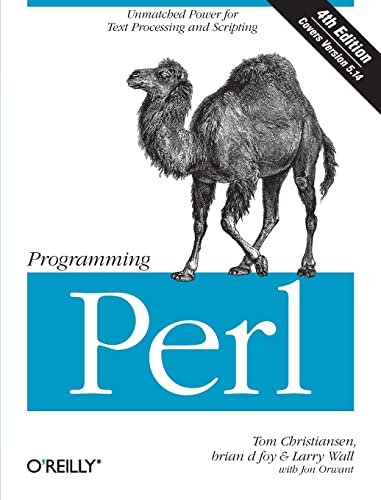
Adopted as the undisputed Perl bible soon after the first edition appeared in 1991, Programming Perl is still the go-to guide for this highly practical language. Perl began life as a super-fueled text processing utility, but quickly evolved into a general purpose programming language that’s helped hundreds of thousands of programmers, system administrators, and enthusiasts, like you, get your job done.In this much-anticipated update to “the Camel,” three renowned Perl authors cover the language up to its current version, Perl 5.14, with a preview of features in the upcoming 5.16. In a world where Unicode is increasingly essential for text processing, Perl offers the best and least painful support of any major language, smoothly integrating Unicode everywhere—including in Perl’s most popular feature: regular expressions.Important features covered by this update include:New keywords and syntaxI/O layers and encodingsNew backslash escapesUnicode 6.0Unicode grapheme clusters and propertiesNamed captures in regexesRecursive and grammatical patternsExpanded coverage of CPANCurrent best practices
User’s Reviews
Editorial Reviews: About the Author Tom Christiansen is a freelance consultant specializing in Perl training and writing. After working for several years for TSR Hobbies (of Dungeons and Dragons fame), he set off for college where he spent a year in Spain and five in America, dabbling in music, linguistics, programming, and some half-dozen differentspoken languages. Tom finally escaped UW-Madison with undergraduate degrees in Spanish and computer science and a graduate degree in computer science. He then spent five years at Convex as a jack-of-all-trades working on everything from system administration to utility and kernel development, withcustomer support and training thrown in for good measure. Tom also served two terms on the USENIX Association Board of directors. With over thirty years’ experience in Unix systems programming, Tom presents seminars internationally. Living in the foothills above Boulder, Colorado, Tom takes summers off for hiking, hacking, birding, music making, and gaming.brian d foy is a prolific Perl trainer and writer, and runs The Perl Review to help people use and understand Perl through educational, consulting, code review, and more. He’s a frequent speaker at Perl conferences. He’s the coauthor of Learning Perl, Intermediate Perl, and Effective Perl Programming, and the author of Mastering Perl. He was an instructor and author for Stonehenge Consulting Services from 1998 to 2009, a Perl user since he was a physics graduate student, and a die-hard Mac user since he first owned a computer. He founded the first Perl user group, the New York Perl Mongers, as well as the Perl advocacy nonprofit Perl Mongers, Inc., which helped form more than 200 Perl user groups across the globe. He maintains the perlfaq portions of the core Perl documentation, several modules on CPAN, and some standalone scripts.Larry Wall originally created Perl while a programmer at Unisys. He now works full time guiding the future development of the language. Larry is known for his idiosyncratic and thought-provoking approach to programming, as well as for his groundbreaking contributions to the culture of free software programming.Jon Orwant founded The Perl Journal and received the White Camel lifetime achievement award for contributions to Perl in 2004. He’s Engineering Manager at Google, where he leads Patent Search, visualizations, and digital humanities teams. For most of his tenure at Google, Jon worked on Book Search, and he developed the widely used Google Books Ngram Viewer. Prior to Google, he wasCTO of O’Reilly, Director of Research at France Telecom, and a Lecturer at MIT. Orwant received his doctorate from MIT’s Electronic Publishing Group in 1999.
Reviews from Amazon users which were colected at the time this book was published on the website:
⭐[ /! To the reader : 1 – Please be aware that reviews listed here also include reviews related to the previous 12 years old 3rd edition of the book. Therefore look well at the date of the review, or choose “newest first”. 2 – Please refer to the updated note at the end of the review]As a computer language specialist, and an early Perl adopter, long before Python or Java, for tackling with art many medium-to-complex problems, and having them quickly solved efficiently and elegantly, I was responsible for introducing Perl in a Tahiti’s University Computer Science course – which I taught for 10 years – as an eclectik general programming language, praising it to my students for having brought to me lots of deep pleasure and appreciation since the older fascinating days of Lisp and Prolog.To this date, O’Reilly has a long successful record at publishing high quality Perl books, like “Programming Perl, 3rd Edition”, “Advanced Perl Programming”, “Perl Hacks”, “Perl Best Practices”, and “Computer Science and Perl Programming”.Amongst these books, “Programming Perl” (also know as the “Camel book”, or the “Blue book”) is certainly the most comprehensive, error free, most precise, most exciting Perl book ever written to date.”Programming Perl” 3rd Edition was released 12 years ago, to support up to Perl 5.6. Any serious enthousiast Perl programmer might have bought this book 1070 pages long. Despite almost a daily use for over 12 years, mainly as a mainstreem reference manual, my personal copy, though heavily annotated for quick reference, has remained in a very good shape all along. The material I kept coming at are chapter 29 “Functions”, which provides the reader with a broad and comprehensive coverage reagarding all Perl built-in functions, and chapter 32 “Standard Modules”, which provides a (almost) complete listing of the standard modules comprising the standard Perl distribution, along with a brief but comprehensive description of what each module does.Long awaited, since Perl jumped from version 5.6 to version 5.14 in the intervening 12 years, I feel very sad to notice that the new 4th edition of the Camel book does not live to its expectations.Thicker by 12mm, but only 60 pages longer, due to using an unnecessary larger font and thicker paper, the important chapter “Standard Modules”, along with chapter 33 “Diagnostic messages”, did not make it into this new release. Also, this long awaited new edition does not provide the seasoned Perl programmers with a clearly separate chapter that would have made a terrific job at summarizing for them the language evolution from Perl 5.6 to Perl 5.14.Since all the information included in the Camel book has, more or less, always been available through the Perldoc and the various man pages installed along with the Perl standard distribution, the only point of buying this book was to gain a practical, up-to-date, efficient, accurate and fast access to this information through an all-in-one book.As this held up to edition 3, this no longer seems the case with new edition 4. The removal of the very important chapter “Standard Modules” so enjoyable at flipping thru, glancing at, or simply reading, in order to learn and etch so many important programming reflexes, is now a thing of the past. And unfortunately a big loss! Quickly finding out about important modules comprising the Standard Perl distribution will never be again that easy. And in all case, you will a minima now need a computer on hand.With so many programming frameworks having gained so much popularity in these last 12 years, e.g. Java, Python, Ruby, or PhP, one could have thought that O’Reilly’s release of this new edition was to give a renewed interest and incentive to the large existing base of already seasoned Perl developers.Hélas, this is not the case. For seasoned Perl developers, I suggest that keeping the 3rd edition of the Camel book, and reading at leisure the man pages “perluniXXX” and “perlXXXdelta” is the way to go, instead of buying this new edition.For new Perl developers, I’m not sure! Though this edition is up-to-date regarding the language features, it misses the important “Standard modules” chapter, a minima an index thereof.As for me, I got this new edition in pre-release at half its price. Therefore, I will clip Chapter 32 from the edition 3, stick it in edition 4, and transfer in my lengthly annotations, to be ready to go another 12 years or so.I urge O’Reilly to consider the followings for further editions of the beautiful Camel book :- Include chapter “Standard Modules”- Provide a chapter “Language evolutions”Then, the Camel book legend will continue stronger than ever, and any one will quickly forget the mis-adventures of Edition 4.Note — 2013/03/03After all, knowing how difficult it is to write a good average technical book, and finding myself using this 4th edition often since I first wrote this review a year ago (sometimes complementing it with for the library with the 3rd edition — not a big deal), absolutely convinced, from reading ten’s of other technical books, that the new “Camel” book, as it is called, still stands as one of the most accurate and comprehensive book ever written on any computer language, here Perl — revered as the Bible amonsgt the Perl community — I feel I was being unfair in giving this new edition only 3 stars, quite an under-evaluation.Today, I’m proud to enhance my review and rate this book a well deserved 5 stars. If 6* were allowed, I would give it 6 ;)Cheers,Franck Porcher, Ph.D — Theoretical Computer science (Paris)
⭐I am a Perl new learner. Honestly it’s really hard to catch up what he is trying to say. There are so many “waste” words trying to decorate or trying to make the book longer and ticker but none of them is useful to make me understood basic Perl programming. I used to be a Java developer and have been doing SQL for over 15 years, I know the basic programming logic but still couldn’t understand what this book is trying to teach. Did I dumb or its teaching method has problem?
⭐I’ve had a chance to read this book thoroughly now, and find it dog-eared and pencil smudged. It’s a great book, but no single book can cover everything perl. This one tries very hard, but the online docs are a much better reference. This is written by people who know perl inside out and it’s pretty obvious on my second perusing. I’d originally written a cheerleader review of this book, but after reading Damien Conway’s Perl Best Practices, I sometimes wonder how this book’s tone would have been had they included Conway as an author. Alas, what we have is a very good book, a rehash of a classic, vastly superior to the third edition, but, from what I can tell, not a true step up from the first edition. I don’t know, I didn’t read that one. Perl is a pretty awesome language and this is a great book to help.If you are like me and you need to write notes, and have post-its all over with scribbled stuff… then BUY the book. If you just want to get your feet wet, see what it’s about, this is a pretty good one to cut your teeth on, but you really should cut your teeth on some of the online docs first and then look at this book AFTER you have some idea what’s going on.Recommended reading: David West’s Object Thinking (yeah, it’s from Microsoft Press, but it’s EXCELLENT!) Damien Conway’s Object Oriented Perl (it’s a bit older, 2000, fantastic explanations of objects) Damien Conway’s Perl Best Practices – great read.anyway, good luck in your journey!
⭐This book for people who want a deep insight into Perl, and is most beneficial for someone who has gained a fair bit for experience coding in Perl. I would advise beginners/newbies to cut their teeth through the “Learning Perl” book and coding multiple examples before delving into Programming Perl.
⭐I really love this book and I enjoy reading it.I’m a professional Programmer and I already master other Programming Languages, but I am completely new at Perl. So I could reference many concepts from other Programming Languages.The book gave me the basic concepts of Perl that I needed to get started with Perl and get very soon the Results I need for my Job in 2 Projects.But I saw that the Book holds even more to study more in depth details about Perl to achieve higher Performance of the Scripts as for example details of the Compiling Process that could be useful to get more processing speed, or details about the Garbage Collector that could help to save Machine Resources.I will certainly still come back to this Book for more in depth study to attain more mastery over this powerful Programming Language Perl.
⭐Although I haven’t read the first quarter of it yet (more than a thousand pages) it’s obvious that this is the ultimate reference for everything Perl. It also makes for a pleasant read, as the authors abuse of humorous references and tongue-in-cheek statements specially appealing for the brainier bunch. There is also (at least in the first chapters) a concern with the linguistic background and semantic capabilities of Perl, exposed frequently.However, the sheer volume and pacing may not be suitable for newcomers to Perl. I’d recommend this book as an addition to ‘Learning Perl’ by Randal L. Schwartz, Brian D Foy & Tom Phoenix. This book offers a quicker, effective hands-on introduction to Perl with a very similar refreshing tone of writing.
⭐I bought this to refresh my memory of Perl and of its strength in using regular expressions. This book seems to jump about a lot in its explanation of Perl and introduces concepts without explaining them, which I found very confusing, expecially as I was reading it on a Kindle and couldn’t thumb through the book to find other sections quickly!Unfortunately it didn’t help with regular expressions – it mentioned them on occasion but not all in one place and I had to resort to Google in the end.
⭐PERFECT !!
⭐An excellent update of a master tome. It manages to really come around everything Perl. The writing is kept in the known conversational tone with the occasional humor bits that you’d expect from Larry Wall and company. A worthy update of a modern classic.
⭐I have read 30% of the book sofar, but i already like it. I already read ‘Learning Perl’ and have working in some web projects with CGI in Perl. Nothing too complex. Reading this book is a trial for upgrading and deeping my knowledge in the language. I think there is no better choice for this.
Keywords
Free Download Programming Perl: Unmatched power for text processing and scripting in PDF format
Programming Perl: Unmatched power for text processing and scripting PDF Free Download
Download Programming Perl: Unmatched power for text processing and scripting 2012 PDF Free
Programming Perl: Unmatched power for text processing and scripting 2012 PDF Free Download
Download Programming Perl: Unmatched power for text processing and scripting PDF
Free Download Ebook Programming Perl: Unmatched power for text processing and scripting