

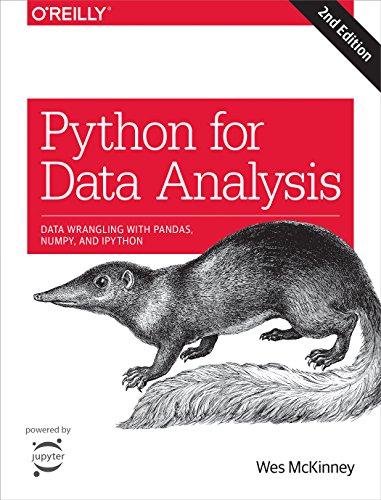
Ebook Info
- Published: 2017
- Number of pages: 724 pages
- Format: PDF
- File Size: 8.34 MB
- Authors: Wes McKinney
Description
Get complete instructions for manipulating, processing, cleaning, and crunching datasets in Python. Updated for Python 3.6, the second edition of this hands-on guide is packed with practical case studies that show you how to solve a broad set of data analysis problems effectively. You’ll learn the latest versions of pandas, NumPy, IPython, and Jupyter in the process.Written by Wes McKinney, the creator of the Python pandas project, this book is a practical, modern introduction to data science tools in Python. It’s ideal for analysts new to Python and for Python programmers new to data science and scientific computing. Data files and related material are available on GitHub.Use the IPython shell and Jupyter notebook for exploratory computingLearn basic and advanced features in NumPy (Numerical Python)Get started with data analysis tools in the pandas libraryUse flexible tools to load, clean, transform, merge, and reshape dataCreate informative visualizations with matplotlibApply the pandas groupby facility to slice, dice, and summarize datasetsAnalyze and manipulate regular and irregular time series dataLearn how to solve real-world data analysis problems with thorough, detailed examples
User’s Reviews
Reviews from Amazon users which were colected at the time this book was published on the website:
⭐I got this book when I was transitioning to doing data science with Python and was struggling to become familiar with standard tools. It’s written by the creator of Pandas, and follows the style of the Pandas documentation: dense, telegraphic, peppered with examples.It’s hard work because Wes McKinney often does not articulate why you would need to do something (assuming you are already knowledgeable on the underlying process), and writes like an impatient person who would rather be doing something else. Additionally examples often suffer from being both too long and too short – too long in that almost every example is on a toy dataset created from scratch, too short in that most of those datasets have only 5 or 10 elements and do not always showcase complex operations. Other examples (particularly involving time series) have an overabundance of data that make the critical results hard to spot. Frankly, my first month with Pandas was a miserable one.But I give the book 5 stars both because I came to love Pandas as I got more familiar with it, and because while McKinney is not fun to read, he does pack the book with useful information and it is (mostly) well organized. If anything it would benefit from being longer and with a more patient treatment of larger and more concrete datasets (eg the Titanic passenger dataset used in the Pandas documentation). The initial chapter on the basics of using Python could go – if you need this book, then you don’t want to be trying to learn the rudiments of Python from it. If you can accept that you’ll need a lot of bookmarks or margin notes to get through a rather steep learning curve, it will reward your persistence.
⭐This book has been my foundation of using python as a data analyst.This book primarily focuses on the pandas Python library, which is awesome at processing and organizing data (Python pandas is like MS Excel times 100. This is not an exaggeration). It also introduces the reader into numpy (lower level number crunching and arrays), matplotlib (data visualizations), scikitlearn (machine learning), and other useful data science libraries. The book contains other book recommendations for continuing education.Although this would be a challenging book for a brand new Python user, I would still recommend it, especially if you are currently doing a lot of work in MS Excel and/ or exporting data from databases. I had a few false starts learning Python, and my biggest stumbling block was lack of application in what I was learning. This book puts practical tools in the reader’s hands very quickly. I personally don’t have time to make goofy games etc. that other books have used as practice examples. Despite other reviews criticizing the use of random data throughout the book, I found the examples easy to follow and useful. I would also argue that learning how to generate random data is useful in itself (thus the purpose of the numpy random library), and that there are practical examples throughout the book. Chapter 14 devoted to real-world data analysis examples.I am almost finished with my second time through the book, this time working through every example. This book has been well worth the hours spent in it. For context, I previously relied on Excel, SQL, and some AutoHotKey. This book has significantly improved how I work.Thanks, Wes and team.
⭐Well written by the creator of Pandas. The author’s copious use of code snippets to illustrate his points makes the material very usable. The snippets are short enough to type by hand so you get the frequent opportunity to play with the code and really understand the tools being presented. And Pandas is awesome!
⭐This book covers all of the basics that you would want to know to get started in programming in Python for data analysis, as the title implies, but it doesn’t really offer compelling real-world examples. The data seem to be made up and the analyses don’t go into enough detail to help you really learn how pandas and numpy work. Overall this is a decent starter book but you will have to bookmark the python and pandas documentation online if you want to have a reference to all of the functionality those tools have, and there are many places online where you can get better examples to learn from. If you haven’t made your mind up about which tool to use for data analysis, I highly recommend checking out dplyr in R, which has an excellent free book online (R for data science, hadley wickham). I find it very easy to learn and it is much easier to set up R and RStudio than it is to set up Python, even though I love Python and Pandas.
⭐Great reference to get started with numpy, pandas, and matplotlib. If you’re already familiar with these libraries, I wouldn’t recommend, as it is easier to just google the functions you’re trying to implement. The examples are good but would’ve been stronger if there was a story to them. Right now they are disjointed examples so it is a bit time consuming understanding the data set and goal for each example when you’re looking at 100 examples all using different data.
⭐Learning Python, I found this book and the examples therein very friendly and instructive. I’d gladly recommend it to anyone.
⭐Clear, concise examples. Author displays deep understanding of topic. Was key developer of Pandas. Hierarchical indexing helped me breakthrough a log jam in my own development project.
⭐My professor recommended this book for Network Administration course. I am a beginner in Python and found this book a little hard to understand.
⭐This book is generally considered a classic but I am in 2 minds over it. It gives an introduction to the Python language, which is nice for a beginner. It also gives very good introductions to numpy, pandas, matplotlib and seaborn. I had not heard of the latter so the book was of great value there. However, all of these libraries are huge; pandas alone is massive. This leaves the author being stuck in terms of how deep to go. Some areas are well covered and others are just skimmed over forcing you to look deeper on the internet. Adding to the problem is that these libraries are being continually updated. I was left with a growing feeling that books like this are becoming redundant. There is so much free material online now that if someone stole this book from me it would not make a jot of difference.
⭐I have purchased other books for jumping into machine learning using Python but they always somewhat gloss over the basics, and you have to accept a bit of magic around Pandas, Matplotlib etc to follow along. I’m so glad I went back to build a solid foundation with this book, so I’m no longer fumbling around with magic commands or spending a huge proportion of time trawling Stack Overflow.Probably my favourite aspect of this book is that you can just read it- every single concept is demonstrated in code, on the paper, with the full input and outputs. The only time I’ve opened my editor is to play around with concepts I wanted to clarify- the rest has been just a good solid read with everything clearly demonstrated. It’s well structured and builds concepts as you progress but is also an excellent reference book I can see myself dipping back into time and again.I think this is essential foundational material for starting your journey into data analysis and/or machine learning with Python.
⭐A good reference book. It did a reasonable job in breaking python data analysis down into consumable chunks, however there are many free resources out there that would do an equally good job. This book rarely focuses on the bigger picture, it rather gives you line of code after line of code without ever going into real world usage of that code/construct. To use an analogy, If I was looking to build a tree house this book gave me hammer and nails without providing a blueprint on how to build that house.Look for a book that takes a project based approach to learning if you are looking to get into python data analysis.
⭐The content of the book is good. The print quality is bad. I can see the texts through the pages. Most of the figures are poorly printed, looks like run out of ink. I can understand that this is paperback print, but I would expect better quality for £30 book. It is too much hassle to return this in the current situation.
⭐Wes is a great writer and teacher, I feel I am learning more about data analysis with python by tracing out the code in the book (Wes refers to this as strengthening one’s “muscle memory”) in my Juptyer notebooks on my laptop than I had from trying moocs on data analysis.
Keywords
Free Download Python for Data Analysis: Data Wrangling with Pandas, NumPy, and IPython 2nd Edition in PDF format
Python for Data Analysis: Data Wrangling with Pandas, NumPy, and IPython 2nd Edition PDF Free Download
Download Python for Data Analysis: Data Wrangling with Pandas, NumPy, and IPython 2nd Edition 2017 PDF Free
Python for Data Analysis: Data Wrangling with Pandas, NumPy, and IPython 2nd Edition 2017 PDF Free Download
Download Python for Data Analysis: Data Wrangling with Pandas, NumPy, and IPython 2nd Edition PDF
Free Download Ebook Python for Data Analysis: Data Wrangling with Pandas, NumPy, and IPython 2nd Edition