

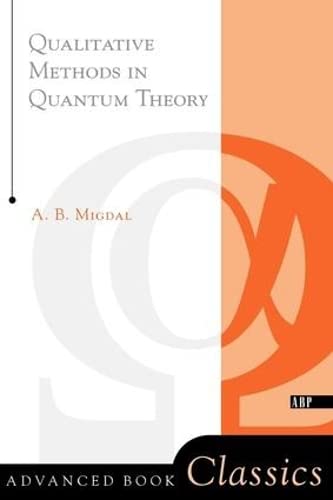
Ebook Info
- Published: 2000
- Number of pages: 437 pages
- Format: PDF
- File Size: 9.81 MB
- Authors: Migdal
Description
This unique book, written by a leading Soviet theorist, is not a textbook of quantum mechanics but rather a compendium of the “tricks of the trade”-the methods that all practicing theoretical physicists use but few have set down in writing.
User’s Reviews
Editorial Reviews: About the Author A B Migdal
Reviews from Amazon users which were colected at the time this book was published on the website:
⭐Mathematician Paul Halmos writes: “I like to start every course I teach with a problem.” Mathematician George Polya had a famous dictum: “if you can’t solve a problem, there is an easier problem you can solve–find it ! ” (both quotes, page 467, Volume 82, Number 5, American Mathematical Monthly). I have, for years, advocated for teaching physics courses in that manner: That is, begin the course with a problem. Are there textbooks which use that approach in physics ? I would say that the book of A.B. Migdal is as close to Halmos and Polya as I have found. The book is replete with riches. Thus, I implore: secure a copy of this marvelous resource. Let us read:(1) “Let us answer the question: beyond what strengths of the electric and magnetic field, do the Maxwell equations in free space become nonlinear ? ” (page 5).(2) “The electromagnetic field in vacuum is an oscillating quantity. The oscillations are called zero-point vibrations of the electromagnetic field. We are now in a position to answer the question,why does not an atom remain in an excited state indefinitely ? ” (page 55).(3) “The interaction of an atomic electron with the zero-point vibrations of the electromagnetic field will make it fluctuate around its equilibrium orbit. We shall estimate its order of magnitude.” (page 80).(4) “We shall illustrate the theory–perturbation applied to boundary conditions–by calculating the one-particle energy levels of a deformed nucleus.” (page 98).(5) “Let us estimate the vibrational energy of a molecule.” (page 129).(6) “It is possible to formulate the problem of the penetration of a potential barrier by a particle in two different ways.” (pages 178-186).(7) “In some cases, as we shall see, the analyticity of physical quantities is a consequence of causality.” (page 221).(8) “The possibility of virtual transitions produces phenomena which at first sight paradoxical.” (page 255).(9) “According to the principle of superposition, the total transition amplitude is just the sum of all possible physically different transition amplitudes. The exact meaning of this assertion will be explained below with examples.” (page 290).(10). “As an illustration of the use of symmetry properties, we shall show how a contemporary theoretician might have deduced Maxwell’s equations in free space, had they not already been known.” (page 363).(11) “Quantum Field Theory starts out from the assumption of a local inter-particle interaction, which means that particles interact only when their space and time coordinates are identical.” (page 380).(12) Conclusion: There are problems everywhere ! Not only does Migdal show you the way, he has others for the student to tackle (with solution). Here is one: “estimate the lifetime of a hydrogenic atom against the emission of two photons.” (page 65). There are many more problems for student-solution scattered throughout. There are footnotes to reference material. Your undergraduate mathematics and physics toolkit is solidified and reviewed (contour integration and quantum mechanics). You learn of the efficacy of dimensional analysis throughout the entire discourse. This book is an expansion of an earlier publication: Approximation Methods in Quantum Mechanics (Migdal and Krainov).If you are able to locate that publication it will be well worth your time (Neo press, orange cover).Physicists can learn from mathematicians: begin each course with a problem !
⭐Nearly all physics texts will solve only models which produce closed-form answers. To be sure, this is not a fault: it is an important part of physics-training to be taught mathematical techniques. And perhaps it is obvious: real world problems are not immediately amenable to closed-form solutions. Real world physics problems demand both (1) sufficient mathematical training to avoid making mistakes, and (2) a “feel” (for lack of a mathematically-rigorous term) for how to “massage” various mathematical expressions to avoid throwing away physics. This book helps with (2); it presents various physical problems which _require_ that one make approximations to get to meaningful results. An example is the text’s treatment of the Thomas-Fermi model of a Z-electron atom. This adds an extra “dimension” to one’s mathematical training that is completely essential. True: one needs training to do algebra and calculus correctly [e.g., the content of (1)], but eventually, closed form algebra and calculus become a “box” that one must be trained to think outside of. This book tries to do that training.When writing a book that forays into new mathematical or physical territory, there is always the risk of that book being confusing. This text is anything but: the mathematical prose is crystal-clear (this seems to be a trend among Russian authors). The text manages to leave relatively little to the reader (with some exceptions), while at the same time managing to be concise. This text’s mathematical prose, in my opinion, carries the crispness of the Landau/Lifshitz course of theoretical physics.The book’s contents are rather ambitious as well. There are qualitative methods discussed in the context of many body physics and quantum field theory. I have not read these last chapters yet, but if they are anything like the first three, I think they would nicely supplement the understanding that closed-form calculation always gives, and the crisp mathematical prose should help avoid a diligent reader’s getting stuck on unclear or awkwardly-posed mathematical statements.I look forward to adding to this review when I have worked through more of this book.
⭐This is a wonderful book which demonstrates how to approach a difficult problem, make order-of-magnitude estimates and guess the answer. I am generally surprised how little known this book is, given its value. The first 30 pages should be required reading for any undergraduate Physics major, and maybe not only Physics. Just look at the first example, Pythagoras’s theorem by dimensional analysis, and you will see what I mean.
⭐A Fantastic Book
⭐しばらく絶版となり、手に入りにくかったが “Advanced Book Classics” の1冊として再版された。本書は量子論のいろいろな問題に対して、近似やモデル化を通して評価をする方法が幅広く取り上げている。目次を見れば、どれほど多くの問題が扱われているかがわかるだろう。優れた物理学者のノートを覗き見るような、ぞくぞくする感じが味わえる数少ない良書のひとつだ。量子論に限らず、物理の問題は厳密に解けるのは稀である。そこで本質を抉り出すような近似やモデル化が重要になるのだが、そこにこそ物理屋のセンスの良さが必要になるのだろう。理論物理学の多方面で活躍した著者の「技」を盗み、センスを磨きたい。最近気が付いたのだが、英語訳は 2003 年のノーベル賞を獲得した Anthony J. Leggett によるものだ。彼も若き日に Migdal から「技」を盗み、センスを磨いたのだろう。大学院レベル以上。
⭐
Keywords
Free Download Qualitative Methods in Quantum Theory in PDF format
Qualitative Methods in Quantum Theory PDF Free Download
Download Qualitative Methods in Quantum Theory 2000 PDF Free
Qualitative Methods in Quantum Theory 2000 PDF Free Download
Download Qualitative Methods in Quantum Theory PDF
Free Download Ebook Qualitative Methods in Quantum Theory