

Ebook Info
- Published: 2017
- Number of pages: 776 pages
- Format: PDF
- File Size: 38.00 MB
- Authors: Mark M. Wilde
Description
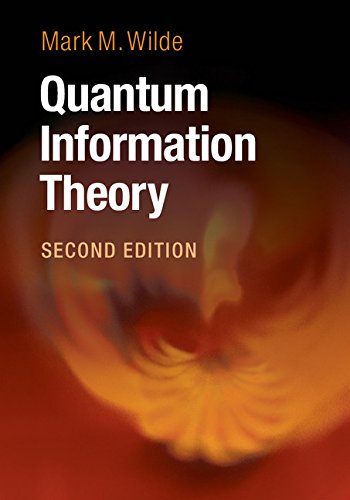
Developing many of the major, exciting, pre- and post-millennium developments from the ground up, this book is an ideal entry point for graduate students into quantum information theory. Significant attention is given to quantum mechanics for quantum information theory, and careful studies of the important protocols of teleportation, superdense coding, and entanglement distribution are presented. In this new edition, readers can expect to find over 100 pages of new material, including detailed discussions of Bell’s theorem, the CHSH game, Tsirelson’s theorem, the axiomatic approach to quantum channels, the definition of the diamond norm and its interpretation, and a proof of the Choi–Kraus theorem. Discussion of the importance of the quantum dynamic capacity formula has been completely revised, and many new exercises and references have been added. This new edition will be welcomed by the upcoming generation of quantum information theorists and the already established community of classical information theorists.
User’s Reviews
Reviews from Amazon users which were colected at the time this book was published on the website:
⭐Certainly to go down as one of the standard references in quantum information theory, this book is accessible to anyone who has a good background in linear algebra, elementary quantum physics, and elementary information theory. To avoid complicated techniques from functional analysis and operator theory, and the attending use of infinite-dimensional Hilbert spaces, the author has chosen to stay within the confines of a finite number of states. This means of course that readers interested in continuous variable quantum communication will have to look elsewhere.Here are just a few of the highlights of the book:- The review of classical Shannon theory. The physicist reader actually may not be familiar with Shannon’s results as they are not typically a part of the physics curriculum, either undergraduate or graduate.- The role of the trace distance in the analysis of the quantum protocols. Readers will see the importance of the trace distance in the discussions of the many protocols and an “operational definition” in terms of ordinary hypothesis testing, but may still be unsure as to why the trace distance is used to distinguish the efficacy of the different protocols. A perusal of the research literature reveals a plethora of metrics to measure the distance between quantum states. This raises the obvious question as to whether the results in this book, and quantum information theory in general, are dependent on the metric chosen to distinguish two states.- Detailed proofs are given for the major results, but the author assigns exercises throughout the book to test the reader’s understanding. The presence of these exercises makes the book a textbook rather than just a monograph.- The author’s honesty about the technological feasibility of the protocols that are discussed in the book.- The insightful discussions on entanglement and how it can be viewed as a communications “resource”. Many “resource inequalities” that compare classical and quantum capabilities for information transfer occur throughout the book, and they serve as good compact summaries for the reader. The author is thankfully not hesitant to give somewhat hand-waiving explanations of entanglement, which is done quite often in physics and improves the reader’s intuition on this bizarre phenomenon. These explanations are not excessively philosophical though, so readers who want to indulge themselves in philosophical musings about entanglement will have to look elsewhere.- The discussion on purification and how noisy quantum theory can unexpectedly be viewed as a subset of noiseless quantum theory. The author shows, interestingly, that one can view noise as resulting from the entanglement of a system with another system. Some readers may naturally wonder if this viewpoint can be extended to the case of infinite dimensions and if it is compatible with some of the work in quantum stochastic calculus and quantum noise.It is difficult to ascertain whether the protocols discussed in the book can actually be represented in the physical world as quantum evolution of states via the Schrodinger equation. In this regard, very early in the book, the author points out that this equation will not appear, with the focus being on the representation of quantum theory using quantum information. Quantum evolution is viewed more as a phenomenon that must satisfy a given set of axioms that is manifested in the Choi-Kraus theorem, and represented by the now ubiquitous “quantum channel”. The physicist reader may therefore be somewhat skeptical as to the actual physical realizability of the protocols. This skepticism may be aggravated by the lack of discussion on experimental results in this book. In this regard, it might be fair to rename quantum information theory as Hilbert space information theory in spite of the eye brows this may raise in discussions of the subject.
⭐Everything I know about Quantum Shannon Theory, I learned from Mark via his book. It is self-contained and wonderfully-explained.
Keywords
Free Download Quantum Information Theory 2nd Edition in PDF format
Quantum Information Theory 2nd Edition PDF Free Download
Download Quantum Information Theory 2nd Edition 2017 PDF Free
Quantum Information Theory 2nd Edition 2017 PDF Free Download
Download Quantum Information Theory 2nd Edition PDF
Free Download Ebook Quantum Information Theory 2nd Edition