

Ebook Info
- Published: 1992
- Number of pages: 212 pages
- Format: PDF
- File Size: 7.23 MB
- Authors: Vladimir B. Braginsky
Description
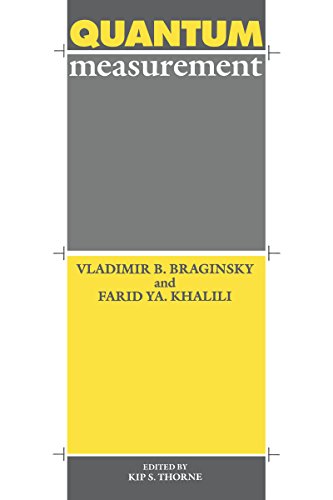
This book is an up-to-date introduction to the quantum theory of measurement, a fast developing field of intense current interest to scientists and engineers for its potential high technology applications. It is also a subject of importance to students for its central role in the foundations of quantum mechanics. Although the main principles of the field were elaborated in the 1930s by Bohr, Schrödinger, Heisenberg, von Neumann and Mandelstam, it was not until the 1980s that technology became sufficiently advanced to allow its application in real experiments. Quantum measurement is now central to many ultra-high technology developments, such as squeezed light, single atom traps, and searches for gravitational radiation. It is also considered to have great promise for computer science and engineering, particularly for its applications in information processing and transfer. The book contains a pedagogical introduction to the relevant theory written at a level accessible to those with only a modest background in quantum mechanics. It then goes on to discuss aspects of the design of practical quantum measurement systems. This book is essential reading for all scientists and engineers interested in the potential applications of technology near the quantum limit. It will also serve as an ideal supplement to standard quantum mechanics textbooks at the advanced undergraduate or graduate level.
User’s Reviews
Reviews from Amazon users which were colected at the time this book was published on the website:
⭐Arrived as described.
⭐In Memoriam:Vladimir Braginsky, 3 August 1931- 29 March 2016For the uninitiated, Braginsky played a role in the Laser Interferometer Gravitational-Wave Observatory. (ligo.caltech.edu/news/ligo20160426).Braginsky, also, penned a review in 1996, Quantum NonDemolition Experiments (Reviews Of Modern Physics, Vol. 68, No.1).Now, let us proceed with this slim book written “for two types of readers, those who have had only a little previous contact with quantum mechanics, and those who have had much.” (page one). As such, starred and unstarred sections serve to delineate those two classes of readership. Now, when first I perused this book (1992) I considered myself part of that first group of readers–someone with “little previous contact with quantum mechanics.” (As such, I confess, at that time the book was out of my league !).Now, the book itself:(1) First, review Heisenberg’s own exposition of his “microscope,” then, read here–Chapter One–for another approach to Heisenberg’s microscope. This first chapter sets the scene for all else to follow. Photons, harmonic oscillators: know something of them, plus dimensional analysis.(2) First chapter was introductory, the next will summarize the principles of quantum mechanics. It can be a bit confusing to the uninitiated:we read “interferometric measurements show that the object can be spread out over some region of space..” (page 17). Also, we read:”so long as one avoids the issue of quantum measurement, one can regard the wave-function as an ordinary classical wave.” (page 19).Keep in mind that this text is an explication of “quantum measurements on a single quantum object” (page one).(3) Then, we read, “to learn the shape of the probability- curve, one must carry out an ensemble of such detection measurements.” (page 21).State preparation is described. We read of “state reduction” as “a sophisticated phenomena in which are intermixed the pure dynamical process of the interaction between the measuring device and the measured object, and the pure information-acquisition process…” (page 27).Thus, Chapter Two is decidedly more technical than the first, Von Neumann’s measurement theory here described. Earlier exposure toquantum mechanics will prove useful for chapter two (for instance, an understanding of states, density– and, unitary– operators).(4) Next, to “understand the connection between the measuring device as an ordinary physical system, and the nature of the desired measurement.” We read: “the observer cannot even in principle write down a wave-function for himself.” (page 39). Photons were chapter One, Electrons–this is chapter three.Specifically, electrons as probes. Aside: Heisenberg’s Uncertainty Principle met time and time again, throughout.(5) Of interest, next, is an interesting “derivation” of redshift in frequency of photon in gravitational field (page 57). And, we read: “the issue ofthe ultimate limit on the accuracy of an energy measurement is still open.” (page 60). Then, fifth chapter, “the measurement process does notshow up in the standard formulation of the uncertainty relations.” Linarity–that is the big take-away concept from this chapter. At this juncture,I would implore the prospective reader to review the first four chapters. The fifth will be much more technical. It couples to the sixth:(6) Continuous Quantum Measurements: “a continuous measurement can be regarded as the limiting case of a sequence of discrete measurements.” Again, Linearity. Again, uncertainty relations. Reiterating, these first one-hundred pages comprise linearity and uncertainty.Nonlinearity makes entrance in seventh chapter. Highlighting the so-called quantum Zeno paradox (pages 94-97): “when any observable of the object with a discrete spectrum of eigenvalues is monitored precisely, the object remains forever in its initial state.”(7) Let us jump ahead to the final chapter (twelve). Photons, again. Squeezed states, coherent states, antibunched states–these described.In conclusion, the author’s write of: ” the hope that this book will prove useful for those who try to construct a satisfactory theory of nonlinearquantum measurements.” (page 187).I can think of no better beginning, a companion, than this thoughtful text of Braginsky and Khalili.A mixture of elementary and advanced. A mixture of theory and experiment. Always a meaningful combination.
⭐Clear, insightful, highly readable. A most enjoyable reading!
⭐This book was one of the first written in the New Age of Quantum Measurement. While Quantum Measurement mainly was a philosophical problem for many years, starting in the 1980s, actual systems were beginning to be built that produced measurements at the quantum limit, for instance, Gravitational Wave Detectors.This book has two parts. A theoretical part that is still indispensable. The part that deals with actual practical systems is somehow obsolete at the present time. You read this book for the theory, mainly, but the theory has practical applications if you work in specific fields.
⭐If you need to understand measurement of quantum systems- this is where you begin. Very well written by leading experts.
Keywords
Free Download Quantum Measurement 1st Edition in PDF format
Quantum Measurement 1st Edition PDF Free Download
Download Quantum Measurement 1st Edition 1992 PDF Free
Quantum Measurement 1st Edition 1992 PDF Free Download
Download Quantum Measurement 1st Edition PDF
Free Download Ebook Quantum Measurement 1st Edition