

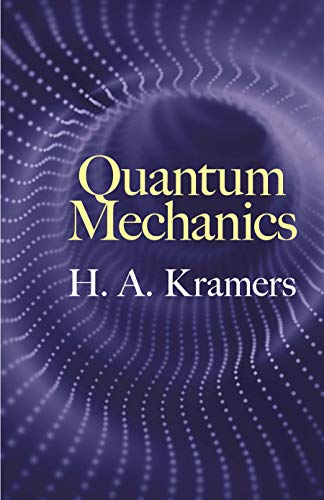
Ebook Info
- Published: 2018
- Number of pages: 512 pages
- Format: PDF
- File Size: 30.43 MB
- Authors: H.A. Kramers
Description
“Rates with Dirac’s book as one of the best expositions of quantum theory available in the English language.” — American Scientist”A fine translation of a remarkable book, which is recommended to every serious student of theoretical physics.” — F. J. Belinfante, Science”Full and leisurely development … detailed without being tedious … This is a book that all who study quantum theory will want to read.” — J. Polkinghorne, Physics Today”Throughout one is conscious of being under the guidance of someone who has thought very deeply and carefully about all the various aspects of quantum theory, and who is able to express his ideas in a most stimulating and lucid way.” — K. W. H. Stevens, Proceedings of the Physical Society A masterful treatment of quantum theory, this classic work develops the subject’s most important concepts from experimental evidence and from theory related to the wave nature of free particles. The first half shows how the classical mechanics of point particles can be generalized into a consistent quantum mechanics; the second part deals with extensions of quantum theory needed for problems of atomic and molecular structure. Suitable for advanced undergraduates and graduate students in physics as well as historians of modern science, this universally praised translation will be a valuable addition to any physical science library.
User’s Reviews
Editorial Reviews: About the Author Rotterdam native H. A. Kramers (1894–1952) studied under Niels Bohr in Copenhagen during World War I and received his Ph.D. from Leiden after the war. He taught at Copenhagen, Utrecht, and the Delft University of Technology.
Reviews from Amazon users which were colected at the time this book was published on the website:
⭐Kramers began his career in physics in as a graduate student at University of Leiden, but left Leiden in 1916 to do his Ph.D. thesis research with Bohr in Copenhagen. Kramers went to to serve as Bohr’s assistant, and later as the vice chairman of Bohr’s famous institute for theoretical physics after it was founded in 1921. Kramers eventually returned to his native Holland to continue his academic career, during which he wrote the original German edition of this book, which was first published in 1933. In 1957, the English version of Kramer’s QM text was published, translated by Kramers’ old graduate student D. ted Haar. As ter Haar’s native language was Dutch, he found himself with “the hazardous task of translating from one foreign language to another.” Nevertheless, he deemed this to be a worthy undertaking because “I felt that that this book still represents the best available exposition of quantum theory.” Although such a bold statement as this might well be challenged, we should be grateful to ter Haar for undertaking this mission and allowing those of us in the English speaking world to get a view of quantum theory from one of Bohr’s closest disciples.Kramers’ book is admirable for its direct and unassuming explanation of quantum theory and its mathematical formalism, and written in such as way as not to overwhelm the reader. As stated by Kramers in the preface to his 1933 edition: “The apparent lack of mathematical models which is contritely pointed out in the text is not exclusively due to the incompetence of the author. Physical morals, even (or rather especially) in their purest form, that is, unencumbered by pedagogic afterthoughts, do not live happily together with their mathematical relations in the restricted mansion of the human mind–and neither in the restricted volume of a monograph.” Despite these modest qualifications penned by Kramers, his book manages to address the depth of concept and completeness of mathematic description common to graduate level textbooks on QM, including the derivation of the Dirac equation. Like Landau and Lifshitz’s QM book, however, Kramers book is still sufficiently unencumbered by abstract arguments that it is accessible to advanced undergraduates. In particular (and also stated in his preface) Kramers avoided reference to group theory in order to make his introduction to QM more approachable.I should also note that Kramers assembled his book in such a way as to highlight the most important aspects of quantum mechanics–and without bothering to look back at earlier contributions that were considered somewhat dated by 1933. It is particularly noteworthy and laudable that Kramers made no reference to his 1924 work with Bohr and Slater (BKS Theory) that pointed the way to Heisenberg’s 1925 work with Born and Jordan on matrix mechanics. Kramers also avoided any mention of his own independent version of the Dirac equation.
⭐While revisiting the older quantum mechanics monographs, my eyes fell upon this book by Kramers. I pondered why I had neglected a thorough perusal of this text for so many year, as it is an astounding historical document. Preparation of the reader will need to be one of lofty technical skill (minimum: senior physics undergraduate). Many years ago, I would not have had the mathematical acumen to understand this exposition which is why it laid unread for so long.Perusal of less demanding tomes make it apparent that this book stands apart. It surely represents Hendrik Kramers mature views regarding Classical and Quantum Mechanics, emphasizing connections between those two disciplines. Two parts comprise the whole: Foundations as preparation for Advanced.(1) Rapid-fire derivation of the Schrodinger wave equation (page 33-34) and superposition principle (pages 61-66), a beautiful discussion !(2) Transformation theory, a tour de force: superposition, probability, so-called correspondence principle, presented in tandem, chapter four.(3) Quantum Theory of N-electron Systems, is an expository gem (section 71, pages 321- 325).(4) I highlight Kramer’s interesting discussion of “Causality in Quantum Mechanics” (pages 120-123).Words from Kramers:(A) ” …in an actual application of probability density, one is dealing with experiments where it is clear from the experimental set-up what shape the wave-function initially possessed.”(B) “A free particle is an idealization from experience…we call the De-Broglie hypothesis the Quantum Postulate for free particles.”(C) “…such a wave packet illustrates a physical situation which to a certain approximation corresponds to a mass point in classical physics.”(D) “The definability of the energy of a system is always connected…with the definability of the frequency..” (page 51).(E) “The electromagnetic field due to the electron is the same as a field generated by a uniformly rotating sphere which is covered uniformly with charge” (page 229).(F) “We wish to investigate in how far it has a meaning to talk about particles of radiation.” (Light Quanta, page 423).(G) “All classical properties of the radiation field have their correspondence analogue in the quantum theory of radiation.” (page 435).(H) “The analytical problem of eigenvalues and expansion in eigenfunctions can always, and in manifold ways, be considered to be the limiting case of a purely algebraic problem” (page 82).(I) “One cannot use correspondence arguments with respect to the electron spin.” (page 311).(J) “The peculiar difference between classical mechanics and quantum mechanics is closely connected to the fact that differential calculus is an essential tool in classical mechanics, but, that it is a strange element in operator calculus and that it can only be applied in some simple cases, and even then in a highly artificial manner.” (page 154).(5) Concluding: I hope the words above will entice the prospective student into perusing the material, basic material at an advanced level. With sufficient mathematical preparation all will become clear !(Mathematical background, I suggest: Mathematical Methods in the Physical Sciences, Boas).Kramers is not easy, yet ever so enriching ! Recommended to all students. After a first encounter, turn to Kramers for continuing enrichment. This text stands as a reference: serving both as historical document and compendium of novel approaches. As with Dirac, Kramers should be required reading for all Physicists.
⭐Certainly one of the best books on QM by one of the pioneers. Ranks with Dirac, Pauli, Sommerfeld, Frenkel and Landay&Lifshits. Very detailed, probably the most detailed of all, no “it is easy to show that … ” excuses.
⭐現在、量子力学を学習する人にとって、どのぐらいの内容が期待されているかは知りませんが、古い人間の私には、この本は十分な内容を持っていると思います。古典力学を極めた人に、新しい物理学が要求する数学が、どのように新しい認識を必要とするか、この本は詳しく説明していると思います。量子力学を手段として学ぶ人にとって現在では読む必要のない本とは思いますが、物理学に志す人は少しでも時間を割いて、読んでほしいと思う本です。
⭐
Keywords
Free Download Quantum Mechanics (Dover Books on Physics) in PDF format
Quantum Mechanics (Dover Books on Physics) PDF Free Download
Download Quantum Mechanics (Dover Books on Physics) 2018 PDF Free
Quantum Mechanics (Dover Books on Physics) 2018 PDF Free Download
Download Quantum Mechanics (Dover Books on Physics) PDF
Free Download Ebook Quantum Mechanics (Dover Books on Physics)