Ebook Info
- Published: 2004
- Number of pages: 640 pages
- Format: PDF
- File Size: 53.69 MB
- Authors: Kurt Gottfried
Description
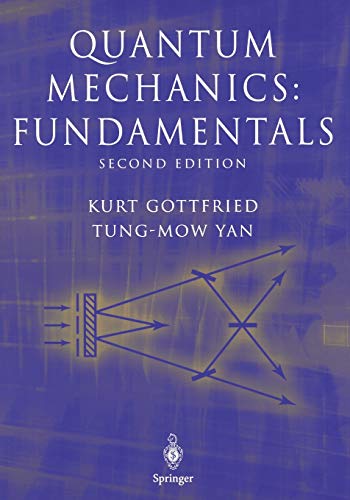
Quantum mechanics was already an old and solidly established subject when the first edition of this book appeared in 1966. The context in which a graduate text on quantum mechanics is studied today has changed a good deal, however. In 1966, most entering physics graduate students had a quite limited exposure to quan tum mechanics in the form of wave mechanics. Today the standard undergraduate curriculum contains a large dose of elementary quantum mechanics, and often intro duces the abstract formalism due to Dirac. Back then, the study of the foundations by theorists and experimenters was close to dormant, and very few courses spent any time whatever on this topic. At that very time, however, John Bell’s famous theorem broke the ice, and there has been a great flowering ever since, especially in the laboratory thanks to the development of quantum optics, and more recently because of the interest in quantum computing. And back then, the Feynman path integral was seen by most as a very imaginative but rather useless formulation of quantum mechanics, whereas it now plays a large role in statistical physics and quantum field theory, especially in computational work. For these and other reasons, this book is not just a revision of the 1966 edition. It has been rewritten throughout, is differently organized, and goes into greater depth on many topics that were in the old edition.
User’s Reviews
Editorial Reviews: Review JOURNAL OF PHYSICS A: MATHEMATICAL AND GENERAL (27 FEBRUARY 2004)”… [The first edition] has become one of the most used and respected accounts of quantum theory … Gottfried and Yan’s book contains a vast amount of knowledge and understanding. As well as explaining the way in which quantum theory works, it attempts to illuminate fundamental aspects of the theory … For use with a well-constructed course (and, of course, this is the avowed purpose of the book; a useful range of problems is provided for each chapter), or for the relative expert getting to grips with particular aspects of the subject or aiming for a deeper understanding, the book is certainly ideal.”PHYSICS TODAY (August 2004)”…especially useful for graduate students and professors who have time to go beyond the bare essentials of a topic and explore it in depth… I would recommend the book for its lucid discussions of less familiar topics alone, but the authors do not short-change the standard subjects… I expect the second edition of Gottfried and Yan to join my library of well thumbed-through texts.”From the reviews of the second edition:”The book under review offers the reader in-depth physical and mathematical understanding of quantum mechanics. The book is the second edition of Gottfried’s Quantum mechanics. … Readers’ anticipations have finally been rewarded by the second edition of the earlier book, which is a complete revision covering most of the topics and much more … . The appendix contains the values of important physical constants, some useful operator identities … . The end notes at the conclusion of each chapter contain many useful references.” (Howard E. Brandt, Mathematical Reviews, Issue 2007 f) From the Back Cover This classic text provides a comprehensive exposition of the concepts and techniques of quantum mechanics. The phenomena treated are sufficiently simple to allow the student to readily assess the validity of the models so that attention is not deflected from the heart of the subject. To that end, the book concentrates on systems that can either be solved exactly or be handled by well-controlled, plausible approximations. With few exceptions, this means systems with a small number of degrees of freedom. The exceptions are many―electron atoms, the electromagnetic field and the Dirac equation. The inclusion of the last two topics reflects the belief that every physicist should now have some knowledge of these cornerstones of modern physics. This new edition has been completely revised and rewritten throughout, but retains the clarity and readability of the first edition. Born in Vienna, Kurt Gottfried emigrated to Canada in 1939 and received his Ph.D. in theoretical physics from the Massachusetts Institute of Technology in 1955. He is a professor emeritus of physics at Cornell University, and had previously been at Harvard University and at CERN in Geneva, Switzerland. He is the coauthor of Concepts of Particle Physics (with V.F. Weisskopf) and of Crisis Stability and Nuclear War. Gottfried has done research in both nuclear and particle physics; he has an active interest in arms control and human rights and is a founder and currently the Chair of the Union of Concerned Scientists. Tung-Mow Yan, originally from Taiwan, received his Ph.D. in theoretical physics from Harvard University in 1968. He has been a member of the Cornell University faculty since 1970 after spending two years as a research associate at the Stanford Linear Accelerator Center. He has conducted research in many areas of elementary particle physics.
Reviews from Amazon users which were colected at the time this book was published on the website:
⭐So we where incouraged to buy this book for an advanced graduate level course in QM. I wouldn’t recommend it though. I feel it is a hard book and that the explanations are often very unclear. All toghether however it does cover a lot of material which you may not find on analogous books. It was apparently chosen for this course because from a survey it came out as the best graduate level book to learn QM. I don’t know, I’m glad I actually knew quite a bit of QM before starting to use this book otherwise it would have been a disaster.
⭐Seems A bit old book , hard to go with the English for internationals who doesn’t have a good command on English.
⭐When I first open this book, it cracked. The book is very bad bound. Finally, it is separated into two part now.
⭐Whenever looking up something about quantum mechanics I start with Gottfried. Measurement theory, angular momenta, elementary scattering theory – all are well done.The book would be more useful if Gottfried had ever finished the second part of it! Several sections are lead-ins to material which was intended for a second volume.
⭐confusing and buggy
⭐Gottfried was the primary textbook used in the two semester graduate level quantum mechanics course that I took as a graduate student almost forty years ago. My professor was a theorist in high energy physics, so naturally he chose a textbook with a strong emphasis on scattering theory. This is probably also the reason, as noted by the famous Irish quantum theorist John S. Bell, that the library at CERN had so many copies of Gottfried. See Bell’s essay “Against measurement” in
⭐for this observation.Chapters 12-17 (pp.94-164) provide an introduction to scattering theory in this 494 page book, which includes the definition of cross section, Born and Eikonal approximations, partial waves, the delta shell potential, resonance scattering, and the coulomb field. Chapter 40 deals with invariance principles as applied to scattering of spin 1/2 particles. Chapter 43 treats scattering of identical particles. Chapter 56 addresses scattering and transitions in a continuum. Chapter 57 considers collision phenomena in the Born approximation. Gottfried also does a good job in providing a large number of useful figures that relate to scattering. Some figures describe scattering geometry while others plot differential cross section as a function of scattering angle.Although I found Gottfried to be a useful textbook for its treatment of scattering, I do consider it to be the most suitable introduction to quantum mechanics for first year physics graduate students. I prefer Schiff’s
⭐, with Baym’s
⭐as a supplement. In particular, I prefer Schiff and Baym’s treatment of the Dirac bra/ket notation.
⭐This is a high level, formal treatment of quantum mechanics. It is very elegant and there are many things in this book that are not covered in many other grad level quantum text books. For example, the nice treatment of the Kepler problem using F+, F- operators, a lengthy discussion of the interpration of QM/entangled states, etc, or a good treatment of the Landau levels in both symmetric and landau gauge. The emphasis on the ideas of the rotation group, Wigner-Eckhart, etc are also very nice. However, user beware, the textbook skips steps, sometimes lacks clarity, and may assume mathematics and quantum that you dont have yet. This is not a casual read. You should have a piece of paper in front of you to work through the steps. But I can assure you that in the end it is very worthwhile and gives you a glimpse into what makes quantum mechanics very beautiful and elegant.If you have read Griffiths before this you may not be prepared. Try Shankar first then move onto this book.
⭐Do you like Shankar? Then you will also like Dirac, (Pauli), and Gottfried. Mathematically very lucid. In his mediocre book, Gasiorowicz inserted a very nice bibliography, where he regarded Gottfried very highly and described it “highly advanced.” Yes, it is an advanced book. But for an undergrad at that time, I found this book more understandable than Gasiorowicz. Many undergrad students are perplexed with “intermediate level” textbooks they are given because there are so many things they have to accept without why. Gottfried is firmly founded on mathematical rigor. You will know which is the axiom and which is a theory based on it. Recommend to those students who like rigor.
⭐The used book Quantum Mechanics: Fundamentals by Gottfried and Yan arrived very quickly and is in very good condition for a used book. It looks like a very good book. This 2nd edition is much more up-to-date than the 1st edition I bought many years.
⭐El libro tiene un nivel desorbitado (o eso quiere hacer parecer…) y se nota en las explicaciones y/o demostraciones.Bastante desordenado en el temario también.Bueno como libro de consulta de aspectos complicados o controvertido, pero pésimo como self-studingno puedo opinar, me censuran los censores de amazon.es
Keywords
Free Download Quantum Mechanics: Fundamentals (Graduate Texts in Contemporary Physics) 2nd Edition in PDF format
Quantum Mechanics: Fundamentals (Graduate Texts in Contemporary Physics) 2nd Edition PDF Free Download
Download Quantum Mechanics: Fundamentals (Graduate Texts in Contemporary Physics) 2nd Edition 2004 PDF Free
Quantum Mechanics: Fundamentals (Graduate Texts in Contemporary Physics) 2nd Edition 2004 PDF Free Download
Download Quantum Mechanics: Fundamentals (Graduate Texts in Contemporary Physics) 2nd Edition PDF
Free Download Ebook Quantum Mechanics: Fundamentals (Graduate Texts in Contemporary Physics) 2nd Edition