

Ebook Info
- Published: 2001
- Number of pages: 244 pages
- Format: PDF
- File Size: 1.02 MB
- Authors: Ken Wilber
Description
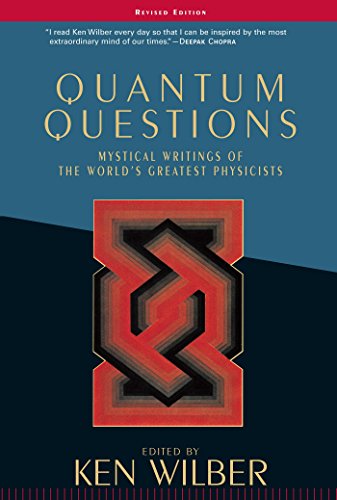
The mystical writings of the world’s great physicists—now in one eye-opening volume that bridges the gap between science and religion Quantum Questions collects the mystical writings of each of the major physicists involved in the discovery of quantum physics and relativity, including Albert Einstein, Werner Heisenberg, and Max Planck. The selections are written in nontechnical language and will be of interest to scientists and nonscientists alike.
User’s Reviews
Reviews from Amazon users which were colected at the time this book was published on the website:
⭐American philosopher Ken Wilber has done a great service by bringing together in a single volume excerpts from the mystical writings of the world’s greatest physicists. Six of the eight men included were Nobel laureates including Einstein, Heisenberg, Schroedinger, Plank, de Broglie, and Pauli.These are the intellectual giants who gave us the twin pillars of modern physics, relativity theory and quantum mechanics, upon which all of contemporary science rests. Given the popular view that they must have been atheists it is astonishing to learn that all of them were quite explicit in expressing the need for a mystical outlook extending beyond the physical world.Let’s be clear. Wilber as editor has not pulled a few paragraphs out of context. Erwin Schroedinger for example writes of “the mystic vision”, De Broglie writes that “the mechanism demands a mysticism”, and Wolfgang Pauli speaks of “embracing the rational and the mystical.”None of these men were particularly ‘religious’ however. The popular religions of today (Christianity, Judaism, Islam, Buddhism, etc.), may be viewed as specific theories of Ultimate Reality (this reviewer’s characterization). They all make specific statements – some empirically testable, many others not – about people and events in the physical world and how these related to God, or Allah, or All That Is, or some similar term.Mysticism on the other hand is not a religion but a path to understanding. It has nothing to do with religious creeds or doctrines, or whether or not there is a personal God, and certainly nothing to do with science which is something else entirely. Mystics simply believe on the basis of personal experience that there is likely to exist another level or levels of consciousness beyond that of the five senses. Through rigorous mental practice they believe that it is possible to access wisdom and insight from that level which represents the highest or ultimate reality.Individual mystics may personally identify with one religion or another but the practice of mysticism as a path is found in all the major religions and is, in and of itself, areligious. This point is unfortunately muddied in Wilber’s otherwise quite interesting introduction where he equates religion with spirituality (p.18), something most thoughtful people would probably strongly reject. One can be deeply spiritual without committing to any specific set of religious doctrines.Finally, I feel compelled comment on Wilber’s assertion that the physicists would reject so called New Age books like “The Tao of Physics” and “The Dancing Wu Li Masters”. The key argument of such books is less that physics “proves” Taoism or Buddhism or some other form of Eastern esoteric thought but rather that seemingly bizarre and unbelievable statements about the nature of space and time and reality made by practitioners of these traditions appear to be supported by the findings of modern physics. (Cf. for example G. Zukav, “Wu Li Masters”, p. 256 and especially p. 331).For the last hundred years or so science and religion have declared a truce in their war for the allegiance of the mind of Man. Science would to stick to matters of the physical world while religion would stick to matters of the world beyond the senses. However as much as both sides, including Ken Wilber, would like to keep it that way, the march of scientific knowledge takes us ever forward toward a world view that challenges our most basic assumptions about the nature of human reality.I am speaking here specifically of entanglement, the now widely accepted principle in physics that particles really do influence each other without regard to distance or time, that is, they interact instantaneously even if they are separated by billions of light years. This was scientifically demonstrated in 1982, the year before Quantum Questions was originally released, and has been confirmed repeatedly since then. Even more disconcerting are recent experiments which seem to imply that actions in the present (as we perceive it) can actually alter events that have already been recorded in the past. (Cf. Amir D. Aczel, “Entanglement: The Greatest Mystery in Physics”, 2003).However troubling such findings may be to our everyday conception of ‘reality’, they merely confirm Max Plank’s famous statement that “those who are not shocked when they first come across quantum theory cannot possibly have understood it.”The shocks keep coming and they are getting stronger whether we like it or not. Will they lead to a total paradigm shift in our conception of reality?The deeper significance of this book is that it shows all scientists and those who someday will be scientists that being a mystic is okay. Want to argue with Heisenberg and Plank and Einstein and Schroedinger and….?
⭐In case you misread the subtitle, that’s physicists, not psychics!I’ve seen them myself: arguments from modern physics that prove the existence of the Spirit (or some metaphysical phenomenon that justifies our spirituality or transcendentalism). I’ve seen the opposite, too: arguments from modern physics that debunk spirituality.So Wilber’s book should be a hit. What do our best minds—the people who actually understand the physics of Quantum Theory, Relativity, and more—have to say on the topic? You’ll recognize a lot of the names in this book: Einstein, Schroedinger, Heisenberg, Bohr, Eddington, Pauli, Plank and more. This is a collection of essays by these men, with brief editing and an introduction by Ken Wilber.Wilber culls the writings of these great minds to uncover their opinions, and discovers that they are virtually unanimous in the opinion that modern science can offer no support for mysticism in any variety. And yet they are all mystics of one sort or another! They simply do not believe modern physics can fully describe the universe we live in. Modern physics isn’t in opposition to spirituality, it is simply indifferent to it. Eddington explains: “We have learnt that the exploration of the external world by the methods of physical science leads not to a concrete reality but to a shadow world of symbols, beneath which those methods are unadapted for penetrating.”If I had to choose a favorite essay, it would be “In the Mind of Some Eternal Spirit” by Sir James Jeans. Science is not yet in contact with ultimate reality, Jeans insists, and this is no surprise. Any meaning that the universe as a whole may have, would entirely transcend our terrestrial experience and so be totally unintelligible to us. The universe is a mathematical construct but—and don’t eschew the profundity of this claim—“the mathematics enters the universe from above instead of from below.” Jeans pictures the universe as consisting of “pure thought.” While Jeans may be the most daring of the bunch, the dualism of mind and matter is nevertheless a common theme.Fascinating book which starts a bit slow (after a great introduction) and builds from there.
⭐An interesting book but mixing up quotes from different books in a single text. Overall I think the general ideas are kept, even perhaps more crisply, by mixing from different sources. But the fact that this is not explicitly stated in the book makes quoting from it a nightmare. I noticed that on Heisenberg’s texts.
⭐Worth reading but not a quantum leap in new knowledge of these physicists. But a happy new year to all.
⭐An inspirational read.
⭐Just as described
⭐I can’t attempt to review this book with the competence of a philosopher or physicist, and will just try briefly to describe my own reaction.Perhaps most of us suspect that there exists a spiritual substrate of some sort behind the world. Men like Shroedinger and Jeans go into the matter very articulately, if not even poetically. One of the questions asked at several points is the following: Why does the universe appear to conform so readily to mathematics? Russell dismissed this question by saying things would be much more mysterious if such conformity were absent, if e.g. rolled dice did not on average yield double sixes one twelfth of the time. The reader will have to decide for himself whether Russell was right in thus dismissing a question posed by thinkers of the top rank.For me the style of the Editor’s comments is just a little cloying, but this is not a serious reservation. They nicely complement a most interesting selection of essays. I would recommend this book to anyone in sympathy with the fact that, as I understand it, the great physicists of the 20th century were of mystical inclination.
Keywords
Free Download Quantum Questions: Mystical Writings of the World’s Great Physicists in PDF format
Quantum Questions: Mystical Writings of the World’s Great Physicists PDF Free Download
Download Quantum Questions: Mystical Writings of the World’s Great Physicists 2001 PDF Free
Quantum Questions: Mystical Writings of the World’s Great Physicists 2001 PDF Free Download
Download Quantum Questions: Mystical Writings of the World’s Great Physicists PDF
Free Download Ebook Quantum Questions: Mystical Writings of the World’s Great Physicists