

Ebook Info
- Published: 2000
- Number of pages: 610 pages
- Format: PDF
- File Size: 33.65 MB
- Authors: A. Stern
Description
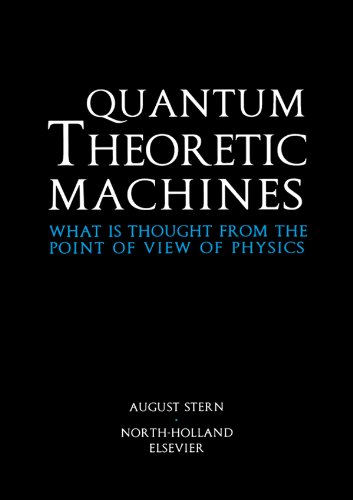
Making Sense of Inner Sense ‘Terra cognita’ is terra incognita. It is difficult to find someone not taken abackand fascinated by the incomprehensible but indisputable fact: there are material systems which are aware of themselves. Consciousness is self-cognizing code. During homo sapiens’s relentness and often frustrated search for self-understanding various theories of consciousness have been and continue to be proposed. However, it remains unclear whether and at what level the problems of consciousness and intelligent thought can be resolved. Science’s greatest challenge is to answer the fundamental question: what precisely does a cognitive state amount to in physical terms? Albert Einstein insisted that the fundamental ideas of science are essentially simple and can be expressed in a language comprehensible to everyone. When one thinks about the complexities which present themselves in modern physics and even more so in the physics of life, one may wonder whether Einstein really meant what he said. Are we to consider the fundamental problem of the mind, whose understanding seems to lie outside the limits of the mind, to be essentially simple too? Knowledge is neither automatic nor universally deductive. Great new ideas are typically counterintuitive and outrageous, and connecting them by simple logical steps to existing knowledge is often a hard undertaking. The notion of a tensor was needed to provide the general theory of relativity; the notion of entropy had to be developed before we could get full insight into the laws of thermodynamics; the notice of information bit is crucial for communication theory, just as the concept of a Turing machine is instrumental in the deep understanding of a computer. To understand something, consciousness must reach an adequate intellectual level, even more so in order to understand itself. Reality is full of unending mysteries, the true explanation of which requires very technical knowledge, often involving notions not given directly to intuition. Even though the entire content and the results of this study are contained in the eight pages of the mathematical abstract, it would be unrealistic and impractical to suggest that anyone can gain full insight into the theory that presented here after just reading abstract. In our quest for knowledge we are exploring the remotest areas of the macrocosm and probing the invisible particles of the microcosm, from tiny neutrinos and strange quarks to black holes and the Big Bang. But the greatest mystery is very close to home: the greatest mystery is human consciousness. The question before us is whether the logical brain has evolved to a conceptual level where it is able to understand itself.
User’s Reviews
Reviews from Amazon users which were colected at the time this book was published on the website:
⭐This is the fourth book by August Stern where he makes a compelling argument for the fundamental unity of logical and physical processes. As a result of this unified model he is able to then explore cognitive processes (logic, implication, learning) at the same level in which we explore fundamental processes of physics. Additionally, he points out that quantum theory and the associated quantum logic are not enough to model cognitive processes. He asserts these are necessary, but how do cognitive processes result from physical processes? He proposes a new matrix logic model that takes into account modern physical theory and cognitive theory. He observes that the physics behind quantum logic requires reversibility, but thought is not necessarily reversible. Simply said, how many of us can unthink a thought that we have already thought?He also goes on to use this mathematical model to make predictions that are worth trying to explore. He gives explanations based on sound physics and the material is not for one who has a faint heart. One could wish that he would go a bit deeper into the details, but then the book would become a treatise on modern string theory and quantum field theory as well. I recommend a strong background in physics and logic to get a full appreciation of the concepts.In any case it is a fascinating read. I would recommend it to anyone interested in cognitive processes particularly modelling them, and if you have a willingness to do the mathematics then you will get more out of it.
Keywords
Free Download Quantum Theoretic Machines: What is thought from the point of view of Physics? 1st Edition in PDF format
Quantum Theoretic Machines: What is thought from the point of view of Physics? 1st Edition PDF Free Download
Download Quantum Theoretic Machines: What is thought from the point of view of Physics? 1st Edition 2000 PDF Free
Quantum Theoretic Machines: What is thought from the point of view of Physics? 1st Edition 2000 PDF Free Download
Download Quantum Theoretic Machines: What is thought from the point of view of Physics? 1st Edition PDF
Free Download Ebook Quantum Theoretic Machines: What is thought from the point of view of Physics? 1st Edition