

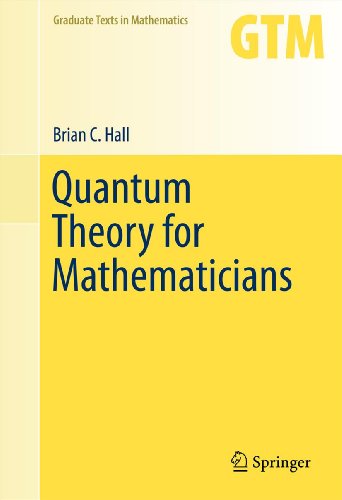
Ebook Info
- Published: 2013
- Number of pages: 570 pages
- Format: PDF
- File Size: 5.28 MB
- Authors: Brian C. Hall
Description
Although ideas from quantum physics play an important role in many parts of modern mathematics, there are few books about quantum mechanics aimed at mathematicians. This book introduces the main ideas of quantum mechanics in language familiar to mathematicians. Readers with little prior exposure to physics will enjoy the book’s conversational tone as they delve into such topics as the Hilbert space approach to quantum theory; the Schrödinger equation in one space dimension; the Spectral Theorem for bounded and unbounded self-adjoint operators; the Stone–von Neumann Theorem; the Wentzel–Kramers–Brillouin approximation; the role of Lie groups and Lie algebras in quantum mechanics; and the path-integral approach to quantum mechanics.The numerous exercises at the end of each chapter make the book suitable for both graduate courses and independent study. Most of the text is accessible to graduate students in mathematics who have had a first course in real analysis, covering the basics of L2 spaces and Hilbert spaces. The final chapters introduce readers who are familiar with the theory of manifolds to more advanced topics, including geometric quantization.
User’s Reviews
Reviews from Amazon users which were colected at the time this book was published on the website:
⭐Brian Hall’s book “Quantum Theory for Mathematicians” is a welcome new resource for mathematicians who are interested in pursuing independent study of non-relativistic quantum mechanics. The primary purpose of the book is clearly identified in the Preface, where the author states that “The twin goals of the book are (1) to explain the physical ideas of quantum mechanics in language mathematicians will be comfortable with, and (2) to develop the necessary mathematical tools to treat those ideas in a rigorous fashion.” There have been other books on quantum theory written primarily for mathematicians (c.f. the books by Faddeev, Hannabuss, Prugovecki, Strocchi, Sudbery, and Takhtajan), but Hall’s book differs from each of these predecessors in important ways. I would like to discuss four aspects of Hall’s book that make it very unique.(1) Hall has written a book that is genuinely accessible to any mathematician or advanced graduate student who has completed the usual graduate coursework in measure theory, real and complex analysis, and functional analysis. One need not be a specialist in functional analysis or have an extensive background in physics in order to profitably study this book. In truth, the presumed physics background is little more than F = ma, although, as is always the case, the more background in physics the reader has, the more connections he will be able to make. To help readers who have no background in classical mechanics, Chapter 2 develops, from scratch, the essential notions of Hamiltonian mechanics that one must carry forward into quantum mechanics. The clarity and economy with which this chapter is written is simply remarkable. To those who have come to believe that they can determine in a few pages whether a book will be useful or not, I would encourage you to read the first few pages of Chapter 2 to make the determination for Hall’s book.(2) Hall’s book is not merely a study of the mathematical structure of quantum mechanics; Hall attempts to convey a fair amount of quantum physics, but he does so while presenting the mathematics with the completeness and rigor that mathematicians demand. A remark from the Preface may resonate with many prospective readers:”Quantum mechanics books in the physics literature are generally not easily understood by most mathematicians…there is a subtle difference in `culture’–differences in terminology and notation–that can make reading the physics literature like reading a foreign language for the mathematician.”Not only does Hall avoid using the ‘cultural differences’ that can make the physics books challenging for the mathematician, but he includes many “Rosetta Stone” passages to help the reader understand those differences (helpful to those who bravely venture out into the physics literature). For example, Section 3.12 contains a helpful discussion of the Dirac bra-ket notation that is so popular in the physics texts (but absent from most mathematics texts), along with an indication of its advantages and pitfalls.(3) Hall has made every reasonable effort to make his book self-contained. In addition to the brilliant introduction to classical mechanics already mentioned, four entire chapters are devoted to the development of spectral theory for bounded and unbounded self-adjoint operators. Chapter 16 provides a succinct overview of Lie groups and Lie algebras just before their first appearance in the study of angular momentum and spin. Nevertheless, readers who are not specialists in functional analysis may occasionally want to consult a text in that subject for purposes of amplification and context. I would suggest that the first volume of Michael Reed and Barry Simon’s four-volume set is an especially good choice, directed as it is toward the study of quantum mechanics. Hall’s earlier (2003) book on Lie theory is an especiallywell-written introduction for those who are completely new to the subject and find his Chapter 16 overview a bit too intense. Finally, it should be noted that the concluding Chapters 21, 22 and 23 in Hall, which discuss geometric quantization, assume a familiarity with the theory of smooth manifolds.(4) Hall’s treatment of the uses of Lie groups and Lie algebras in quantum theory is exceptionally clear and understandable–I would judge it to be one of the strongest aspects of an already outstanding book. This is an area in which physicists and mathematicians truly speak different dialects, and Hall’s presentation will be a revelation to mathematicians who have struggled to understand some of the physics references.Hall’s book presents quantum mechanics at approximately the same level as a graduate physics course. A mathematician who is totally new to the subject may ultimately be led to ask some more basic historical and foundational questions about the early development of the subject. The first five chapters of the undergraduate-level book “Quantum Physics” by Eisberg and Resnick contain a beautiful distillation of the early history of quantum theory along with elegant heuristic arguments that help explain how the mathematical structure of the theory gradually emerged. Advanced books such as Hall’s must, of necessity, take much of this material for granted.The author of this review is a mathematician who has devoted much of his professional life to mathematical physics. It is therefore particularly encouraging to me to finally see a book on quantum theory that fully achieves the goals of presenting the subject undiluted and in a form that will make it accessible to a broad audience of mathematicians. I regret that Hall’s book was not available many years ago when I first began teaching myself quantum theory; it has now become my primary recommendation to my mathematical colleagues who ask for my opinion. Hall’s book should be added to a short, selective list of works that attempt to communicate modern physics to mathematicians without compromising the physical content; I would include in that list: (1) Gerald Folland’s book on quantum field theory, (2) the book by V. I. Arnol’d and, at a more advanced level, (3) the book by Ralph Abraham and Jerrold Marsden on classical mechanics, and (4) Barrett O’Neill’s masterful introduction to semi-Riemannian geometry and general relativity, along with his later work on Kerr black holes.Throughout history, it has proved important to both disciplines to keep the lines of communication open between mathematicians and physicists; this is perhaps more true than ever in this age of hyper-specialization. Hall’s book represents a substantive contribution to the effort.
⭐This is a good overview. However, the mathematical rigor is a little light for a core graduate course. It almost seems the author wants to address too many audiences. If it is for a mathematics audience – the rigor should be more robust.
⭐More physics would be welcome. And less material. Still, it’s quite well written.
⭐Awesome book! Great service!
⭐Another book for your PhD son
⭐This Book is a complete view of Quantum Theory
⭐I should have been reading this book 25 years ago. Though I have a good working knowledge of QM, I always have been wondering where and how advanced math courses on Hilbert spaces fall in place: the stuff of Fredholm and Volterra operators, the spectral theorem, Riesz, Banach spaces. Now math starts to blend in with (physics) methods. This book is strongly recommended to physicists with advanced math knowledge. Its superb!
⭐I am a 60 year old salesman, and a ‘hobby mathematician’.This book gives a really clear understanding, how quantum theory ‘works’.For the most part, the mathematical prerequisites are not that high, a good knowledge of linear algebra seems sufficient.An exception are chapters 21 & 23, where knowledge of differential geometry is needed ( which made them hard for me…).The physicist’s notions are explained, but generally not used – which certainly helps the reader with a more mathematical background.The proofs of the theorems are generally easy to follow, the author mostly avoids sentences like “…..as can be seen readily..”, where it cannot be.Key theorems, like e.g. the Stone – von Neumann Theorem are proved in detail.I found about 35 or so typos, mostly of a harmless nature.I think, this is a excellent book to explain the foundations of quantum theory to an interested person with a good undergratuate grasp of mathematics.
⭐I come from a Mathematical Finance background, and this was just the book I was looking for, having previously struggled through several other “Physics” textbooks. I think some introductory background in functional analysis is useful (Hilbert spaces etc) for chapters 6-10 on Spectral Theory, but overall prerequisites not too heavy. I had no Physics background at all, and had no problems.Chapters 21-23 require differential geometry. I enjoyed these as well, although they did feel slightly more rushed/compacted than the rest of the book.Overall a really excellent book, with lots of useful commentary and careful explanation.
⭐This book really lives up to its claim of bridging the gap between mathematics and physicists. As its title says it is for mathematicians. I don’t think physicists will like it too much. It uses representation theory to make sense of all the mysterious things that physicists do when they “add angular momenta.” There is also a very solid connection made between physics and analysis. I liked it so much that I bought two copies and gave one to my daughter for Christmas.
⭐La reseña va enfocada al servicio y no al contenido del libro. En la publicación, el tiempo de envío decía de 3 a 4 días. Al final tardó casi un mes. El papel usado en la impresión no es de buena calidad.Je veux apprendre la Theorie quantique des champs et je suis mathématicien retraité ; l’ouvrage est bien écrit mais il reste très en deçà de ce qu’on attend comme mathématicien ; d’autres , écrits cependant davantage pour des physiciens sont bien meilleurs ; à commencer par “A tourist Guide for mathematicians” de Folland qui dans son genre est un tour de force ; il est vrai que Folland vise très haut et va rapidement à la Théorie quantique des champs ; le propos ici est beaucoup plus modeste mais Grifiths fait beaucoup mieux à mon goût . Déçu . Toutefois un débutant pourra s’y faire les dents de façon utile .Sometimes it took me hours to understand simple concepts of Quantum Theory when reading physics literature on the matter. Finding this book was amazing, everything is so much easier now.
Keywords
Free Download Quantum Theory for Mathematicians (Graduate Texts in Mathematics Book 267) 2013th Edition in PDF format
Quantum Theory for Mathematicians (Graduate Texts in Mathematics Book 267) 2013th Edition PDF Free Download
Download Quantum Theory for Mathematicians (Graduate Texts in Mathematics Book 267) 2013th Edition 2013 PDF Free
Quantum Theory for Mathematicians (Graduate Texts in Mathematics Book 267) 2013th Edition 2013 PDF Free Download
Download Quantum Theory for Mathematicians (Graduate Texts in Mathematics Book 267) 2013th Edition PDF
Free Download Ebook Quantum Theory for Mathematicians (Graduate Texts in Mathematics Book 267) 2013th Edition