

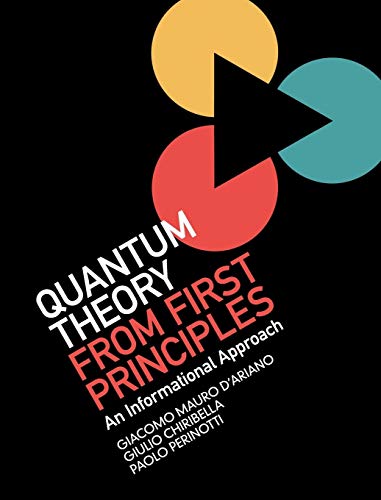
Ebook Info
- Published: 2017
- Number of pages: 356 pages
- Format: PDF
- File Size: 2.08 MB
- Authors: Giacomo Mauro D’Ariano
Description
Quantum theory is the soul of theoretical physics. It is not just a theory of specific physical systems, but rather a new framework with universal applicability. This book shows how we can reconstruct the theory from six information-theoretical principles, by rebuilding the quantum rules from the bottom up. Step by step, the reader will learn how to master the counterintuitive aspects of the quantum world, and how to efficiently reconstruct quantum information protocols from first principles. Using intuitive graphical notation to represent equations, and with shorter and more efficient derivations, the theory can be understood and assimilated with exceptional ease. Offering a radically new perspective on the field, the book contains an efficient course of quantum theory and quantum information for undergraduates. It is aimed at researchers, professionals, and students in physics, computer science and philosophy, as well as the curious outsider seeking a deeper understanding of the theory.
User’s Reviews
Editorial Reviews: Review ‘An extraordinary book on the deep principles behind quantum theory.’ Nicolas Gisin, Université de Genève‘Part quantum mechanics textbook, part original research contribution, this book is a fascinating, audacious effort to ‘rebuild quantum mechanics from the ground up’, presenting it as the logical consequence of simple information-theoretic postulates. Students wishing to learn quantum information should read it and do all the exercises!’ Scott Aaronson, Massachusetts Institute of Technology’From the earliest days of quantum theory to the present, physicists have been pleased with the excellent results it yields but also unsettled (in varying degrees) by the fact that its mathematical forms do not always have clear physical interpretations. Some efforts to resolve this problem in recent decades have focused on replacing mathematical postulates with informational postulates. The authors take this approach here … [intended for] not just physicists but also mathematicians and computer scientists. The first section, about one-third of the book’s length, is flagged by the authors as suitable for an undergraduate course and might well serve so at the highest undergraduate levels … The two remaining sections are aimed at a master’s-level audience; the final section lays out the derivation of quantum theory from six informational principles … A generous number (more than 200) practice exercises are included, with solutions available for selected problems.’ K. D. Fisher, Choice Book Description A new presentation of quantum theory and quantum information based on fundamental principles, for anyone seeking a deeper understanding of the subject. About the Author Giacomo Mauro D’Ariano is a Professor at Università degli Studi di Pavia, Italy, where he teaches quantum mechanics and foundations of quantum theory, and leads the Quantum Information Theory (QUIT) group. He is a Fellow of the American Physical Society and of the Optical Society of America, a member of the Academy Istituto Lombardo of Scienze e Lettere, the Center for Photonic Communication and Computing at Northwestern University, Illinois, and the Foundational Questions Institute (FQXi). Giulio Chiribella is Associate Professor in the Department of Computer Science at The University of Hong Kong. He is a Visiting Fellow of Perimeter Institute for Theoretical Physics, a member of the Standing Committee of the International Colloquia on Group Theoretical Methods in Physics, and a member of the Foundational Questions Institute (FQXi). In 2010, he was awarded the Hermann Weyl Prize for applications of group theory in quantum information.Paolo Perinotti is Assistant Professor at Università degli Studi di Pavia, Italy, where he teaches quantum information theory. His research activity is focused on foundations of quantum information, quantum mechanics and quantum field theory. He is a member of the Foundational Questions Institute (FQXi) and the International Quantum Structures Association. In 2016 he was awarded the Birkhoff-von Neumann Prize for research in quantum foundations. Read more
Reviews from Amazon users which were colected at the time this book was published on the website:
⭐Quantum mechanics is notoriously hard to understand. The math behind it is well understood, but there are still fierce debates on what conceptually quantum theory really means. Since its inception, physicists have tried to interpret quantum mechanics in different ways. But it isn’t until recently that researchers were able to reconstruct quantum mechanics from mathematical, physical and operational principles. The principles are often hard to relate to. Nonetheless, because they are rigorous and do not have quantum mechanics as a starting point, they are a step up from interpretations of quantum mechanics.This book reconstructs quantum mechanics from 6 clear operational principles, with only 1 principle setting quantum mechanics apart from classical theory.I thoroughly enjoyed this book. Most books on quantum mechanics give you a better understanding of its formalism, but not of what quantum theory really means. This is the first book I’ve read that has genuinely improved my understanding of quantum theory (even if I am still not completely at ease with quantum mechanics).I highly recommend this book!
⭐Let me first define this book. This is a book on the structure of quantum theory, not on quantum phenomena: you won’t learn about the behaviour of particles, the structure of the atoms, energy levels, and the like. It is also not written as your first book on quantum theory: kets, operators, Born’s rule should be familiar notions. So, there you are: you have learned that the description of quantum phenomena uses a rather not intuitive level of maths, and you think “Ma chi gliel’ha fatto fare?” — loosely speaking, “Why is it so?” Granted, classical physics must be replaced; but why does the replacement look as it does?Historically, it simply happened: what Schroedinger and Heisenberg did in 1926 has been successful ever after in describing and predicting phenomena, with extensions in scope but no changes in the foundations. But we feel that there must be a more compelling reason than a mere “it works”. We are also rarely comfortable with being told “that’s all there is”: we want to ask “could it have been different?”, and for this, we need to make a bit of space, to embed what we have in a larger class.The current book brings you on such a journey. It starts by rewriting the quantum theory you are familiar with in a more formal way (Part I). Many of the notions introduced here in a rigorous way are central to quantum information theory, so this chapter can also be used as a serious introduction to the mathematics of that field. Then the scenery is enlarged: Part II introduces the class of theories, of which quantum is going to be a single example. They are called “operation (or generalised) probabilistic theories” (O/GPTs). Their definition is inspired the notion of tomography: once you know the dimension of the Hilbert space, a state (or a channel, for that matters) is uniquely characterised by a list of probabilities. The idea of OPTs is to work only with such list of probabilities, suitably adapting the description of transformations and measurements. In Part III you discover that several “typically quantum” features (the no-cloning theorem, the existence of states that one would call entangled, and many others) are in fact shared by the whole OPT class. At this point, you would like to come home and you are wondering what identifies quantum theory (which, let’s not forget it, as of today is the most accurate description of the physical universe we live in): the reconstruction axioms are provided in Part IV. The content of this chapter is less than 10 years old: it brings to completion the program that was started by the “quantum logic” approach, but that could not be concluded satisfactorily because one or two of the axioms still retained a purely mathematical form. The breakthrough came when people started using axioms about composite systems, inspired by the understanding of the central role of entanglement. The current authors were among the protagonists of this achievement, alongside with others to whom credit is duly given in the introductory part of the book.I can hardly think of a more consciously, carefully crafted itinerary into these matters. After all, there are only a handful of trusted guides along these paths, and here you are in very safe hands. I can only regret that, at the very start, they did not indicate the existence of another path: that of device-independent principles for quantum physics, initiated by Popescu and Rohrlich, and that has led to the formulation of principles like information causality and macroscopic locality. Maybe a footnote in the next edition?(I received a complimentary copy from the publisher with the request for an unbiased review)
⭐To be clear, this is a book about the foundations of quantum mechanics (QM), intended for an audience that is already somewhat familiar with the subject. Its aim is to recover, or reconstruct, the mathematical apparatus of finite-dimensional QM from principles that can be stated in probabilistic or operational terms. This project has a long history. The book’s forerunners include the classic monographs by von Neumann (1927) and Mackey (1963), along with the books of Varadarajan (1968), Piron (1976), and Ludwig (1985). As these publication dates suggest, this line of research had more or less stalled by the mid 1980s. What revived it, in the early 2000s, was the development of quantum information theory (QIT). Besides making it respectable to concentrate on finite-dimensional systems, QIT makes essential use of properties of composite systems and entangled states, making it seem reasonable to treat certain properties of such states as postulates. Taking this general approach, a spate of papers by various authors, including those of the present book, deduced finite-dimensional quantum mechanics from various (but similar) packages of (more or less) operational assumptions.A key idea exploited in all of these papers is that systems having a common “information content” should be physically isomorphic. Here information content refers to the maximum number of states that can be sharply distinguished by a single-shot measurement. Another is a “locality” condition, requiring that the state of a composite system should depend only on the joint probabilities it assigns to the results of measurements on the two subsystems. Most of the these papers also rely on a symmetry assumption, requiring that any two pure states should be related by a reversible physical transformation. The authors replace this with a stronger “purification principle”, requiring that any state of any system A should be representable as the marginal, or reduced, state of a pure bipartite state on a compound system AB consisting of the given system together with an ancillary system, B, and that this should be unique up to a reversible transformation on B. A rather amazing amount of structure flows from this one assumption.This is first book-length treatment of these ideas. In that sense, it is a research monograph. However, it is presented as a textbook: explanations and examples are developed in detail, and in an attractive and easy-going style, and there are even exercises! This is a very good thing, and should be more widely imitated. In particular, this manner of presentation makes the book accessible to graduate students, or even well-prepared undergraduates, while also making it comparatively easy reading for the physicist of mathematician interested in an introduction to this area, and even for the expert who wants to understand the details of the authors’ particular approach.A striking feature of the book, apparent on nearly every page, is the use of a notation that replaces equations involving tensor products with diagrams. These take up space, and may be a bit off-putting at first for those not familiar with them, but it well repays the small effort needed to master this formalism: once one has learned to trust it (say, by translating a few examples back into equational language), many proofs become so natural as to be almost automatic. The book is well-produced, with an attractive layout and, in view of the complexity of the diagrammatic typesetting remarkably few typos. All in all, the authors are to be congratulated on producing a delightful, inspiring, and persuasive introduction to their way of looking at finite-dimensional quantum theory.
⭐Muy sorprendente hasta para un físico.El nivel es muy alto. Lejos del alcance de casi todos nosotros. Tardaré una reencarnación completa en leerlo pero valdrá la pena.
⭐
Keywords
Free Download Quantum Theory from First Principles: An Informational Approach 1st Edition in PDF format
Quantum Theory from First Principles: An Informational Approach 1st Edition PDF Free Download
Download Quantum Theory from First Principles: An Informational Approach 1st Edition 2017 PDF Free
Quantum Theory from First Principles: An Informational Approach 1st Edition 2017 PDF Free Download
Download Quantum Theory from First Principles: An Informational Approach 1st Edition PDF
Free Download Ebook Quantum Theory from First Principles: An Informational Approach 1st Edition