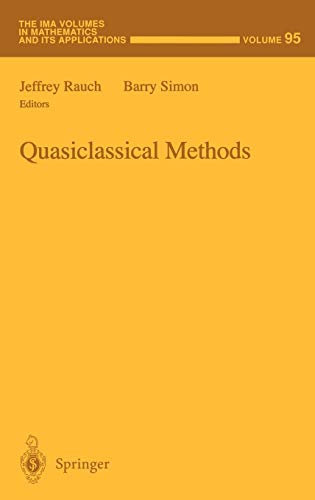
Ebook Info
- Published: 1997
- Number of pages: 239 pages
- Format: PDF
- File Size: 9.58 MB
- Authors: Jeffrey Rauch
Description
This IMA Volume in Mathematics and its Applications QUASICLASSICAL METHODS is based on the proceedings of a very successful one-week workshop with the same title, which was an integral part of the 1994-1995 IMA program on “Waves and Scattering.” We would like to thank Jeffrey Rauch and Barry Simon for their excellent work as organizers of the meeting. We also take this opportunity to thank the National Science Foun dation (NSF), the Army Research Office (ARO) and the Office of Naval Research (ONR), whose financial support made the workshop possible. A vner Friedman Robert Gulliver v PREFACE There are a large number of problems where qualitative features of a partial differential equation in an appropriate regime are determined by the behavior of an associated ordinary differential equation. The example which gives the area its name is the limit of quantum mechanical Hamil tonians (Schrodinger operators) as Planck’s constant h goes to zero, which is determined by the corresponding classical mechanical system. A sec ond example is linear wave equations with highly oscillatory initial data. The solutions are described by geometric optics whose centerpiece are rays which are solutions of ordinary differential equations analogous to the clas sical mechanics equations in the example above. Much recent work has concerned with understanding terms beyond the leading term determined by the quasi classical limit. Two examples of this involve Weyl asymptotics and the large-Z limit of atomic Hamiltonians, both areas of current research.
User’s Reviews
Editorial Reviews: From the Back Cover The chapters in this volume explore the various aspects of quasiclassical methods such as approximate theories for large Coulomb systems, Schroedinger operator with magnetic wells, ground state energy of heavy molecules in strong magnetic field, and methods with emphasis on coherent states. Included are also mathematical theories dealing with h-pseudodifferential operators, asymptotic distribution of eigenvalues in gaps, a proof of the strong Scott conjecture, Lieb- Thirring inequalities for the Pauli operator, and local trace formulae.
Reviews from Amazon users which were colected at the time this book was published on the website:
⭐Rauch of U. Michigan and Simon of Caltech edit this volume for the IMA (Institute for Mathematics and its Applications, University of Minnesota). It deserves 5 stars for the depth and complexity and importance for physics applications, but not for simplicity or even ability to communicate with the public. For the latter two things, the reader should hire a reputable consultant or tutor to translate. IMA is published by Springer, which is usually noted for its clarity, simplicity, and ability to translate for non-specialists. However, IMA and a few other institutes and even publishing companies direct themselves solely to specialists and to industrial applications and to very recent results that have not yet been translated even for most other theoreticians. It will be necessary to split this book review into several parts (hopefully) in order to give some flavor of the book. Here a few definitions and directions will be indicated. We are talking quantum mechanics for very small Planck’s constant, h, in which case classical physics plays a key role. When h is very small, quantum mechanical objects become unusually big, which is another way of looking at this book. The large Z limit of atomic Hamiltonians (think of the Hamiltonian as an energy operator) is the area of current research, together with Weyl asymptotics. The latter refers to the classical results of Weyl, one of the greatest algebraic theorists of all time, that some very important things become determined by volumes in this region (technically, eigenvalue distributions of elliptic operators on compact manifolds become more and more determined by volume, which will hopefully be clarified later). In this “twilight zone” region, we are dealing with heavy molecules in strong magnetic fields, gaps in the (essential) spectrum where semiconductors and insulators have impurities that create new energy levels and thus affect conduction, color, and so on. The results are also applicable to linear wave equations whose initial data are very oscillatory and whose solutions involve geometric optics rays which are solutions of ordinary differential equations (rate/speed/acceleration type equations ) even though the original problem involves partial differential equations (rate equations with multiple variables all of which except one are held fixed or constant).
Keywords
Free Download Quasiclassical Methods (The IMA Volumes in Mathematics and its Applications, 95) 1997th Edition in PDF format
Quasiclassical Methods (The IMA Volumes in Mathematics and its Applications, 95) 1997th Edition PDF Free Download
Download Quasiclassical Methods (The IMA Volumes in Mathematics and its Applications, 95) 1997th Edition 1997 PDF Free
Quasiclassical Methods (The IMA Volumes in Mathematics and its Applications, 95) 1997th Edition 1997 PDF Free Download
Download Quasiclassical Methods (The IMA Volumes in Mathematics and its Applications, 95) 1997th Edition PDF
Free Download Ebook Quasiclassical Methods (The IMA Volumes in Mathematics and its Applications, 95) 1997th Edition