

Ebook Info
- Published: 2002
- Number of pages: 400 pages
- Format: PDF
- File Size: 11.23 MB
- Authors: J. B. Kuipers
Description
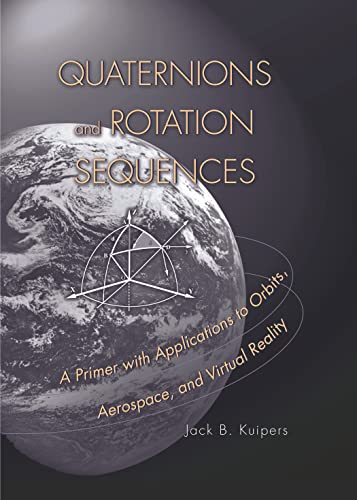
Ever since the Irish mathematician William Rowan Hamilton introduced quaternions in the nineteenth century–a feat he celebrated by carving the founding equations into a stone bridge–mathematicians and engineers have been fascinated by these mathematical objects. Today, they are used in applications as various as describing the geometry of spacetime, guiding the Space Shuttle, and developing computer applications in virtual reality. In this book, J. B. Kuipers introduces quaternions for scientists and engineers who have not encountered them before and shows how they can be used in a variety of practical situations. The book is primarily an exposition of the quaternion, a 4-tuple, and its primary application in a rotation operator. But Kuipers also presents the more conventional and familiar 3 x 3 (9-element) matrix rotation operator. These parallel presentations allow the reader to judge which approaches are preferable for specific applications. The volume is divided into three main parts. The opening chapters present introductory material and establish the book’s terminology and notation. The next part presents the mathematical properties of quaternions, including quaternion algebra and geometry. It includes more advanced special topics in spherical trigonometry, along with an introduction to quaternion calculus and perturbation theory, required in many situations involving dynamics and kinematics. In the final section, Kuipers discusses state-of-the-art applications. He presents a six degree-of-freedom electromagnetic position and orientation transducer and concludes by discussing the computer graphics necessary for the development of applications in virtual reality.
User’s Reviews
Editorial Reviews: Review “This book will appeal to anyone with an interest in three-dimensional geometry. It is a competent and comprehensive survey. . . . This book is unique in that it is probably the only modern book to treat quaternions seriously. . . . A valuable asset.” ― Aeronautical Journal”[A] splendid book . . . everything one could wish for in a primer. It is also beautifully set out with an attractive layout, clear diagrams, and wide margins with explanatory notes where appropriate. It must be strongly recommended to all students of physics, engineering or computer science.”—Peter Rowlands, Contemporary Physics Review “The text is written in a clear and readable style well suited for students wishing to master fundamental quaternion concepts.”―Mark C. Allman, Senior Engineer, The Boeing Company”This is the most complete discussion of quaternions and their applications that I have seen.”―Alan C. Tribble, author of A Tribble’s Guide to Space From the Back Cover “The text is written in a clear and readable style well suited for students wishing to master fundamental quaternion concepts.”–Mark C. Allman, Senior Engineer, The Boeing Company”This is the most complete discussion of quaternions and their applications that I have seen.”–Alan C. Tribble, author of A Tribble’s Guide to Space About the Author J. B. Kuipers is Professor Emeritus of Mathematics at Calvin College. In addition to publishing papers and research notes on quaternions, he spent seventeen years in the aerospace industry where his work included developing applications of quaternion theory for aerospace systems. He also developed a six-dimensional graphics system and, as a consequence, is regarded by some as the founder of virtual reality. Read more
Reviews from Amazon users which were colected at the time this book was published on the website:
⭐Latitude and longitude look simple enough, at first – just put your finger in the globe, and see which horizontal line crosses which vertical. When you start doing arithmetic, though, things get weird. Measuring longitude in degrees, 179+2=-179. In degrees latitude, 89+2=89, but the longitude changes! And, when you try to figure longitude precisely at the north pole, you run into a singularity. Believe me, you don’t want to be in a plane when its navigation programs run into singularities.Those bits of strangeness all vanish when quaternions represent angles. Quaternions are a bit like complex numbers, but with three different complex parts instead of one. They have very nice mathematical properties, even better than rotation matrices, and a compact form.Kuipers gives a clear, thorough introduction to quaternions and their uses in geometric computations. Everything is explained one step at a time, giving the reader plenty of chance to back off and try again when the discussion gets thick. The buildup is very methodical, just about every derivation is carried out in steps that are easy to follow, using legible, standard notation. Kuipers uses side bars to remind the reader about the basics under more complex discussions, keeping an awareness of where a beginner might go off the rails. Since this discusses geometric computations, illustrations are profuse.The book is not for the reader in a hurry. There are lots of gems here, but you really do have to dig through a lot to find them. The illustrations contain all needed information, but it may take some effort to pick them apart. And, like any technical book, this assumes a reader with a certain background. In this case, intuition about 3D objects, trig, and linear algebra are compulsory, but I guess a sufficiently dedicated reader could substitute blind obedience to formulas for linear algebra. Ch.11-13 assumes calculus through partial differentials and ODEs, but many readers can skip these chapters without loss.This is all the how and why of quaterion representations of 3D rotations. It’s gently paced, and makes only moderate assumptions about the reader’s background. I’ve never seen this material presently so clearly, from so many angles, anywhere else. Highly recommended.//wiredweird
⭐This is a great book that describes all representations of rotation sequences including quaternions. Unlike a lot of references, it lays out the derivation of each without skipping steps, making it very easy to follow and understand even for someone with no previous experience. It’s also my go-to reference for algorithms to convert between the various rotation representations.
⭐Quick delivery, great deL, happy with this item
⭐As the title states, it is a “Primer with applications to Orbits.” It covers all the topics with enough detail to understand them without going into needless proofs. All of these required proofs are easily accessible on the internet, so it is good not wasting space in the book with them.Has some interesting analysis of eigenvectors and their use in quaternions.Good use of “Tufte” format — that it, it presents parenthetical information in the margins in a useful and non-distracting manner. The author put a lot of thought into this book and it pays off.
⭐My graduate school work was in theoretical quantum mechanics, and was especially concentrated in the group properties of rotations. I can honestly say that I would have been twice as effective if I had this reference available then.Kuiper does an outstanding job of pulling together the traditional matrix-based approach to describing rotations with the less-frequently encountered quaternion approach. In doing so, he clearly shows the benefits of the quaternion algebra, especially for computer systems modeling rigid body rotations and virtual worlds. The exposition is clear, concise, and aimed at the practitioner rather than the theoretician. The examples are taken from classical engineering problems — a refreshing change from the quantum-mechanical problems I was used to from previous works on the subject.Despite the practical foocus, though, there is plenty of material here for those more interested in understanding the minutia of the SO(3) symmetry group. And unlike most work in this field, he doesn’t stop with algebra, but includes the calculus of rotation matrices and quaternions using material on kinematics and dynamics of rigid bodies, celestial mechanics, and rotating reference frames.I give the book my highest recommendation. It should be considered an essential reference work for anyone who encounters rotational problems with any frequency.–Tony Valle
⭐The great thing about this book is the author goes through detailed expositions of every topic. So if you “get it” the first time, you can skim ahead to the next topic; if not, you can work through the proofs, step-by-step, to make sure you understand it. There’s no “the proof is left as an exercise for the interested reader.”Another thing I really like about this book is that you don’t need to be a mathematician to understand it (i.e. it’s perfect for engineers). If there is reference to a mathematical topic, the author defines the terminology and gives you a concise explanation. He will give you enough to make it relevant to the current subject.For example, you don’t need to have a grad-school course in groups and fields to be able to understand how they relate to the specific applications of quaternions covered in the book. That cannot be said about some other books on quaternions I have been reading. About all you need here is some knowledge of vectors, matrices and complex numbers.This book is not only tractable but downright accessible. And it is so well organized that, after reading the first few chapters, you may find the specific application of interest to you and jump straight to it.
⭐I wanted a good book on this subject.I consider this purchase delivers this.Pleased with purchase – value for money.
⭐An excellent book, where complex math is explained and illustrated in a way that makes it easier to understand.
⭐This book is simply EXCELLENT.Its goal, namely, to convey quaternion algebra to people not necessarily mathematicians, is really fulfilled.A variety of readers should benefit from this work.And, hopefully, quaternions will soon become part of conventional mathematics education,as well as part of every branch of Science – including, for instance, biology and medicine.Dr. Kuipers’ “Quaternions and Rotation Sequences” is a fundamental step in this direction.It presents, elegantly and authoritatively, this unequaled, powerful algebraic system, initially proposed by Sir William R. Hamilton in 1843.It is surprising just how long Hamilton’s Quaternions have been forgotten…This book is hence a BREAKTHROUGH, not only in mathematics, but in all Science.If you’ve never heard about “quaternions” before, yet science and its achievements are of interest to you,don’t hesitate to dig more on this topic, and this book is sure one of the first steps!And if you did hear about quaternions, maybe you have heard that vectorial algebra was equivalent and more tractable…That’s NOT TRUE. Quaternions are far more superior than vector algebra, and this book shows us why.I first heard about quaternions just a couple of years ago, through Wikipedia, by accident, while searching “gyroscopes”…It struck me a lot to read that there are numbers with 4 dimensions; with 4 inherent dimensions!!!Immediately, I knew this had to be an UTTERLY IMPORTANT scientific field.Yet, what surprised me most was that I had never heard about it, ever. How could this be?Not any of my math teachers,neither any of the mathematics nor philosophy of science books that I’ve read, or that I happened to look a while,none have never even mentioned its existence!!!That puzzled me for a while, and I thought that maybe quaternion algebra might be extremely difficult for mathematicians and non-mathematicians alike.Fortunately, Dr. Kuipers’ book proved me I was wrong: Quaternions are just as accessible as any other conventional mathematics.Eventually, it is even easier, were it presented to us early, as part as our ordinary mathematical education in schools.So, now, this is one of MY MOST CHERISHED BOOKS, and it figures as one of those few turning-point books that I have read,delimitating a “before-and-after” in my personal history.(By the way, my other turning-point book,s are:”À la Recherche du Temps Perdu [In Search of Lost Time]”, by Proust,”The Structure of Scientific Revolutions”, by Thomas Khun;”
⭐Darwinism Evolving: Systems Dynamics and the Genealogy of Natural Selection
⭐”, by David Depew and Bruce Weber;”L’Évolution Créatrice” (
⭐Creative Evolution
⭐), by Henry Bergson;”Critique of Pure Reason”, by Kant; and”
⭐Mind in Life: Biology, Phenomenology, and the Sciences of Mind
⭐” by Evan Thompson).Unquestionably, it is scientific masterpiece.alo_world
⭐Acquistato durante l’estate è un libro adatto per l’introduzione all’argomento. Richieste conoscenze di base di geometria ed algebra e di calcolo matriciale.I like this book for various reasons. In my view you will not be disappointed even if you buy it just for a read.
Keywords
Free Download Quaternions and Rotation Sequences: A Primer with Applications to Orbits, Aerospace and Virtual Reality in PDF format
Quaternions and Rotation Sequences: A Primer with Applications to Orbits, Aerospace and Virtual Reality PDF Free Download
Download Quaternions and Rotation Sequences: A Primer with Applications to Orbits, Aerospace and Virtual Reality 2002 PDF Free
Quaternions and Rotation Sequences: A Primer with Applications to Orbits, Aerospace and Virtual Reality 2002 PDF Free Download
Download Quaternions and Rotation Sequences: A Primer with Applications to Orbits, Aerospace and Virtual Reality PDF
Free Download Ebook Quaternions and Rotation Sequences: A Primer with Applications to Orbits, Aerospace and Virtual Reality