

Ebook Info
- Published:
- Number of pages: 186 pages
- Format: PDF
- File Size: 1.70 MB
- Authors: D M Potts
Description
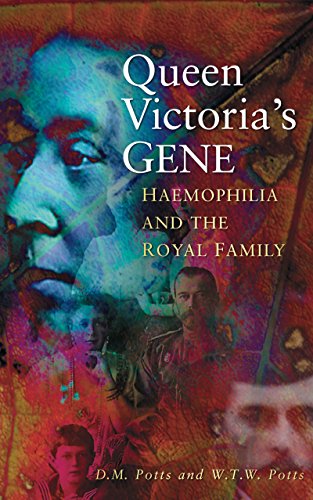
Queen Victoria’s son, Prince Leopold, died from haemophilia, but no member of the royal family before his generation had suffered from the condition. Medically, there are only two possibilities: either one of Victoria’s parents had a 1 in 50,000 random mutation, or Victoria was the illegitimate child of a haemophiliac man. However the haemophilia gene arose, it had a profound effect on history. Two of Victoria’s daughters were silent carriers who passed the disease to the Spanish and Russian royal families. The disease played a role in the origin of the Spanish Civil War; and the tsarina’s concern over her only son’s haemophilia led to the entry of Rasputin into the royal household, contributing directly to the Russian revolution.
User’s Reviews
Reviews from Amazon users which were colected at the time this book was published on the website:
⭐I am on page 92 now but already found several mistakes, e.g. Frederic ( Friedrich ) the great’s father was NOT Friedrich I That was the grandfather. His Father was Friedrich Wilhelm I.Princess/Queen Charlotte ( wife of the Prince Regent ) was NOT a descendent of Frederic the great. He had no children, neither legitimate nor illigimate.Where is proof the Frederic the great had porphyria? Just because he was constipated?? That is easily explained by his diet. I have NEVER. heard of that kind of disease in connection with Frederic.Lastly, this book is full of assumptions about who slept with whom. Just to attract more readers, I guess. I’m not a prude, but some assumptions are borderline to slander
⭐A couple of weeks ago, I read and reviewed a new book by British author Deborah Cadbury, “Queen Victoria’s Matchmaking: The Royal Marriages that Shaped Europe”. The book was excellent and while Cadbury didn’t write much about the hemophilia gene, I became curious about it. Looking through Amazon, I found this book, “Queen Victoria’s Gene: Hemophilia and The Royal Family”., by DM Potts. Published in the 1990’s, the book is well-written in a sort of wandering way through Victoria’s life and those of her children and grandchildren.The gene for hemophilia was either passed down to Victoria by her father or it spontaneously appeared in her gene pool. Potts does look at Victoria’s parents. The gene was passed along to three of her children; one son suffered from the disease and two daughters were carriers. The two daughters carried the gene by marriage into the Russian and Spanish royal houses. Potts does a good job in showing how the hemophilia of the tsarvich Alexei basically destroyed the last Romanov tsar and his family. Potts writes more about the Russian revolution and the fate of Nicholas, Alexandra, and their four kids. I mentioned the publication date above because information about the murders and the dispersal of the bodies was not well-known til after this book was published. That’s a problem with reading a book that is almost 20 years old and is certainly not the fault of the author. DM Potts wrote what was known at the time.DM Potts book is shortish and was a good read after Cadbury’s longer book. I’d advise both books to the Victoria-fanatic!
⭐This book was very interesting. It is a story of Genes. It tells the story about Queen Victoria and her family. Two of her daughters, Alice (As well as two daughters and a son), and Beatrice (as well as two sons and a daughter) were carriers of a disease called hemophilia and her son Leopold (As well as a daughter) had the disorder. One might wonder what the mystery is about it. Well it is this, where did the three children get the disorder? Because the daughters were carriers of it they could not have gotten it from there father Albert, so it must have been Victoria. One problem is that supposedly comes from one the most well documented families off all time (The family can trace there lineage to Adam and Eve) that leaves three posiblities-1. That she is not the Granddaughter of King George III 2. Her mother (Victoria of Sax-Coburg) was a carrier-which turned out to be false or 3. There was a spontaneous combustion of the egg or sperm that made Victoria. The authors get into all three of these hypotheses in order to try to understand just how Victoria got the gene for hemophilia. The authors also delve into the lives of the people who had hemophilia and tells about some of the pretenders to the thrones descendent from Queen Victoria and how with the knowledge of the gene people have figured out they are fakes.
⭐From the opening, I found this book to be uninteresting. Two chapters about royal marriages 100 years priorto Queen Victoria’s birth. I did not recognize the names, nor did I have interest in reading about them. Book is not about Hemophilia itself and the line of Queen Victoria. Not straight forward information. History of Europe, a chapter on the Nicholas and Alexandra from Russia, Rasputin. Not smooth, interesting or truly to the point ofHemophilia genetics carrying on through the lines of monarchy.
⭐a quick read, and entertaining but doesn’t really follow through on its title. very little of the book is actually about the appearance of hemophilia in victoria’s line; some of it is an abbreviated story of her family, some of it is a primer on genetics, some of it is a description of family members who inherited it. but the “hook” that induced me to buy this book was the connection between victoria and hemophilia, and about this the book has only mild speculation. where did she get the gene? the author suggests maybe from an unknown “real” father; but surely such speculation is irresponsible without some evidence? of which there is none.
⭐Book was awful. Hard to follow they try to be cool and switch up the different names they call a character. Do not read.
⭐I wanted to learn more about hemophilia and the royal family bloodline as to how it was passed down to her children and grandchildren. This book elucidated this information. I found it enlightening. Thank you.
⭐good reading –
⭐Tells you nothing you didn’t know, silly suppositions in light of modern medicine and full of no real evidence and “What if’s”.
⭐The explanation of Haemophilia contains enough significant material without being too scientific, and useful to read about the effects on the major European dynasties in the 19th/20th Century. A comfortable read with lots of contextual background – I very much enjoyed this book.
⭐Great book,!very interesting, very intenseas I suffer from haemophilia I wanted to know where it started
⭐Actually, I like it a lot. Amazon can put ****1/2. This book is a credible account of the facts concerning the European royal haemophiliacs and of the appearance and disappearance of the gene in one family. Just what I wanted. The author’s skills are, true enough, more medical and forensic than historical, thence the missing 1/2 star. But the balance is predominantly positive.I wish D.M. Potts would tackle the gene of the madness of George III!
⭐This is an excellent book on the problems of the blood clotting. This is a nasty thing to have and poor old Leopold had a miserable life.
Keywords
Free Download Queen Victoria’s Gene: Haemophilia and the Royal Family in PDF format
Queen Victoria’s Gene: Haemophilia and the Royal Family PDF Free Download
Download Queen Victoria’s Gene: Haemophilia and the Royal Family PDF Free
Queen Victoria’s Gene: Haemophilia and the Royal Family PDF Free Download
Download Queen Victoria’s Gene: Haemophilia and the Royal Family PDF
Free Download Ebook Queen Victoria’s Gene: Haemophilia and the Royal Family